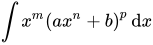
Ein binomisches Integral ist ein Integral der Form:
∫ x m ( a x n + b ) p d x {\displaystyle \int x^{m}\left(ax^{n}+b\right)^{p}\,\mathrm {d} x} , wobei m , n , p {\displaystyle m,\ n,\ p} rationale Zahlen sind und a ≠ 0 , n ≠ 0 {\displaystyle a\neq 0,n\neq 0} .
Der Satz von Tschebyschow macht nun eine Aussage, wann ein binomisches Integral elementar integrierbar ist. Elementar integrierbar bedeutet, dass das Integral mit Hilfe einer Stammfunktion bestimmt werden kann.
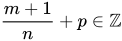
Ein binomisches Integral ist elementar integrierbar genau dann, wenn mindestens eine der Zahlen p , m + 1 n {\displaystyle \textstyle p,\ {\frac {m+1}{n}}} bzw. m + 1 n + p {\displaystyle \textstyle {\frac {m+1}{n}}+p} ganz ist.
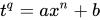
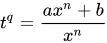
Ist die Funktion elementar integrierbar, so lässt sich in folgenden drei Fällen die Stammfunktion bestimmen:
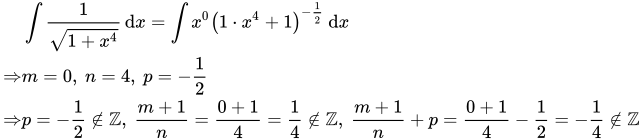
1. Beispiel
∫ 1 1 + x 4 d x = ∫ x 0 ( 1 ⋅ x 4 + 1 ) − 1 2 d x ⇒ m = 0 , n = 4 , p = − 1 2 ⇒ p = − 1 2 ∉ Z , m + 1 n = 0 + 1 4 = 1 4 ∉ Z , m + 1 n + p = 0 + 1 4 − 1 2 = − 1 4 ∉ Z {\displaystyle {\begin{aligned}&\int {\frac {1}{\sqrt {1+x^{4}}}}\,\mathrm {d} x=\int x^{0}\left(1\cdot x^{4}+1\right)^{-{\frac {1}{2}}}\,\mathrm {d} x\\\Rightarrow &m=0,\ n=4,\ p=-{\frac {1}{2}}\\\Rightarrow &p=-{\frac {1}{2}}\notin \mathbb {Z} ,\ {\frac {m+1}{n}}={\frac {0+1}{4}}={\frac {1}{4}}\notin \mathbb {Z} ,\ {\frac {m+1}{n}}+p={\frac {0+1}{4}}-{\frac {1}{2}}=-{\frac {1}{4}}\notin \mathbb {Z} \end{aligned}}}
Somit ist 1 1 + x 4 {\displaystyle \textstyle {\frac {1}{\sqrt {1+x^{4}}}}} nicht elementar integrierbar.
2. Beispiel
∫ x 3 ( x + 1 ) 2 3 d x = ∫ x 1 3 ( 1 ⋅ x 1 + 1 ) 2 3 d x ⇒ m = 1 3 , n = 1 , p = 2 3 ⇒ p = 2 3 ∉ Z , m + 1 n = 1 3 + 1 1 = 4 3 ∉ Z , m + 1 n + p = 1 3 + 1 1 + 2 3 = 2 ∈ Z {\displaystyle {\begin{aligned}&\int {\sqrt[{3}]{x}}{\sqrt[{3}]{\left(x+1\right)^{2}}}\,\mathrm {d} x=\int x^{\frac {1}{3}}\left(1\cdot x^{1}+1\right)^{\frac {2}{3}}\,\mathrm {d} x\\\Rightarrow &m={\frac {1}{3}},\ n=1,\ p={\frac {2}{3}}\\\Rightarrow &p={\frac {2}{3}}\notin \mathbb {Z} ,\ {\frac {m+1}{n}}={\frac {{\frac {1}{3}}+1}{1}}={\frac {4}{3}}\notin \mathbb {Z} ,\ {\frac {m+1}{n}}+p={\frac {{\frac {1}{3}}+1}{1}}+{\frac {2}{3}}=2\in \mathbb {Z} \end{aligned}}}
Also ist x 3 ( x + 1 ) 2 3 {\displaystyle \textstyle {\sqrt[{3}]{x}}{\sqrt[{3}]{\left(x+1\right)^{2}}}} elementar integrierbar.
 nicht elementar integrierbar.
![{\displaystyle {\begin{aligned}&\int {\sqrt[{3}]{x}}{\sqrt[{3}]{\left(x+1\right)^{2}}}\,\mathrm {d} x=\int x^{\frac {1}{3}}\left(1\cdot x^{1}+1\right)^{\frac {2}{3}}\,\mathrm {d} x\\\Rightarrow &m={\frac {1}{3}},\ n=1,\ p={\frac {2}{3}}\\\Rightarrow &p={\frac {2}{3}}\notin \mathbb {Z} ,\ {\frac {m+1}{n}}={\frac {{\frac {1}{3}}+1}{1}}={\frac {4}{3}}\notin \mathbb {Z} ,\ {\frac {m+1}{n}}+p={\frac {{\frac {1}{3}}+1}{1}}+{\frac {2}{3}}=2\in \mathbb {Z} \end{aligned}}}](https://wikimedia.org/api/rest_v1/media/math/render/svg/089439c6bac25c5d36d14e2eb1a389b9265ae5cb)
![{\displaystyle \textstyle {\sqrt[{3}]{x}}{\sqrt[{3}]{\left(x+1\right)^{2}}}}](https://wikimedia.org/api/rest_v1/media/math/render/svg/0da8d156f59431c1fe7fbc0b0e2983ab572a03de) elementar integrierbar.
elementar integrierbar.