Eurovision Song Contest 1980

Eurovision Song Contest 1980
Date and venue
Final
  • 19 April 1980
VenueNederlands Congresgebouw
The Hague, Netherlands
Organisation
OrganiserEuropean Broadcasting Union (EBU)
ScrutineerFrank Naef
Production
Host broadcasterNederlandse Omroep Stichting (NOS)
DirectorTheo Ordeman
Executive producerFred Oster
Musical directorRogier van Otterloo
PresenterMarlous Fluitsma
Participants
Number of entries19
Debuting countries Morocco
Returning countries Turkey
Non-returning countries
  • A coloured map of the countries of EuropeBelgium in the Eurovision Song Contest 1980Italy in the Eurovision Song Contest 1980Netherlands in the Eurovision Song Contest 1980Switzerland in the Eurovision Song Contest 1980Germany in the Eurovision Song Contest 1980United Kingdom in the Eurovision Song Contest 1980Monaco in the Eurovision Song ContestLuxembourg in the Eurovision Song Contest 1980Spain in the Eurovision Song Contest 1980Ireland in the Eurovision Song Contest 1980Denmark in the Eurovision Song Contest 1980Finland in the Eurovision Song Contest 1980Norway in the Eurovision Song Contest 1980Portugal in the Eurovision Song Contest 1980Sweden in the Eurovision Song Contest 1980Israel in the Eurovision Song ContestGreece in the Eurovision Song Contest 1980Malta in the Eurovision Song ContestAustria in the Eurovision Song Contest 1980France in the Eurovision Song Contest 1980Turkey in the Eurovision Song Contest 1980Yugoslavia in the Eurovision Song ContestMorocco in the Eurovision Song Contest 1980
         Competing countries     Countries that participated in the past but not in 1980
Vote
Voting systemEach country awarded 12, 10, 8–1 point(s) to their 10 favourite songs
Winning song Ireland
"What's Another Year"
1979 ← Eurovision Song Contest → 1981
Event page at eurovision.com Edit this at Wikidata

The Eurovision Song Contest 1980 was the 25th edition of the Eurovision Song Contest, held on 19 April 1980 at the Nederlands Congresgebouw in The Hague, Netherlands, and presented by Marlous Fluitsma. It was organised by the European Broadcasting Union (EBU) and host broadcaster Nederlandse Omroep Stichting (NOS), who staged the event after the Israel Broadcasting Authority (IBA), which had won the 1979 contest for Israel, declined hosting responsibilities due to financial constraints. Although Fluitsma was the main presenter, each song was introduced by a presenter appointed by each participating broadcaster.

Broadcasters from nineteen countries took part this year, with Monaco and the previous year's winner Israel deciding not to participate, and Turkey returning. Morocco made its only appearance in the contest. It was the last Eurovision Song Contest not to be hosted in the previous edition's winning country for 43 years (the next time this would occur would be in 2023).

The winner was Ireland with the song "What's Another Year", sung by Johnny Logan and written by Shay Healy.

Location

Nederlands Congresgebouw, host venue of the 1980 contest

One month after its win in the 1979 contest, the Israel Broadcasting Authority (IBA) announced at an EBU conference held in Willemstad, Netherlands Antilles that it was considering staging the 1980 edition at an open-air venue, either in Caesarea or at a site on the Sea of Galilee. The broadcaster provisionally scheduled the event for 29 March or 10 May. However, on 13 August 1979, IBA formally renounced its right to host the upcoming edition, as the organisation of the 1979 contest in Jerusalem and investments in the roll-out of colour television had exhausted its financial resources.

The EBU determined that the contest would need to take place on 26 April 1980 and invited member broadcasters interested in staging the event to come forward before 3 September 1979. When the deadline passed, none of them had declared interest in hosting, despite several having examined the possibility of submitting a bid. Runner-up Spain's Televisión Española (TVE) showed no interest, despite the fact that the tourism board of the Costa del Sol had offered the Conference Centre [es] in Torremolinos as a possible venue. In the Netherlands, TROS was eager to stage the event under the auspices of the Nederlandse Omroep Stichting (NOS), but NOS declined to back the bid, preferring to see another broadcaster volunteer.

With no other broadcaster willing to host, the EBU turned to the Netherlands, which remained the only viable option. NOS agreed to host, but on two conditions: the contest had to be moved a week earlier to 19 April due to availability of the Nederlands Congresgebouw, and the EBU had to increase its financial contribution. Once the participating EBU members agreed to these terms, the final decision was made on 23 October 1979 for NOS to host the event in The Hague.

Participants

Eurovision Song Contest 1980 – Participation summaries by country

Because the contest was rescheduled for 19 April, it fell on Yom HaZikaron, Israel's memorial day for fallen soldiers. After a prolonged but unsuccessful effort to persuade the EBU to change the date, IBA announced on 10 December 1979 that it would withdraw from the 1980 edition. After Israel announced its absence, Morocco entered the contest for its first, and to date only, participation. Monaco also withdrew from the contest, and would not return until 2004.

Several of the performing artists had previously competed as lead artists representing the same country in past editions: Paola del Medico had represented Switzerland in 1969, Katja Ebstein had represented Germany in 1970 and in 1971, and Maggie MacNeal had represented the Netherlands in 1974 as part of Mouth and MacNeal.

Production and format

Due to the tight timeline leading up to 19 April 1980, NOS decided to organise the event using an experienced production team consisting of AVRO and KRO employees, who had previously worked on the 1976 edition. This infuriated TROS, which subsequently withdrew from organising the upcoming edition of the Nationaal Songfestival. Theo Ordeman [nl] and Fred Oster [nl], both from AVRO, were appointed as the show's director and executive producer. Musical accompaniment was provided by the Metropole Orkest, led by Rogier van Otterloo. The overall budget was ƒ1.5 million (€0.54 million), of which the host broadcaster contributed ƒ900,000 and the EBU contributed ƒ600,000.

Visual and stage design

As a cost-saving measure in light of the limited budget, NOS decided to recycle several elements of the 1976 production, such as the opening sequence and parts of the set. The stage was designed by Roland de Groot [nl], who had also been responsible for the stage design in 1970 and 1976. The main platform featured a five-step staircase and three curved horizontal panels as a backdrop for the performers. Overhead, a series of cable-suspended geometric elements shifted into different shapes, illuminated by coloured lighting, that changed with each song.

Presenter and song announcements

The contest was presented by Dutch actress Marlous Fluitsma, who spoke almost entirely in Dutch, switching to English and French only for the official protocols and the voting segment. As with the 1977 and 1978 contests, there were no pre-filmed videos between the songs. Instead, the entries were introduced by a guest presenter appointed by each participating broadcaster, in some cases the same person providing the commentary. Most songs were introduced in the language in which they were performed; however, Ireland's entry was introduced in Irish, despite the song being sung in English. The announcements were accompanied by two or three photographs of the artist at a location in the Netherlands.

Selection of postcard images shown during the song announcements. Top to bottom, left to right: Luxembourg, Italy, Spain, and Belgium
Country Postcard location Announcer
 Austria A petting zoo Chris Lohner [de]
 Belgium Kurhaus of Scheveningen Arlette Vincent [fr]
 Denmark Aalsmeer Flower Auction Jørgen de Mylius
 Finland Panorama Mesdag Heikki Harma
 France A greenhouse Évelyne Dhéliat
 Germany Madurodam and Hofvijver Carolin Reiber
 Greece Broeker Veiling [nl] Kelly Sakakou
 Ireland A pub Thelma Mansfield
 Italy Windmills near Leidschendam Beatrice Cori
 Luxembourg Cheese market in Gouda Michèle Etzel [fr]
 Morocco Scheveningen harbour Mohammed Bouzidi
 Netherlands Bloemenmarkt Marlous Fluitsma
 Norway Zaanse Schans Åse Kleveland
 Portugal A hotel Eládio Clímaco
 Spain Keukenhof Mari Cruz Soriano
 Sweden Port of Rotterdam Ulf Elfving
  Switzerland A flower stall at Schiphol Airport Lyliam Stambac
 Turkey Oosterscheldekering construction site Şebnem Savaşçı
 United Kingdom A cheese farm Noel Edmonds

Contest overview

Maggie MacNeal and Katja Ebstein performing their entries

The contest was held on 19 April 1980 at 21:00 CEST and lasted two hours and sixteen minutes. The table below outlines the participating countries, the order in which they performed, and the results of the voting. The Dutch Rhythm Steel & Show Band [nl] and the Lee Jackson Dancers performed "San Fernando" as an interval act. The performance was intercut by brief interviews with some of the participants in the backstage green room, conducted by Hans van Willigenburg [nl].

Australian-born Johnny Logan, representing his parents' country Ireland, was crowned the winner with the song "What's Another Year", written by Shay Healy. This was Ireland's second victory in the competition, having previously won in 1970 with "All Kinds of Everything", coincidentally also held on Dutch soil. It was also the first time that a male solo artist had won the contest since Udo Jürgens won for Austria in 1966.

Spokespersons

Each participating broadcaster appointed a spokesperson who was responsible for announcing the votes for its respective country via telephone. Known spokespersons at the 1980 contest are listed below.

Detailed voting results

Johnny Logan performing "What's Another Year"

The scoring system implemented in 1975 remained the same; each country had a jury who awarded 12, 10, and 8–1 point(s) for their top ten songs. However this year for the first time, spokespersons were required to declare their scores in ascending order (1, 2, 3, et cetera). This change made for the added excitement of waiting for each country to award their highest 12 points at the end of each voting round.

For the voting sequence, Marlous Fluitsma used a different telephone to speak to each of the nineteen jury spokespersons, although the phones were simply props and were not connected.

Detailed voting results
Total score
Austria
Turkey
Greece
Luxembourg
Morocco
Italy
Denmark
Sweden
Switzerland
Finland
Norway
Germany
United Kingdom
Portugal
Netherlands
France
Ireland
Spain
Belgium
Contestants
Austria 6413451456463341041
Turkey 233128
Greece 30512243184
Luxembourg 5611463787838
Morocco 77
Italy 8726231086274121221010
Denmark 25426715
Sweden 478101065521
Switzerland 104625738212101076101222
Finland 651
Norway 154623
Germany 12881031012757210812105127
United Kingdom 106758810121043775686
Portugal 71454106821815674
Netherlands 931212612331082412153
France 453721141354365
Ireland 143101271127128121212568712
Spain 384786562
Belgium 143110

12 points

Below is a summary of all 12 points in the final:

N. Contestant Nation(s) giving 12 points
7  Ireland Belgium,  Denmark,  Germany,  Greece,  Norway,   Switzerland,  United Kingdom
4  Netherlands Austria,  France,  Luxembourg,  Turkey
3  Germany Italy,  Netherlands,  Spain
2   Switzerland Finland,  Ireland
1  Italy Portugal
 Turkey Morocco
 United Kingdom Sweden
Broadcasts

Each participating broadcaster was required to relay the contest via its networks. Non-participating EBU member broadcasters were also able to relay the contest as "passive participants". Broadcasters were able to send commentators to provide coverage of the contest in their own native language and to relay information about the artists and songs to their television viewers. At least 300 journalists were onsite to cover the event.

The contest was also reportedly broadcast in Cyprus, Israel, Iceland, and Jordan; in Czechoslovakia, Poland, Romania, and the Soviet Union via Intervision; and in Cuba, South Korea, and the United Arab Emirates, with an estimated audience of 450 million viewers. The contest was reportedly broadcast via radio in countries including Belgium, Finland, Germany, Ireland, the Netherlands, Norway, Sweden, Turkey, and the United Kingdom. Known details on the broadcasts in each country, including the specific broadcasting stations and commentators are shown in the tables below.

Notes

  1. ↑ On behalf of the German public broadcasting consortium ARD
  2. ↑ Edmonds was incorrectly identified on screen as Noel Edmunds
  3. ↑ Deferred broadcast at 22:00 (CEST)
  4. ↑ Deferred broadcast at 22:40 (CET)
  5. ↑ Broadcast through a second audio programme on TSR
  6. ↑ Simulcast on BBC Radio 1, BBC Radio Birmingham, BBC Radio Blackburn, BBC Radio Carlisle, BBC Radio Cleveland, BBC Radio Derby, BBC Radio Manchester, BBC Radio Merseyside, and BBC Radio Newcastle.
  7. 1 2 Deferred broadcast the following day at 9:30 (HKT)
  8. ↑ Delayed broadcast on 26 April 1980 at 21:30 (WET)
  9. ↑ Delayed broadcast on 20 April 1980 at 21:30 (IST)
  10. ↑ Delayed broadcast on 20 July 1980 at 16:00 (ADT)
  11. ↑ Delayed broadcast in a shortened format on 4 May 1980 at 14:40 (EET)
  12. ↑ Delayed broadcast on 3 May 1980 at 22:30 (KST)

References

  1. 1 2 "The Hague 1980". Eurovision Song Contest. Retrieved 14 June 2026.
  2. 1 2 "Songfestival 1980 aan Meer van Galilea" [Eurovision 1980 on Sea of Galilee]. Leeuwarder Courant (in Dutch). 5 May 1979. p. 2 – via Delpher.
  3. 1 2 "Eurovisie songfestival in Israels buitenlucht" [Eurovison Song Contest in Israel's open air]. Amigoe (in Dutch). 12 May 1979. p. 2 – via Delpher.
  4. ↑ "האירוויזיון לא ייערך בישראל – מטעמי חסכון" [Eurovision will not be held in Israel – for cost-saving reasons]. Maariv (in Hebrew). 14 August 1979. p. 4 – via National Library of Israel.
  5. ↑ "Songfestival '80 niet in Israël: te weinig geld" [Eurovision '80 not in Israel: too little money]. Nieuwsblad van het Noorden (in Dutch). 14 August 1979. p. 7 – via Delpher.
  6. ↑ "Israël heeft geen geld voor Eurovisie Songfestival" [Israel has no money for the Eurovision Song Contest]. Algemeen Dagblad. 15 August 1979 – via Delpher.
  7. 1 2 3 "Geen land wil Songfestival" [No country wants Eurovision]. Algemeen Dagblad (in Dutch). 5 September 1979. p. 9 – via Delpher.
  8. ↑ "El Patronato de Turismo de la Costa del Sol ha iniciado diversas gestiones ante la Subsecretaría de Estado de Turismo para promover la organización del próximo Festival de Eurovisión en el Palacio de Congresos de Torremolinos (Málaga)" [The Costa del Sol Tourism Board has initiated negotiations with the Undersecretary of State for Tourism to promote the organisation of the next Eurovision Song Contest at the Torremolinos Conference Centre (Málaga)]. El País (in Spanish). 24 August 1979. Archived from the original on 24 May 2018.
  9. ↑ "TROS wil Eurosongfestival 1980 organiseren" [TROS wants to organise the Eurovision Song Contest 1980]. De Telegraaf (in Dutch). 16 August 1979. p. 2 – via Delpher.
  10. 1 2 3 4 "Eurovisie-songfestival definitief in Den Haag" [Eurovision Song Contest confirmed for The Hague]. Leidsch Dagblad (in Dutch). Leiden, Netherlands. Geassocieerde Pers Diensten (GPD). 24 October 1979. p. 5. Retrieved 19 February 2025 – via Erfgoed Leiden en Omstreken.
  11. ↑ "Geen interesse voor Eurovisie songfestival" [No interest for Eurovision Song Contest]. De Waarheid (in Dutch). 6 September 1979. p. 2 – via Delpher.
  12. ↑ "NOS: geen interesse in organisatie songfestival" [NOS: no interest in Eurovision organisation]. Limburgsch Dagblad (in Dutch). 8 September 1979. p. 5 – via Delpher.
  13. ↑ "Songfestival 1980 in Nederland of helemaal niet" [Eurovision 1980 in the Netherlands or not at all]. Leeuwarder Courant (in Dutch). 26 September 1979. p. 2 – via Delpher.
  14. ↑ "NOS wil songfestival" [NOS wants Eurovision]. Trouw (in Dutch). 10 October 1979. p. 4 – via Delpher.
  15. ↑ "ישראל לא תשתתף השנה באירוויזיון" [Israel will not participate in Eurovision this year]. Maariv (in Hebrew). 11 December 1979. p. 15 – via National Library of Israel.
  16. ↑ "The Hague 1980 – Participants". European Broadcasting Union. Archived from the original on 5 February 2023. Retrieved 5 July 2023.
  17. 1 2 3 4 Roxburgh, Gordon (2016). Songs for Europe: The United Kingdom at the Eurovision Song Contest. Volume Three: The 1980s. Prestatyn: Telos Publishing. pp. 39–55. ISBN 978-1-84583-118-9.
  18. ↑ "Alle deutschen ESC-Acts und ihre Titel" [All German ESC acts and their songs]. www.eurovision.de (in German). ARD. Archived from the original on 12 June 2023. Retrieved 12 June 2023.
  19. 1 2 "Tros grijpt naast Songfestival" [TROS misses out on Eurovision]. Het Vrije Volk (in Dutch). 24 October 1979. p. 9 – via Delpher.
  20. 1 2 "The Hague 1980". Songfestival.be (in Dutch). Retrieved 27 January 2025.
  21. ↑ "Korte berichten uit het binnenland" [Short reports from the interior]. Zierikzeesche Nieuwsbode (in Dutch). Zierikzee, Netherlands. 18 April 1980. p. 9. Retrieved 16 December 2024 – via ZB Krantenbank Zeeland.
  22. ↑ "Songfestival kost anderhalf miljoen gulden" [Eurovision costs 1.5 million guilders]. Limburgsch Dagblad (in Dutch). 18 April 1980. p. 5 – via Delpher.
  23. ↑ "81-jarige podiumontwerper van Songfestival neemt kijkje in Ahoy: 'ongelooflijk'" [81-year-old Eurovision stage designer takes a look at Ahoy: 'unbelievable']. NOS (in Dutch). 29 April 2021. Retrieved 27 January 2025.
  24. ↑ "Décor Songfestival moet goedkoper" [Eurovision decor must be cheaper]. Het Vrije Volk (in Dutch). Rotterdam, Netherlands. 1 March 1980. p. 11. Retrieved 8 March 2025 – via Delpher.
  25. ↑ "Eurovision 1980". OGAE Spain. 25 January 2025. Retrieved 27 January 2025.
  26. ↑ "The Hague 1980 – Scoreboard". European Broadcasting Union. Archived from the original on 12 April 2021. Retrieved 12 April 2021.
  27. ↑ "12 sange er klar til Grand Prix" [12 songs are ready for the Grand Prix]. Aalborg Stiftstidende (in Danish). Aalborg, Denmark. Archived from the original on 26 June 2023. Retrieved 26 June 2023.
  28. ↑ Murtomäki, Asko (2007). Finland 12 points! Suomen Euroviisut (in Finnish). Helsinki, Finland: Teos. pp. 106–111. ISBN 951-851-106-3.
  29. 1 2 "TV Page". Evening Herald. Dublin, Ireland. 19 April 1980. p. 15. Retrieved 19 July 2025 – via Newspapers.com.
  30. ↑ r. d. (17 April 1980). "Am Samstag um 21.00 Uhr in Den Haag: 19 Teilnehmer am Grand Prix Eurovision de la Chanson" [On Saturday at 9:00 p.m. in The Hague: 19 participants in the Eurovision Song Contest]. Tageblatt (in German). Esch-sur-Alzette, Luxembourg. p. 3. Retrieved 21 May 2026 – via National Library of Luxembourg.
  31. ↑ Thorsson, Leif; Verhage, Martin (2006). Melodifestivalen genom tiderna : de svenska uttagningarna och internationella finalerna (in Swedish). Stockholm: Premium Publishing. pp. 148–149. ISBN 91-89136-29-2.
  32. ↑ "1.24396 Medewerkers aan het Eurovisie-songfestival 1980 in het Nederlands Congresgebouw". Haags Gemeentearchief. Retrieved 13 June 2026.
  33. ↑ "The Hague 1980 – Detailed voting results". European Broadcasting Union. Archived from the original on 12 April 2021. Retrieved 12 April 2021.
  34. ↑ "Eurovision Song Contest 1980 – Scoreboard". European Broadcasting Union. Archived from the original on 24 September 2015. Retrieved 19 October 2021.
  35. ↑ "The Rules of the Contest". European Broadcasting Union. 31 October 2018. Archived from the original on 4 October 2022. Retrieved 19 December 2022.
  36. ↑ "Jubileum Songfestival niet zonder problemen" [Song contest anniversary not without problems]. Provinciale Zeeuwse Courant (in Dutch). Vlissingen, Netherlands. 18 April 1980. p. 9. Retrieved 18 February 2025 – via ZB Krantenbank Zeeland.
  37. 1 2 "Eurovisie Songfestival gaat de wereld over" [Eurovision Song Contest goes around the world]. Provinciale Zeeuwse Courant (in Dutch). Middelburg, Netherlands. 14 April 1980. p. 7. Retrieved 16 December 2024 – via ZB Krantenbank Zeeland.
  38. ↑ "Eurofestival: l'appuntamento è per domani" [Eurovision Song Contest: The appointment is for tomorrow]. Il Piccolo (in Italian). Trieste, Italy. 18 April 1980. p. 8. Retrieved 29 November 2024.
  39. ↑ "Sigurlagið samið í strætó í Dublin" [The winning song was written on a bus in Dublin]. Dagblaðið (in Icelandic). Reykjavík, Iceland. 21 April 1980. p. 9. Retrieved 24 December 2024 – via Timarit.is.
  40. ↑ "Hören + sehen" [Listen + watch]. AZ (in German). Vienna, Austria. 19 April 1980. p. 24. Archived from the original on 28 July 2026. Retrieved 28 July 2026.
  41. ↑ Halbhuber, Axel (22 May 2015). "Ein virtueller Disput der ESC-Kommentatoren". Kurier (in German). Archived from the original on 23 May 2015. Retrieved 5 January 2023.
  42. 1 2 "TV–programma's van zaterdag 19 april 1980" [TV programmes of Saturday 19 April 1980]. De Standaard (in Dutch). Brussels, Belgium. 19 April 1980. p. 2/19. Retrieved 15 June 2025 – via BelgicaPress [nl].
  43. ↑ "Rundfunk-programm" [Radio programme]. Grenz-Echo and St. Vither Zeitung [de] (in German). Eupen, Belgium. 18 April 1980. p. 4. Retrieved 4 November 2024.
  44. ↑ "Alle tiders programoversigter – Lørdag den 19. april 1980" [All-time programme overviews – Saturday 19 April 1980] (in Danish). DR. Archived from the original on 20 April 2024. Retrieved 20 April 2024.
  45. ↑ "Radio · TV". Helsingin Sanomat (in Finnish). Helsinki, Finland. 19 April 1980. p. 71. Archived from the original on 23 December 2022. Retrieved 14 November 2022.
  46. ↑ "Brittivinoilua euroviisuista" [British mockery of the Eurovision Song Contest]. Helsingin Sanomat (in Finnish). Helsinki, Finland. 22 April 1980. p. 17. Archived from the original on 23 December 2022. Retrieved 23 December 2022.
  47. ↑ "Téléprevision – Samedi 19 avril" [TV forecast – Saturday 19 April]. L'Est éclair [fr] (in French). Saint-André-les-Vergers, France. 19–20 April 1980. p. 27. Retrieved 11 November 2024 – via Aube en Champagne.
  48. ↑ "Diese woche im Fernsehen – Samstag, 19. 4" [This week on TV – Saturday, 19. 4.]. Der Spiegel (in German). Hamburg, West Germany. Retrieved 24 June 2024.
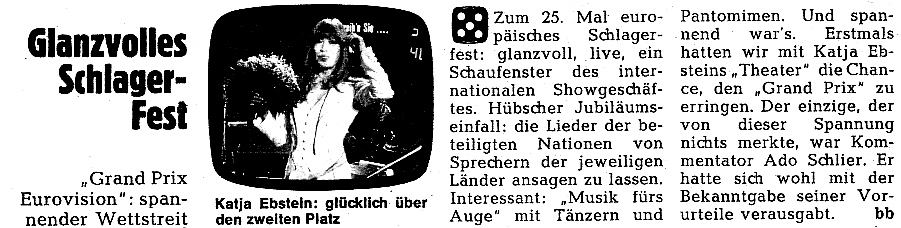
  49. ↑ "Glanzvolles Schlager-Fest" [Brilliant schlager festival]. Gong (in German). Munich, West Germany. Archived from the original on 4 April 2023. Retrieved 18 January 2023.
  50. ↑ "TV". Laos [el] (in Greek). Veria, Greece. 19 April 1980. p. 2. Retrieved 13 June 2024 – via Public Central Library of Veria [el].
  51. ↑ "Η ΕΡΤ θα μεταδώσει σήμερα το βράδυ το διαγωνισμό της "Γιουροβίζιον"" [ERT will broadcast 'Eurovision' tonight]. Makedonia (in Greek). Thessaloniki, Greece. 19 April 1980. p. 5. Retrieved 31 December 2024 – via National Library of Greece.
  52. ↑ "Double Dutch". Evening Herald. Dublin, Ireland. 19 April 1980. p. 15. Retrieved 18 July 2025 – via Newspapers.com.
  53. 1 2 "Sabato 19 aprile" [Saturday 19 April]. Radiocorriere TV (in Italian). Vol. 57, no. 16. Turin, Italy. 13–19 April 1980. pp. 204–205. Archived from the original on 5 April 2023. Retrieved 18 January 2023 – via Rai Teche.
  54. ↑ "Télé hebdo" [TV weekly]. Luxemburger Wort (in German and French). Luxembourg City, Luxembourg. 18 April 1980. Archived from the original on 12 January 2023. Retrieved 12 January 2023 – via National Library of Luxembourg.
  55. ↑ "Radio en televisie, programma's" [Radio and television, programmes]. Limburgs Dagblad (in Dutch). Heerlen, Netherlands. 19 April 1980. p. 9. Retrieved 12 January 2023 – via Delpher.
  56. ↑ "Het grote gebeuren van morgenavond! Eurovisie Songfestival." [Tomorrow night's big event! Eurovision Song Contest.]. De Volkskrant (in Dutch). Amsterdam, Netherlands. 18 April 1980. p. 23. Retrieved 12 January 2023 – via Delpher.
  57. 1 2 "Radio TV i helgen" [Radio TV at the weekend]. Tønsbergs Blad (in Norwegian). Tønsberg, Norway. 19 April 1980. p. 31. Archived from the original on 12 January 2023. Retrieved 12 January 2023 – via National Library of Norway.
  58. ↑ "Hoje" [Today]. Diário de Lisboa (in Portuguese). Lisbon, Portugal. 19 April 1980. p. 20. Archived from the original on 12 January 2023. Retrieved 12 January 2023 – via Casa Comum.
  59. ↑ "Rádio". Diário de Lisboa (in Portuguese). Lisbon, Portugal. 19 April 1980. p. 26. Archived from the original on 12 January 2023. Retrieved 12 January 2023 – via Casa Comum.
  60. ↑ "Programas para hoy" [Programmes for today] (PDF). La Gaceta del Norte [es] (in Spanish). Bilbao, Spain. 19 April 1980. p. 39. Retrieved 2 January 2025 – via Bizkaiko Foru Liburutegia [eu].
  61. ↑ "Esta noche, Festival de la Canción de Eurovisión" [Tonight, Eurovision Song Contest] (PDF). La Gaceta del Norte (in Spanish). Bilbao, Spain. 19 April 1980. p. 39. Retrieved 2 January 2025 – via Bizkaiko Foru Liburutegia.
  62. ↑ "tv programmen" [tv programmes]. Svenska Dagbladet (in Swedish). Stockholm, Sweden. 19 April 1980. p. 23.
  63. ↑ "radioprogrammen" [radio programmes]. Svenska Dagbladet (in Swedish). Stockholm, Sweden. 19 April 1980. p. 23.
  64. 1 2 "Tele-tip heute" [Tele-tip today]. Thuner Tagblatt (in German). Thun, Switzerland. 19 April 1980. p. 13. Retrieved 2 January 2025 – via E-newspaperarchives.ch.
  65. ↑ "TV – samedi 19 avril" [TV – Saturday 19 April]. Radio TV – Je vois tout (in French). Vol. 58, no. 16. Lausanne, Switzerland. 17 April 1980. pp. 18–19. Retrieved 12 January 2023 – via Scriptorium.
  66. ↑ "Oggi e domani sul video" [Today and tomorrow on the video]. Popolo e Libertà (in Italian). Bellinzona, Switzerland. 19 April 1980. p. 12. Retrieved 1 May 2026 – via Sistema bibliotecario ticinese [it].
  67. ↑ "Televizyon" [Television]. Cumhuriyet (in Turkish). Istanbul, Turkey. 19 April 1980. p. 6. Archived from the original on 12 January 2023. Retrieved 12 January 2023.
  68. 1 2 "Bütün kalpler Eurovision Yarışması için atiyor "Haydi Ajda" Diyoruz..." [All hearts are beating for the Eurovision Contest, we say "Come on Ajda"...]. Milliyet (in Turkish). Istanbul, Turkey. 19 April 1980. p. 8. Retrieved 5 November 2024.
  69. ↑ "Eurovision Song Contest 1980 – BBC1". Radio Times. London, United Kingdom. 19 April 1980. Archived from the original on 11 January 2023. Retrieved 11 January 2023 – via BBC Genome Project.
  70. ↑ "with Radio 2 through the night – BBC Radio 1". Radio Times. London, United Kingdom. 19 April 1980. Retrieved 2 January 2025 – via BBC Genome Project.
  71. ↑ "TV and Radio". The Centre Pages. Coventry, United Kingdom. 19 April 1980. p. 2. Retrieved 22 March 2025 – via Newspapers.com.
  72. ↑ "TV and radio this week end". Lancashire Evening Telegraph. Burnley, United Kingdom. 19 April 1980. pp. 30–31. Retrieved 19 March 2025 – via Newspapers.com.
  73. 1 2 3 "Saturday radio and television". The Journal. Newcastle upon Tyne, United Kingdom. 19 April 1980. p. 8. Retrieved 22 March 2025 – via Newspapers.com.
  74. ↑ "Weekend TV and radio". Isle of Wight County Press. Newport, United Kingdom. 19 April 1980. p. 4. Retrieved 22 March 2025 – via Newspapers.com.
  75. ↑ "Saturday's radio". Manchester Evening News. Manchester, United Kingdom. 19 April 1980. p. 10. Retrieved 21 March 2025 – via Newspapers.com.
  76. ↑ "And on your radio". Daily Post. Liverpool, United Kingdom. 19 April 1980. p. 2. Retrieved 22 March 2025 – via Newspapers.com.
  77. ↑ "Eurovision Song Contest – BBC Radio 2". Radio Times. London, United Kingdom. 19 April 1980. Archived from the original on 11 January 2023. Retrieved 11 January 2023 – via BBC Genome Project.
  78. ↑ "Τηλεόραση" [Television]. I Simerini (in Greek). Nicosia, Cyprus. 19 April 1980. p. 4. Retrieved 4 March 2024 – via Press and Information Office [el].
  79. 1 2 "星期日 – Sunday, 20 April – 四月二十號". Wah Kiu Yat Po Colour Weekly (in Traditional Chinese and English). Quarry Bay, Hong Kong. 20 April 1980. p. 11. Retrieved 3 November 2024 – via Internet Archive.
  80. 1 2 "Laugardagur 26. apríl 1980" [Saturday 26 April 1980]. Dagskrá sjónvarpsins (in Icelandic). Reykjavík, Iceland. 26 April 1980. Retrieved 26 June 2026 – via Timarit.is.
  81. 1 2 "20.4.80 – טלוויזיה" [Television – 20.4.80]. Maariv (in Hebrew). Tel Aviv, Israel. 22 April 1980. p. 39. Retrieved 11 January 2023 – via National Library of Israel.
  82. ↑ "20.4.80 – רדיו" [Radio – 20.4.80]. Maariv (in Hebrew). Tel Aviv, Israel. 22 April 1980. p. 39. Retrieved 11 January 2023 – via National Library of Israel.
  83. ↑ "Jordan Times Daily Guide". The Jordan Times. Amman, Jordan. 19 April 1980. p. 5. Retrieved 5 November 2024 – via Internet Archive.
  84. 1 2 "Telearuba – Zondag" [Telearuba – Sunday]. Amigoe (in Dutch). Willemstad, Curaçao. 19 July 1980. p. 5. Retrieved 17 July 2024 – via Delpher.
  85. 1 2 "tv1". Radio TV (in Romanian). No. 19. 4–10 May 1980. p. 2-a.
  86. 1 2 "TV프로" [TV programmes]. The Chosun Ilbo (in Korean). Seoul, South Korea. 3 May 1980. p. 8. Retrieved 16 December 2024 – via Naver.