The vertical axis represents the value of the hinge loss (in blue) and zero-one loss (in green) for fixed t = 1, while the horizontal axis represents the value of the prediction y. The plot shows that the hinge loss penalizes predictions y < 1, corresponding to the notion of a margin in a support vector machine.
For an intended output t = ±1 and a classifier score y, the hinge loss of the prediction y is defined as:
Note that should be the "raw" output of the classifier's decision function, not the predicted class label. For instance, in linear SVMs, , where are the parameters of the hyperplane and is the input variable(s).
When t and y have the same sign (meaning y predicts the correct class) and , the hinge loss . When they have opposite signs, increases linearly with y, and similarly if , even if it has the same sign (correct prediction, but not by enough margin).
While binary SVMs are commonly extended to multiclass classification in a one-vs-all or one-vs-one fashion,
it is also possible to extend hinge loss itself for such an end. Several different variations of multiclass hinge loss have been proposed. For example, Crammer and Singer
defined it for a linear classifier as
,
where is the target label, and are the model parameters.
Weston and Watkins provided a similar definition, but with a sum rather than a max:
.
In structured prediction, hinge loss can be further extended to structured output spaces. Structured SVMs with margin rescaling use the following variant, where w denotes the SVM's parameters, y the SVM's predictions, φ the joint feature function, and Δ the Hamming loss:
.
Optimization
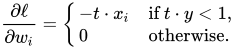
Hinge loss is a convex function, so many of the usual convex optimizers used in machine learning can work with it. It is not differentiable, but has a subgradient with respect to model parameters w of a linear SVM with score function that is given by
Plot of three variants of hinge loss as a function of z = ty: the "ordinary" variant (blue), its square (green), and the piece-wise smooth version by Rennie and Srebro (red). The y-axis is the l(y) hinge loss, and the x-axis is the parameter t
However, since the derivative of the hinge loss at is undefined, smoothed versions may be preferred for optimization, such as Rennie and Srebro's
or the quadratically smoothed
suggested by Zhang. The modified Huber loss is a special case of this loss function with , specifically .