Zig-zag: If U is a submonoid of a monoid (or a subsemigroup of a semigroup) S, then a system of equalities;
in which and , is called a zig-zag of length m in S over U with value d. By the spine of the zig-zag we mean the ordered (2m + 1)-tuple.
Dominion
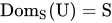
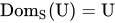
Dominion: Let U be a submonoid of a monoid (or a subsemigroup of a semigroup) S. The dominion is the set of all elements such that, for all homomorphisms coinciding on U, .
We call a subsemigroup U of a semigroup S closed
if , and dense if .
Isbell's zigzag theorem
Isbell's zigzag theorem:
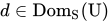
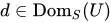
If U is a submonoid of a monoid S then if and only if either or there exists a zig-zag in S over U with value d that is, there is a sequence of factorizations of d of the form
Example of non-surjective epimorphism in the category of rings: The inclusion is an epimorphism in the category of all rings and ring homomorphisms by proving that any pair of ring homomorphisms:\mathbb {Q} \to R}
to any ring which agree on are fact equal.
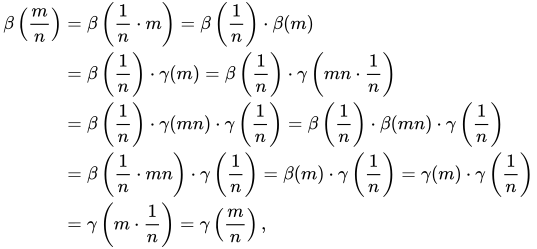
A proof sketch for example of non-surjective epimorphism in the category of rings by using zig-zag
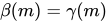
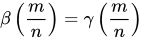
We show that: Let to be ring homomorphisms, and , . When for all , then for all .
Higgins, Peter M. (2016). "Ramsey's theorem in algebraic semigroup". First International Tainan-Moscow Algebra Workshop: Proceedings of the International Conference held at National Cheng Kung University Tainan, Taiwan, Republic of China, July 23–August 22, 1994. Walter de Gruyter GmbH & Co KG. ISBN9783110883220. Archived from the original on August 13, 2023. Retrieved August 13, 2023.