Type of equation involving matrix-valued functions
In mathematics, a nonlinear eigenproblem, sometimes nonlinear eigenvalue problem, is a generalization of the (ordinary) eigenvalue problem to equations that depend nonlinearly on the eigenvalue. Specifically, it refers to equations of the form
where is a vector, and is a matrix-valued function of the number . The number is known as the (nonlinear) eigenvalue, the vector as the (nonlinear) eigenvector, and as the eigenpair. The matrix is singular at an eigenvalue .
Let , and let be a function that maps scalars to matrices. A scalar is called an eigenvalue, and a nonzero vector is called a right eigenvector if . Moreover, a nonzero vector is called a left eigenvector if , where the superscript denotes the Hermitian transpose. The definition of the eigenvalue is equivalent to , where denotes the determinant.
In general, could be a linear map, but most commonly it is a finite-dimensional, usually square, matrix.
Definition: The problem is said to be regular if there exists a such that . Otherwise it is said to be singular.
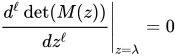
Definition: An eigenvalue is said to have algebraic multiplicity if is the smallest integer such that the th derivative of with respect to , in is nonzero. In formulas that but for .
Definition: Let be an eigenpair. A tuple of vectors is called a Jordan chain iffor , where denotes the th derivative of with respect to and evaluated in . The vectors are called generalized eigenvectors, is called the length of the Jordan chain, and the maximal length a Jordan chain starting with is called the rank of .
Theorem: A tuple of vectors is a Jordan chain if and only if the function has a root in and the root is of multiplicity at least for , where the vector valued function is defined as
Mathematical software
The eigenvalue solver package SLEPc contains C-implementations of many numerical methods for nonlinear eigenvalue problems.
The FEAST eigenvalue solver is a software package for standard eigenvalue problems as well as nonlinear eigenvalue problems, designed from density-matrix representation in quantum mechanics combined with contour integration techniques.
The MATLAB toolbox NLEIGS contains an implementation of fully rational Krylov with a dynamically constructed rational interpolant.
The MATLAB toolbox CORK contains an implementation of the compact rational Krylov algorithm that exploits the Kronecker structure of the linearization pencils.
The MATLAB toolbox AAA-EIGS contains an implementation of CORK with rational approximation by set-valued AAA.
The MATLAB toolbox RKToolbox (Rational Krylov Toolbox) contains implementations of the rational Krylov method for nonlinear eigenvalue problems as well as features for rational approximation.
The Julia package NEP-PACK contains many implementations of various numerical methods for nonlinear eigenvalue problems, as well as many benchmark problems.
The review paper of Güttel & Tisseur contains MATLAB code snippets implementing basic Newton-type methods and contour integration methods for nonlinear eigenproblems.
Eigenvector nonlinearity
Eigenvector nonlinearities is a related, but different, form of nonlinearity that is sometimes studied. In this case the function maps vectors to matrices, or sometimes hermitian matrices to hermitian matrices.
↑Hernandez, Vicente; Roman, Jose E.; Vidal, Vicente (September 2005). "SLEPc: A scalable and flexible toolkit for the solution of eigenvalue problems". ACM Transactions on Mathematical Software. 31 (3): 351–362. doi:10.1145/1089014.1089019. S2CID14305707.
↑Betcke, Timo; Higham, Nicholas J.; Mehrmann, Volker; Schröder, Christian; Tisseur, Françoise (February 2013). "NLEVP: A Collection of Nonlinear Eigenvalue Problems". ACM Transactions on Mathematical Software. 39 (2): 1–28. doi:10.1145/2427023.2427024. S2CID4271705.
↑Polizzi, Eric (2020). "FEAST Eigenvalue Solver v4.0 User Guide". arXiv:2002.04807 [cs.MS].
↑Güttel, Stefan; Van Beeumen, Roel; Meerbergen, Karl; Michiels, Wim (1 January 2014). "NLEIGS: A Class of Fully Rational Krylov Methods for Nonlinear Eigenvalue Problems". SIAM Journal on Scientific Computing. 36 (6): A2842–A2864. Bibcode:2014SJSC...36A2842G. doi:10.1137/130935045.