NORBIT
In electronics, the NORBIT family of modules is a very early form (since 1960) of digital logic developed by Philips (and also provided through Valvo and Mullard) that uses modules containing discrete components to build logic function blocks in resistor–transistor logic (RTL) or diode–transistor logic (DTL) technology.

Overview
The system was originally conceived as building blocks for solid-state hard-wired programmed logic controllers (the predecessors of programmable logic controllers (PLC)) to replace electro-mechanical relay logic in industrial control systems for process control and automation applications, similar to early Telefunken/AEG Logistat, Siemens Simatic, Brown, Boveri & Cie, ACEC Logacec or Akkord Estacord systems.
Each available logical function was recognizable by the color of its plastic container, black, blue, red, green, violet, etc. The most important circuit block contained a NOR gate (hence the name), but there were also blocks containing drivers, and a timer circuit similar to the later 555 timer IC.
The original Norbit modules of the YL 6000 series introduced in 1960 had potted single in-line packages with up to ten long flying leads arranged in two groups of up to five leads in a row. These modules were specified for frequencies of less than 1 kHz at ±24 V supply.
Also available in 1960 were so called Combi-Element modules in single-in line packages with ten evenly spaced stiff leads in a row (5.08 mm / 0.2-inch pitch) for mounting on a PCB. They were grouped in the 1-series (aka "100 kHz series") with ±6 V supply. The newer 10-series and 20-series had similarly sized packages, but came with an additional parallel row of nine staggered leads for a total of 19 leads. The 10-series uses germanium alloy transistors, whereas in the 20-series silicon planar transistors are used for a higher cut-off frequency of up to 1 MHz (vs. 30 kHz) and a higher allowed temperature range of +85 °C (vs. +55 °C).
In 1967, the Philips/Mullard NORBIT 2 aka Valvo NORBIT-S family of modules was introduced, first consisting of the 60-series for frequencies up to 10 kHz at a single supply voltage of 24 V, only. Later, the 61-series, containing thyristor trigger and control modules, was added. A 90-series became available in the mid-1970s as well. There were three basic types contained in a large (one by two inch-sized) 17 pins dual in-line package, with nine pins spaced 5.08 mm (0.2-inch) on one side and eight staggered pins on the other side.
Modules
Original Norbit family
- YL 6000 series
- YL6000 - NOR gate (red) ("NOR")
- YL6001 - Emitter follower (yellow) ("EF")
- YL6004 - High power output (Double-sized module) ("HP")
- YL6005, YL6005/00 - Counter unit (triple binary) ("3C") (violet)
- YL6005/05 - Single divide by 2 counter (violet) ("1C")
- YL6006 - Timer (brown) ("TU")
- YL6007 - Chassis ("CU")
- YL6008 - Medium power output (orange) ("MP")
- YL6009 - Low power output (white) ("LP")
- YL6010 - Photo-electric detector head ("PD")
- YL6011 - Photo-electric lamp head ("PL")
- YL6012 - Twin 2-input NOR gate (black) ("2.2 NOR")
- YL 6100 series
- YL6101 - Rectifier unit, 3…39V 1A
- YL6102 - Rectifier unit, 3…39V 5A
- YL6103/00 - Regulator unit, 6…30V 250mA
- YL6103/01 - Regulator unit, 1…6V 250mA
- YL6104 - Longitudinal link for regulator unit
- YL6105 - Regulator unit, 6V 150mA
- 88930 Relay series
Used to control relays using variable-length pulse sequences (as with telephone pulse dialing).
- 88930/30 - Input/Output unit
Filters an input pulse string and can drive two command circuits and two relay units
Contains 1×/48, 2×/51, and 2×/57. - 88930/33 - Primary pulse counting unit (dual command)
Can trigger two different signals via two different pulse sequences. The number of pulses that will trigger each command is configurable. - 88930/36 - Dual command unit
Adds two additional commands to the /33. - 88930/37 - Quad command unit
Adds four additional commands to the /33. - 88930/39 - Output unit
Can drive two command circuits (in /36 or /37 command units) plus two /60 relay units.
Contains 2×/51 and 2×/57. - 88930/42 - Empty unit
For adding custom circuitry. Comprises an empty housing, connector, and blank circuit board. - 88930/48 - Pulse shaper unit for /33 (no housing)
- 88930/51 - Command preparation unit (no housing)
For providing input to command units. - 88930/54 - Reset unit
- 88930/57 - Relay amplifier unit (no housing)
For driving a low-impedance relay such as the /60 relay block unit. - 88930/60 - Relay block unit
Double-pole, double throw 250V 2A relay. Accepts a /57 relay amplifier unit. - 88930/64 - Power supply unit
Provides 280V 45mA, 150V 2mA, 24V 750mA, and 15V 120mA.
Combi-Element family
- 1-series / B890000 series
- B893000, B164903 - Twin 3-input AND gates (orange) ("2.3A1", "2x3N1")
- B893001, B164904 - Twin 2-input AND gates (orange) ("2.2A1", "2x2N1")
- B893002, 2P72729 - Twin 3-input OR gates (orange) ("2.3O1", "23O1", "2x3P1")
- B893003, 2P72730 - Twin 2-input OR gates (orange) ("2.2O1", "22O1", "2x2P1")
- B894002, B164910 - Twin inverter amplifier (yellow) ("2IA1", "2.IA1", "2xIA1")
- B894005, 2P72728 - Twin inverter amplifier (yellow) ("2IA2", "2xIA2")
- B894001, B164909 - Twin emitter follower (yellow) ("2EF1", 2xEF1")
- B894003, 2P72727 - Twin emitter follower (yellow) ("2EF2", "2xEF2")
- B894000, B164907 - Emitter follower/inverter amplifier (yellow) ("EF1/IA1")
- B895000, B164901 - Pulse shaper (Schmitt trigger + amplifier) (green) ("PS1")
- B895001, B164908 - One-shot multivibrator ("OS1")
- B895003 - One-shot multivibrator ("OS2")
- B892000, B164902 - Flip-flop (red) ("FF1")
- B892001, 2P72707 - Shift-register Flip-flop (red) ("FF2")
- B892002 - Flip-flop (red) ("FF3")
- B892003 - Flip-flop (red) ("FF4")
- B893004, 2P72726 - Pulse logic (orange) ("PL1", "2xPL1")
- B893007 - Pulse logic (orange) ("2xPL2")
- B885000, B164911 - Decade counter ("DC1")
- B890000 - Power amplifier ("PA1")
- B896000 - Twin selector switch for core memories ("2SS1")
- B893005 - Selection gate for core memories ("SG1")
- 2P72732 - Pulse generator for core memories ("PG1")
- 2P72731 - Read amplifier for core memories ("RA1")
- 10-series
- 2P73701 - Flip-flop ("FF10")
- 2P73702 - Flip-flop ("FF11")
- 2P73703 - Flip-flop / Bistable multivibrator with built-in trigger gates and set-reset inputs (black) ("FF12")
- Dual trigger gate ("2.TG13")
- Dual trigger gate ("2.TG14")
- Quadruple trigger gate ("4.TG15")
- Dual positive gate inverter amplifier ("2.GI10")
- Dual positive gate inverter amplifier ("2.GI11")
- Dual positive gate inverter amplifier ("2.GI12")
- Gate amplifier ("GA11")
- One-shot multivibrator ("OS11")
- Timer unit ("TU10")
- Pulse driver ("PD11")
- Relay driver ("RD10")
- Relay driver ("RD11")
- Power amplifier ("PA10")
- Pulse shaper ("PS10")
- Numerical indicator tube driver ("ID10")
- 20-series
- 2P73710 - ("2.GI12", "2GI12")
Norbit 2 / Norbit-S family
- 60-series
- 2NOR60, 2.NOR60 - Twin NOR (black)
- 4NOR60, 4.NOR60 - Quadruple NOR (black)
- 2.IA60, 2IA60 - Twin inverter amplifier for low power output (blue)
- LPA60 - Twin low power output
- 2.LPA60, 2LPA60 - Twin low power output (blue)
- PA60 - Medium power output (blue)
- HPA60 - High power output (black)
- 2.SF60, 2SF60 - Twin input switch filter (green)
- TU60 - Timer (red)
- FF60 - Flip-flop
- GLD60 - Grounded load driver (black)
- 61-series
- TT61 - Trigger transformer
- UPA61 - Universal power amplifier
- RSA61 - Rectifier and synchroniser
- DOA61 - Differential operational amplifier
- 2NOR61, 2.NOR61 - Twin NOR
- 90-series
- PS90 - Pulse shaper (green)
- FF90 - Flip-flop (red)
- 2TG90, 2.TG90 - Twin trigger gate (red)
- Accessories
- PSU61 - Power supply
- PCB60 - Printed wiring board
- MC60 - Mounting chassis
- UMC60 - Universal mounting chassis
- MB60 - Mounting bar
Photo gallery
- Examples of the 60-series NORBIT 2 family
 Top view
 Bottom view


- Examples of Printed Circuit Boards that uses the 60-series NORBIT 2 family


See also
Notes
- ↑ Mullard called these modules Combi-Element in the UK, whereas Philips and Valvo just called them circuit blocks, but distinguished them from the original Norbit series.
- ↑ Some later datasheets distinguished between the 100 kHz series and the 1-series.
- ↑ So far, the assumed equivalence of Valvo's Norbit-S series with the Philips Norbit 2 series is based on their release date in 1967. Often, the modules of the newer families were still referred to as Norbits only.
- ↑ The modules of the 90-series were grouped into the 60-series in early datasheets.
References
- 1 2 3 4 5 6 7 8 9 10 11 12 13 14 15 16 17 18 19 20 21 22 23 "Guide to Circuit Blocks (Combi-Elements) and their use in Digital Systems and Equipment - Part IV" (PDF). Sub-Assemblies Bulletin (9). Manor Royal Crawley, Sussex, England: Mullard Equipment Limited. November 1962 [May 1960]. Archived (PDF) from the original on 2018-06-20. Retrieved 2018-06-20.
- 1 2 "Prefabricated Electronic Bricks" (PDF). Wireless World. Technical Notebook. 66 (8): 374. August 1960. Retrieved 2018-06-20.
[…] ready-assembled circuit modules can cut down development time spent on a control-engineering or data processing problem by eliminating the work of designing individual circuits. A particular range made by Mullard are slim colour-coded plastics "boxes" of guaranteed performance specifications covering the commonly used circuit functions. Typical units are AND/OR gates, timing and relay-operating circuits called "Norbits" (for control purposes) and flip-flop, pulse shaper and inverter-amplifier stages called Combi elements (for digital circuits). By giving only a performance specification the manufacturers can take advantage of advances in techniques (for instance, complete solid-state circuits) without, at the same time, rendering obsolete existing apparatus. Transistors are used throughout, so that battery operation is reasonably economical, and the modules are designed to connect together compatibly in a manner suited to their functions. Norbits have long, flexible flying leads for use with terminal blocks while Combi-elements have short, stiff tinned wires suitable for fitting into printed wiring boards. […]
- 1 2 3 4 "INTERKAMA 1960 - Dusseldorf Exhibition of Automation and Instruments" (PDF). Wireless World. 66 (12): 588–589. December 1960. Retrieved 2018-06-18.
[…] Another point noticed was the widespread use of small-package solid-state logic (such as "and," "or," "not") and instrumentation (timers, amplifiers, etc.) units. There would seem to be a good case here for the various manufacturers to standardise practical details such as mounting, connections and power supplies so that a Siemens "Simatic," say, is directly interchangeable with an Ateliers des Constructions Electronique de Charleroi "Logacec," a Telefunken "Logistat," or a Mullard "Norbit" or "Combi-element." […]
- 1 2 3 4 5 6 7 8 9 10 11 12 13 14 15 16 Norbit Sub-Assemblies YL 6000 Series (PDF). Norbit Handbook (2 ed.). Mullard Equipment Limited. February 1962. Archived (PDF) from the original on 2018-06-20. Retrieved 2018-06-20.
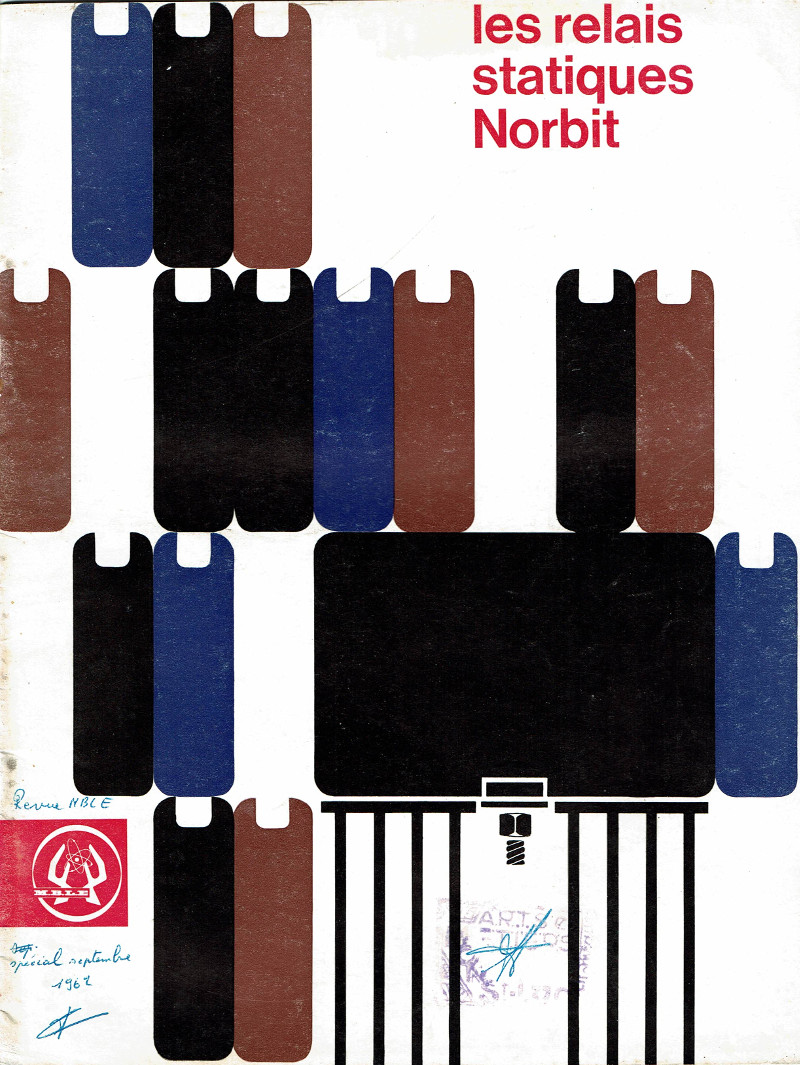
- 1 2 3 "les relais statiques Norbit". Revue MBLE (in French). Brussels, Belgium: Philips Research Laboratory, Manufacture Belge de Lampes et de Materiel Electronique (MBLE Research Laboratory). September 1962. Archived from the original on 2018-06-18. Retrieved 2018-06-18.
- ↑ "Judicial Greffe - Trademarks Database - Individual Record - NORBITS - TM 2671 - Mullard Limited". 2003-03-26 [1967-06-27]. Archived from the original on 2018-06-19. Retrieved 2018-06-19.
- ↑ "Judicial Greffe - Trademarks Database - Individual Record - NORBIT - TM 2672 - Mullard Limited". 2003-03-26 [1967-06-27]. Archived from the original on 2018-06-19. Retrieved 2018-06-19.
- 1 2 Pistorius, Arthur (September 2007). "Retronics - Philips 60-series NORbits (1968)". Elektor Electronics. 2007 (9): 76. Retrieved 2018-06-20.
- ↑ Estacord - Das universelle Bausteinsystem für kontaktlose Steuerungen (Catalog) (in German). Herxheim/Pfalz, Germany: Akkord-Radio GmbH.
- ↑ Klingelnberg, W. Ferdinand (2013) [1967, 1960, 1939]. Pohl, Fritz; Reindl, Rudolf (eds.). Technisches Hilfsbuch (in German) (softcover reprint of 15th hardcover ed.). Springer-Verlag. p. 135. doi:10.1007/978-3-642-88367-5. ISBN 978-3-64288368-2. LCCN 67-23459. 0512.
- ↑ Weißel, Ralph; Schubert, Franz (2013-03-07) [1995, 1990]. "4.1. Grundschaltungen mit Bipolar- und Feldeffekttransistoren". Digitale Schaltungstechnik. Springer-Lehrbuch (in German) (reprint of 2nd ed.). Springer-Verlag. p. 116. doi:10.1007/978-3-642-78387-6. ISBN 978-3-540-57012-7.
- ↑ Walker, Mark John (2012-09-08). The Programmable Logic Controller: its prehistory, emergence and application (PDF) (PhD thesis). Department of Communication and Systems Faculty of Mathematics, Computing and Technology: The Open University. pp. 223, 269, 308. Archived (PDF) from the original on 2018-06-20. Retrieved 2018-06-20.
- 1 2 3 4 5 6 7 8 9 10 11 12 13 14 15 16 17 18 19 Wylie, Andrew (2009). "Packaged circuits". Archived from the original on 2018-06-18. Retrieved 2019-06-22.
- ↑ "Schakelen met de 60-serie NORBITs" (in Dutch). Philips. Archived from the original on 2018-06-18. Retrieved 2013-08-06. (NB. Green cover.)
- 1 2 3 4 5 6 7 8 9 10 11 12 13 14 15 16 17 18 19 20 21 22 23 24 25 26 27 28 29 30 31 32 33 34 35 36 37 38 39 40 41 42 43 44 45 46 47 48 49 50 51 52 53 Valvo-Taschenbuch (in German) (1964 ed.). Hamburg, Germany: Valvo GmbH. 1964. (NB. An English version of this book was also available as Valvo Pocketbook.)
- ↑ Mullard Combi Elements (PDF). Mullard. 1963 [May 1960]. Archived (PDF) from the original on 2018-06-20. Retrieved 2018-06-20.
- ↑ Gossel, Dieter; Kaps, Gerhard; Schott, Winfried (1965). "A new system of digital circuit blocks for industrial measuring and control equipment" (PDF). Philips Technical Review. 26 (4/5/6). Philips Zentrallaboratorium GmbH, Hamburg, Germany: Philips: 164–170. 621.374.32. Retrieved 2018-06-19.
{{cite journal}}: CS1 maint: deprecated archival service (link) - 1 2 3 4 5 6 7 8 9 10 11 12 13 14 15 16 17 18 19 20 van Barneveld, Evert Jan (1967). "Digital circuit blocks" (PDF). Philips Technical Review. 28 (2). Philips Electronic Components and Materials Product Division (Elcoma), Eindhoven, Netherlands: Philips: 44–56. Archived (PDF) from the original on 2018-06-19. Retrieved 2018-06-19.
- 1 2 3 4 5 6 7 8 9 10 11 12 13 14 15 16 17 18 19 20 21 22 23 24 25 NORBIT 2 and 61 SERIES - Solid state control elements - Data sheets. Mullard Limited. March 1974. TP1428.
- ↑ Philips Nederland n.v. (June 1967). "Kijk: Norbit 2 is er! Statisch schakelen is nu óók goedkoop schakelen" (PDF). Elektuur (Advertisement) (in Dutch) (54). Eindhoven, Netherlands: 604.
- ↑ NORBIT 2 - Low Priced Static Switches. Philips. 1967.
- ↑ Norbit-S-Kompendium (in German). Hamburg, Germany: Valvo GmbH / Curtze. April 1969. (128 pages + appendix)
- ↑ Dokter, Folkert; Steinhauer, Jürgen (1973-06-18). "6.5. Digital modules with discrete components". Digital Electronics. Philips Technical Library (PTL) / Macmillan Education (Reprint of 1st English ed.). Eindhoven, Netherlands: The Macmillan Press Ltd. / N. V. Philips' Gloeilampenfabrieken. pp. 226, 232. doi:10.1007/978-1-349-01417-0. ISBN 978-1-349-01419-4. SBN 333-13360-9. Archived from the original on 2020-07-16. Retrieved 2018-07-01. (270 pages) (NB. This is based on a translation of volume I of the two-volume German edition.)
- ↑ Dokter, Folkert; Steinhauer, Jürgen (1975) [1969]. "6.5.2 Bauformen digitaler Funktionsbausteine". Digitale Elektronik in der Meßtechnik und Datenverarbeitung: Theoretische Grundlagen und Schaltungstechnik. Philips Fachbücher (in German). Vol. I (improved and extended 5th ed.). Hamburg, Germany: Deutsche Philips GmbH. pp. 281–285. ISBN 3-87145-272-6. (xii+327+3 pages) (NB. The German edition of volume I was published in 1969, 1971, two editions in 1972, and 1975. Volume II was published in 1970, 1972, 1973, and 1975.)
- ↑ Rosielle, C. (May 1968). Deerson, Jonathan (ed.). Control system design manual for 60-series NORbits: A Guide to the application of electronic logic circuits in industry. Philips Application Book (1 ed.). Eindhoven, Netherlands: N.V. Philips' Gloeilampenfabrieken, Electronic Components and Materials Division (Elcoma), Technical Publications Department. 9399 263 016 01. (233+8 pages) (NB. There exists a fourth edition from 1974 as well.)
- ↑ Semiconductors - Part 5 - Field-effect transistors (PDF). Electronic components and materials (Elcoma) - Philips Data Handbook. Philips. October 1980. Archived (PDF) from the original on 2018-06-19. Retrieved 2018-06-19.
[…] COMPONENTS AND MATERIALS (GREEN SERIES) […] Part 1 - July 1979 - CM107-79 - Assemblies for industrial use PLC modules, high noise immunity logic FZ/30 series, NORbits 60-series, 61-series, 90-series, input devices, hybrid integrated circuits, peripheral devices […]
- ↑ Schakelen met NORBITs (in Dutch). Philips. (NB. Brown cover.)
- ↑ Dean, K. J. (January–February 1973). "Trends in semiconductor digital circuits". Radio and Electronic Engineer. 43 (1.2). IET: 67–74. doi:10.1049/ree.1973.0011. ISSN 0033-7722. Archived from the original on 2018-06-20. Retrieved 2018-06-20.
- 1 2 3 Reuvers, Paul; Simons, Marc (2018-02-24) [2017-11-28]. "Circuit Blocks". www.cryptomuseum.com. Archived from the original on 2018-06-18. Retrieved 2018-06-17.
- 1 2 3 4 5 6 7 8 9 10 11 12 13 14 15 16 17 18 19 20 21 22 23 24 25 26 27 28 29 30 31 32 33 Components and materials - Part 1: Circuit blocks, Input/Output devices (PDF). Philips Data Handbook. Philips. September 1970. 9399 261 14901. Archived (PDF) from the original on 2018-06-20. Retrieved 2018-06-20. (NB. Has green cover.)


Further reading
- Norbit-Bausteine (in German). Valvo GmbH. 1962. (43 pages) (NB. Also part of the Valvo-Handbuch 1962 pages 83–125.)
- Valvo-Handbuch Bausteine (in German) (1963 ed.). Hamburg, Germany: Valvo GmbH. 1963. (253 pages) (NB. Contains a chapter about Norbit modules as well.)
- Norbit-S-Bausteine (in German) (1967/1968 ed.). Hamburg, Germany: Valvo GmbH. 1967. (25 pages)
- Circuit Blocks 40-Series, NORBITS 60-Series, Input/Output Devices. Philips Product Data. Philips Electronic Components and Materials Division. September 1969. 9399 261 10501.
- Grimley, Robert (2016) [2011]. "Mullard & CES - Mullard & Combined Electronic Services (CES)". Early Philips Colour TV. Archived from the original on 2017-10-27. Retrieved 2017-01-14.
External links
- Holm, Åke. "Picture of four NORBIT 2 modules". Archived from the original on 2018-06-19. Retrieved 2018-06-19.

