グリーゼ892

グリーゼ892
Gliese 892
グリーゼ892の位置
グリーゼ892の位置
星座 カシオペヤ座
見かけの等級 (mv) 5.574
変光星型 閃光星
分類 K型主系列星
位置
元期:J2000.0
赤経 (RA, α)  23h 13m 16.97632s
赤緯 (Dec, δ) +57° 10′ 06.0823″
視線速度 (Rv) -18.5 km/s
固有運動 (μ) 赤経: 2,075.07 ミリ秒/年
赤緯: 295.45 ミリ秒/年
年周視差 (π) 152.76 ± 0.29ミリ秒
(誤差0.2%)
距離 21.35 ± 0.04 光年
(6.55 ± 0.01 パーセク)
絶対等級 (MV) 6.46
軌道要素と性質
惑星の数 6
物理的性質
半径 0.778 ± 0.005 R☉
質量 0.78 ± 0.022 M☉
平均密度 太陽の1.729 ± 0.073倍
表面重力 4.50 (log g)
自転速度 6.94 km/s
自転周期 42.3 ± 0.1 日
スペクトル分類 K3V
光度 0.265 ± 0.002 L☉
表面温度 4,699 ± 16 K
色指数 (B-V) +0.983
色指数 (U-B) +0.902
金属量[Fe/H] 0.20
年齢 ~124.6 億年
他のカタログでの名称
BD+56 2966, FK5 875,
GJ 892, HD 219134,
HIP 114622, HR 8832,
SAO 35236
■Template (■ノート ■解説) ■Project
大きさの比較
太陽 グリーゼ892
太陽 Exoplanet

グリーゼ892(Gliese 892)は、カシオペヤ座にある主系列星である。HR 8832やHD 219134とも呼ばれる。太陽よりも小さくて光度が低いスペクトル型K3Vの恒星であり、橙赤色に輝く。グリーゼ892は比較的太陽系に近く、距離は21.25光年と推定されている。この恒星は、裸眼で見える限界に近い視等級である。

この恒星は、106.6″離れた位置に9.4等級の伴星を伴っている。
惑星系

グリーゼ892の周囲には、6つの既知の太陽系外惑星が公転していることが知られている。惑星bは、大きさ(地球半径の1.6倍)と密度(1立方センチメートルあたり6.4 g)に基づいて、岩石質のスーパーアースであるとされている。さらに3つの太陽系外惑星(1つのスーパーアース(cと指定され、後に岩石質であることが判明)、1つの天王星型惑星(d)、及び1つの木星型惑星(e))は、2015年にMotalebiらによってHARPS-Nのドップラー分光法を用いた観測データから推定された。2か月後、スティーブン・ボーグトらはグリーゼ892系に関する論文を発表し、6つの惑星の解を発見した。b、c、dはMotalebiらが発見した惑星に対応し、fとgは新しい惑星、hはMotalebiらが発見したeに対応しているが、推定パラメータが異なり、より正確である。

グリーゼ892の惑星系に関しては、いくつかの独立した研究が行われてきたが、その結果の一部は矛盾している。2017年3月の時点では、この恒星には少なくとも5つの惑星があることが知られており、そのうち2つ(bとc)はトランジットを起こす岩石質のスーパーアースであることが知られている。2016年の研究では、fに対応するドップラー分光法で検出された信号は恒星活動によって引き起こされている可能性があると示唆されたが、後に2017年と2021年の研究によって惑星によるものであると確認された。惑星gはその後の研究では報告されておらず、2020年の研究では、主張されている94日周期の惑星の証拠は見つからず、代わりに192日周期であることが判明した。

グリーゼ892の惑星
名称
(恒星に近い順)
質量 軌道長半径
(天文単位)
公転周期
(日)
軌道離心率 軌道傾斜角 半径
b 4.74±0.19 M⊕ 0.03838±0.00044 3.092947+0.000076
−0.000079
0.063+0.070
−0.045
85.008±0.091° 1.533+0.097
−0.078
 R⊕
c 4.36±0.22 M⊕ 0.06466+0.00074
−0.00073
6.76406+0.00093
−0.00076
0.16+0.12
−0.11
87.304±0.059° 1.507+0.074
−0.060
 R⊕
f ≥7.72+0.73
−0.70
 M⊕
0.1453+0.0017
−0.0016
22.7945+0.0047
−0.0056
0.072+0.078
−0.051
— ≥1.31±0.02 R⊕
d ≥16.4±1.0 M⊕ 0.2345±0.0027 46.734±0.012 0.077+0.055
−0.050
— ≥1.61±0.02 R⊕
g ≥15.3±1.59 M⊕ 0.603±0.001 192.0+0.5
−0.4
0.16±0.1 — —
h(e) ≥97.9±4.4 M⊕ 2.968±0.037 2104+16
−17
0.025+0.027
−0.018
— —

ハビタブルゾーン

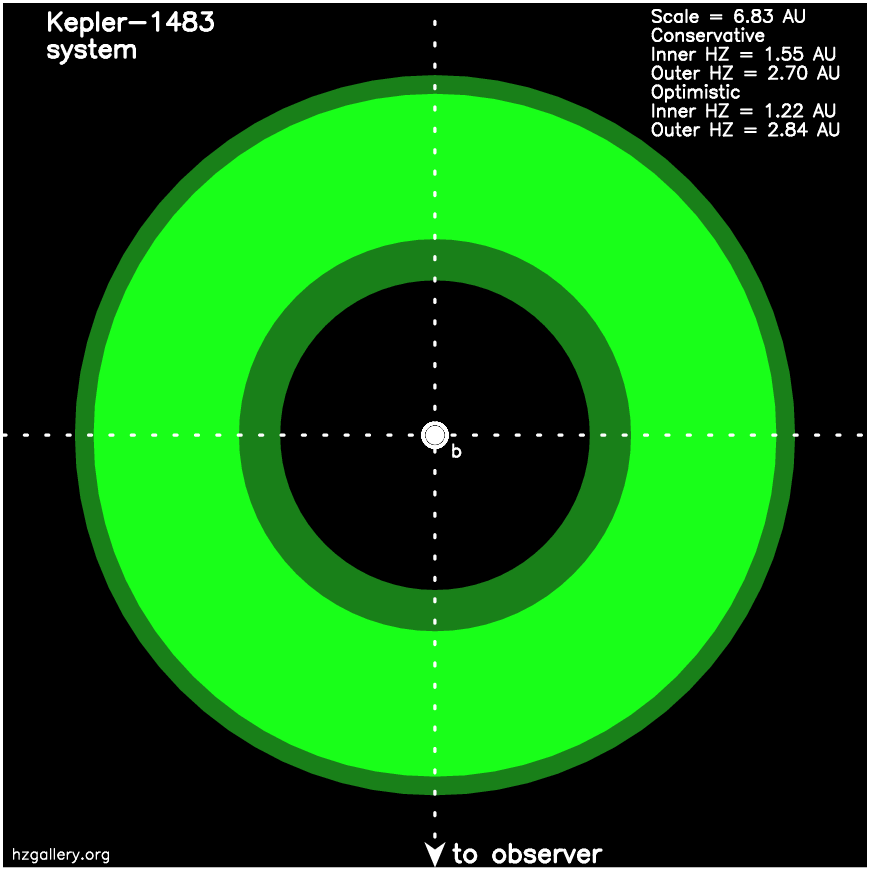
グリーゼ892の保守的なハビタブルゾーン(CHZ)は、0.516 au から0.948 au の範囲であると推定されている。2024年の時点では、この恒星の周囲を公転する惑星のいずれも、ハビタブルゾーン内を公転していることは確認されていない。gは当初公表されたパラメータに基づくとハビタブルゾーンの内縁よりわずかに内側を公転している可能性があったが、より最近の推定公転周期192日、軌道長半径0.603 au に基づくと、ハビタブルゾーン内を公転している可能性がある。この惑星は地球よりもかなり質量が大きいため、太陽系の天王星型惑星に匹敵する高密度の大気を保持している可能性がある。

脚注

注釈

  1. 1 2 パーセクは1 ÷ 年周視差(秒)より計算、光年は1÷年周視差(秒)×3.2615638より計算

出典

  1. 1 2 3 Oja, T. (August 1986). “UBV photometry of stars whose positions are accurately known. III”. Astronomy and Astrophysics Supplement Series. 65 (2): 405–409. Bibcode:1986A&AS...65..405O.
  2. 1 2 “HR 8832 -- Flare Star”. SIMBAD Astronomical Object Database. Centre de Données astronomiques de Strasbourg. 2012年4月8日閲覧.
  3. 1 2 3 4 5 van Leeuwen, F. (November 2007). “Validation of the new Hipparcos reduction”. Astronomy and Astrophysics. 474 (2): 653–664. arXiv:0708.1752. Bibcode:2007A&A...474..653V. doi:10.1051/0004-6361:20078357.
  4. ↑ Wielen, R.; et al. (1999). Sixth Catalogue of Fundamental Stars (FK6). Part I. Basic fundamental stars with direct solutions. Astronomisches Rechen-Institut Heidelberg. Bibcode:1999VeARI..35....1W.
  5. 1 2 3 4 5 6 Motalebi, F.; et al. (2015年7月31日). “The HARPS-N Rocky Planet Search -- I. HD 219134 b: A transiting rocky planet in a multi-planet system at 6.5 pc from the Sun”. Astronomy & Astrophysics. arXiv:1507.08532. 2015年8月13日閲覧.
  6. 1 2 3 Vogt, Steven S.; et al. (2015年11月). “Six Planets Orbiting HD 219134”. アストロフィジカルジャーナル. 814 (1): 12. arXiv:1509.07912. Bibcode:2015ApJ...814...12V. doi:10.1088/0004-637X/814/1/12. S2CID 45438051.
  7. ↑ Michaël Gillon; et al. (2017年3月4日). “Two massive rocky planets transiting a K-dwarf 6.5 parsecs away”. arXiv:1703.01430v1 [astro-ph.EP].
  8. 1 2 3 Frasca, A.; et al. (December 2009). “REM near-IR and optical photometric monitoring of pre-main sequence stars in Orion. Rotation periods and starspot parameters”. Astronomy and Astrophysics. 508 (3): 1313–1330. Bibcode:2009A&A...508.1313F. doi:10.1051/0004-6361/200913327.
  9. ↑ Martínez-Arnáiz, R.; et al. (September 2010). “Chromospheric activity and rotation of FGK stars in the solar vicinity. An estimation of the radial velocity jitter”. Astronomy and Astrophysics. 520: A79. arXiv:1002.4391. Bibcode:2010A&A...520A..79M. doi:10.1051/0004-6361/200913725.
  10. ↑ Takeda, Genya; et al. (February 2007). “Structure and Evolution of Nearby Stars with Planets. II. Physical Properties of ~1000 Cool Stars from the SPOCS Catalog”. The Astrophysical Journal Supplement Series. 168 (2): 297–318. arXiv:astro-ph/0607235. Bibcode:2007ApJS..168..297T. doi:10.1086/509763.
  11. ↑ Eggleton, P. P.; et al. (September 2008). “A catalogue of multiplicity among bright stellar systems”. Monthly Notices of the Royal Astronomical Society. 389 (2): 869–879. arXiv:0806.2878. Bibcode:2008MNRAS.389..869E. doi:10.1111/j.1365-2966.2008.13596.x.
  12. ↑ “PIA19832: Location of Nearest Rocky Exoplanet Known”. NASA. 2015年7月30日. 2015年7月30日閲覧.
  13. ↑ Chou, Felicia; et al. (2015年7月30日). “NASA's Spitzer Confirms Closest Rocky Exoplanet”. NASA. 2015年7月31日閲覧.
  14. ↑ Motalebi, F.; et al. (2015年12月). “The HARPS-N Rocky Planet Search. I. HD 219134 b: A transiting rocky planet in a multi-planet system at 6.5 pc from the Sun”. Astronomy & Astrophysics. 584: A72. arXiv:1507.08532. Bibcode:2015A&A...584A..72M. doi:10.1051/0004-6361/201526822. S2CID 45652878.
  15. ↑ “Cassiopeia's Hidden Gem”. Harvard. 2015年7月30日. 2015年7月30日閲覧.
  16. 1 2 Johnson, Marshall C.; et al. (April 2016). “A 12-year Activity Cycle for the Nearby Planet Host Star HD 219134”. アストロフィジカルジャーナル. 821 (2): 74. arXiv:1602.05200. Bibcode:2016ApJ...821...74J. doi:10.3847/0004-637X/821/2/74. S2CID 118651905.
  17. 1 2 Gillon, Michaël; et al. (2017). “Two massive rocky planets transiting a K-dwarf 6.5 parsecs away”. Nature Astronomy. 1 (3). 0056. arXiv:1703.01430. Bibcode:2017NatAs...1E..56G. doi:10.1038/s41550-017-0056. S2CID 56075932.
  18. ↑ “Back Alley Astronomy: HD 219134 Scorecard: 5 planets, 2 transiting”. 2017年4月18日. 2017年12月24日閲覧.
  19. ↑ Rosenthal, Lee J.; et al. (2021). “The California Legacy Survey. I. A Catalog of 178 Planets from Precision Radial Velocity Monitoring of 719 Nearby Stars over Three Decades”. The Astrophysical Journal Supplement Series. 255 (1): 8. arXiv:2105.11583. Bibcode:2021ApJS..255....8R. doi:10.3847/1538-4365/abe23c. S2CID 235186973.
  20. 1 2 3 Hirsch, Lea A.; et al. (2021). “Understanding the Impacts of Stellar Companions on Planet Formation and Evolution: A Survey of Stellar and Planetary Companions within 25 pc”. The Astronomical Journal. 161 (3): 134. arXiv:2012.09190. Bibcode:2021AJ....161..134H. doi:10.3847/1538-3881/abd639. S2CID 229297873.
  21. ↑ “HD 219134 Overview”. NASA Exoplanet Archive. 2025年1月30日閲覧.
  22. ↑ “HD 219134 g”. ExoKyoto. 2021年7月21日閲覧.
  23. ↑ “HD 219134”. hzgallery.org. 2022年12月12日閲覧.
  24. ↑ Dietrich, Jeremy; et al. (2022). “An Integrative Analysis of the HD 219134 Planetary System and the Inner solar system: Extending DYNAMITE with Enhanced Orbital Dynamical Stability Criteria”. The Astronomical Journal. 163 (2): 88. arXiv:2112.05337. Bibcode:2022AJ....163...88D. doi:10.3847/1538-3881/ac4166. S2CID 245117944.

外部リンク