Lijst van goniometrische gelijkheden Directe onderlinge relaties
tan
x
=
sin
x
cos
x
sec
x
=
1
cos
x
csc
x
=
1
sin
x
cot
x
=
1
tan
x
=
cos
x
sin
x
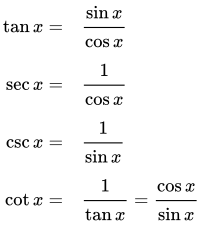
{\displaystyle {\begin{array}{rl}\tan x=&{\cfrac {\sin x}{\cos x}}\\\sec x=&{\cfrac {1}{\cos x}}\\\csc x=&{\cfrac {1}{\sin x}}\\\cot x=&{\cfrac {1}{\tan x}}={\cfrac {\cos x}{\sin x}}\\\end{array}}}
sin
x
=
sin
(
x
+
2
π
)
=
sin
(
π
−
x
)
sin
x
=
cos
(
π
2
−
x
)
cos
x
=
cos
(
x
+
2
π
)
=
cos
(
−
x
)
cos
x
=
sin
(
π
2
−
x
)
=
sin
(
π
2
+
x
)
tan
x
=
tan
(
x
+
2
π
)
=
tan
(
x
+
π
)
tan
x
=
cot
(
π
2
−
x
)
−
sin
x
=
sin
(
x
+
π
)
=
sin
(
−
x
)
−
cos
x
=
cos
(
x
+
π
)
=
cos
(
π
−
x
)
−
tan
x
=
tan
(
−
x
)
=
tan
(
π
−
x
)
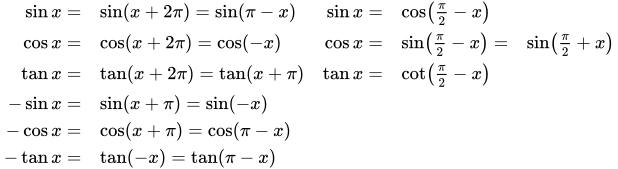
{\displaystyle {\begin{array}{rlrl}\sin x=&\sin(x+2\pi )=\sin(\pi -x)&\sin x=&\cos \left({\frac {\pi }{2}}-x\right)\\\cos x=&\cos(x+2\pi )=\cos(-x)&\cos x=&\sin \left({\frac {\pi }{2}}-x\right)=&\sin \left({\frac {\pi }{2}}+x\right)\\\tan x=&\tan(x+2\pi )=\tan(x+\pi )&\tan x=&\cot \left({\frac {\pi }{2}}-x\right)\\-\sin x=&\sin(x+\pi )=\sin(-x)&\\-\cos x=&\cos(x+\pi )=\cos(\pi -x)&\\-\tan x=&\tan(-x)=\tan(\pi -x)&\end{array}}}
Gelijkheden voor de som en het verschil van twee hoeken
sin
(
x
±
y
)
=
sin
(
x
)
cos
(
y
)
±
cos
(
x
)
sin
(
y
)
cos
(
x
±
y
)
=
cos
(
x
)
cos
(
y
)
∓
sin
(
x
)
sin
(
y
)
tan
(
x
±
y
)
=
tan
(
x
)
±
tan
(
y
)
1
∓
tan
(
x
)
tan
(
y
)
cot
(
x
±
y
)
=
cot
(
x
)
cot
(
y
)
∓
1
cot
(
x
)
±
cot
(
y
)
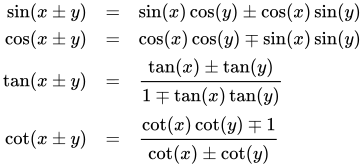
{\displaystyle {\begin{array}{rcl}\sin(x\pm y)&=&\sin(x)\cos(y)\pm \cos(x)\sin(y)\\\cos(x\pm y)&=&\cos(x)\cos(y)\mp \sin(x)\sin(y)\\\tan(x\pm y)&=&{\cfrac {\tan(x)\pm \tan(y)}{1\mp \tan(x)\tan(y)}}\\\cot(x\pm y)&=&{\cfrac {\cot(x)\cot(y)\mp 1}{\cot(x)\pm \cot(y)}}\\\end{array}}}
Gelijkheden voor de dubbele hoek
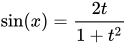
sin
(
2
x
)
=
2
sin
(
x
)
cos
(
x
)
=
2
tan
(
x
)
1
+
tan
2
(
x
)
cos
(
2
x
)
=
cos
2
(
x
)
−
sin
2
(
x
)
=
2
cos
2
(
x
)
−
1
=
1
−
2
sin
2
(
x
)
=
1
−
tan
2
(
x
)
1
+
tan
2
(
x
)
tan
(
2
x
)
=
2
tan
(
x
)
1
−
tan
2
(
x
)
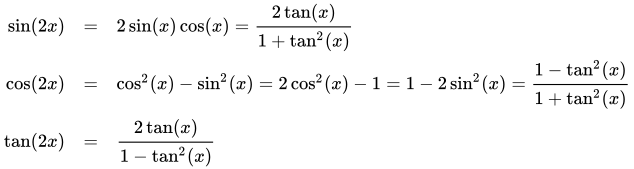
{\displaystyle {\begin{array}{rcl}\sin(2x)&=&2\sin(x)\cos(x)={\cfrac {2\tan(x)}{1+\tan ^{2}(x)}}\\\cos(2x)&=&\cos ^{2}(x)-\sin ^{2}(x)=2\cos ^{2}(x)-1=1-2\sin ^{2}(x)={\cfrac {1-\tan ^{2}(x)}{1+\tan ^{2}(x)}}\\\tan(2x)&=&{\cfrac {2\tan(x)}{1-\tan ^{2}(x)}}\\\end{array}}}
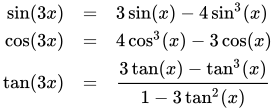
Derdehoekregel
sin
(
3
x
)
=
3
sin
(
x
)
−
4
sin
3
(
x
)
cos
(
3
x
)
=
4
cos
3
(
x
)
−
3
cos
(
x
)
tan
(
3
x
)
=
3
tan
(
x
)
−
tan
3
(
x
)
1
−
3
tan
2
(
x
)
{\displaystyle {\begin{array}{rcl}\sin(3x)&=&3\sin(x)-4\sin ^{3}(x)\\\cos(3x)&=&4\cos ^{3}(x)-3\cos(x)\\\tan(3x)&=&{\cfrac {3\tan(x)-\tan ^{3}(x)}{1-3\tan ^{2}(x)}}\end{array}}}
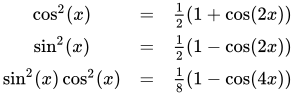
Deze formules worden ook naar Carnot genoemd.
cos
2
(
x
)
=
1
2
(
1
+
cos
(
2
x
)
)
sin
2
(
x
)
=
1
2
(
1
−
cos
(
2
x
)
)
sin
2
(
x
)
cos
2
(
x
)
=
1
8
(
1
−
cos
(
4
x
)
)
{\displaystyle {\begin{array}{ccl}\cos ^{2}(x)&=&{\tfrac {1}{2}}(1+\cos(2x))\\\sin ^{2}(x)&=&{\tfrac {1}{2}}(1-\cos(2x))\\\sin ^{2}(x)\cos ^{2}(x)&=&{\tfrac {1}{8}}(1-\cos(4x))\end{array}}}
Gelijkheden voor de halve hoek
cos
(
1
2
x
)
=
±
1
+
cos
x
2
sin
(
1
2
x
)
=
±
1
−
cos
x
2
tan
(
1
2
x
)
=
sin
(
1
2
x
)
cos
(
1
2
x
)
=
±
1
−
cos
x
1
+
cos
x
tan
(
1
2
x
)
=
sin
x
1
+
cos
x
=
1
−
cos
x
sin
x
=
−
1
±
1
+
tan
2
x
tan
x
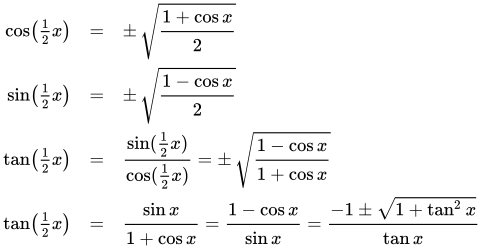
{\displaystyle {\begin{array}{rcl}\cos \left({\tfrac {1}{2}}x\right)&=&\pm \,{\sqrt {\cfrac {1+\cos x}{2}}}\\\sin \left({\tfrac {1}{2}}x\right)&=&\pm \,{\sqrt {\cfrac {1-\cos x}{2}}}\\\tan \left({\tfrac {1}{2}}x\right)&=&{\cfrac {\sin({\tfrac {1}{2}}x)}{\cos({\tfrac {1}{2}}x)}}=\pm \,{\sqrt {\cfrac {1-\cos x}{1+\cos x}}}\\\tan \left({\tfrac {1}{2}}x\right)&=&{\cfrac {\sin x}{1+\cos x}}={\cfrac {1-\cos x}{\sin x}}={\cfrac {-1\pm {\sqrt {1+\tan ^{2}x}}}{\tan x}}\\\end{array}}}
Deze formules zijn naar Thomas Simpson genoemd.
sin
(
x
)
+
sin
(
y
)
=
2
sin
(
x
+
y
2
)
cos
(
x
−
y
2
)
sin
(
x
)
−
sin
(
y
)
=
2
cos
(
x
+
y
2
)
sin
(
x
−
y
2
)
cos
(
x
)
+
cos
(
y
)
=
2
cos
(
x
+
y
2
)
cos
(
x
−
y
2
)
cos
(
x
)
−
cos
(
y
)
=
−
2
sin
(
x
+
y
2
)
sin
(
x
−
y
2
)
{\displaystyle {\begin{array}{ccrrr}\sin(x)+\sin(y)&=&2\sin \left({\cfrac {x+y}{2}}\right)\cos \left({\cfrac {x-y}{2}}\right)\\\sin(x)-\sin(y)&=&2\cos \left({\cfrac {x+y}{2}}\right)\sin \left({\cfrac {x-y}{2}}\right)\\\cos(x)+\cos(y)&=&2\cos \left({\cfrac {x+y}{2}}\right)\cos \left({\cfrac {x-y}{2}}\right)\\\cos(x)-\cos(y)&=&-2\sin \left({\cfrac {x+y}{2}}\right)\sin \left({\cfrac {x-y}{2}}\right)\\\end{array}}}
Deling van de eerste door de tweede formule geeft
sin
(
x
)
+
sin
(
y
)
sin
(
x
)
−
sin
(
y
)
=
tan
(
x
+
y
2
)
tan
(
x
−
y
2
)
{\displaystyle {\dfrac {\sin(x)+\sin(y)}{\sin(x)-\sin(y)}}={\dfrac {\tan \left({\dfrac {x+y}{2}}\right)}{\tan \left({\dfrac {x-y}{2}}\right)}}}
cos
(
x
)
cos
(
y
)
=
cos
(
x
−
y
)
+
cos
(
x
+
y
)
2
sin
(
x
)
sin
(
y
)
=
cos
(
x
−
y
)
−
cos
(
x
+
y
)
2
sin
(
x
)
cos
(
y
)
=
sin
(
x
−
y
)
+
sin
(
x
+
y
)
2
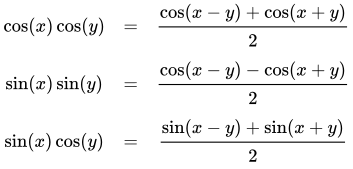
{\displaystyle {\begin{array}{ccc}\cos(x)\cos(y)&=&{\cfrac {\cos(x-y)+\cos(x+y)}{2}}\\\sin(x)\sin(y)&=&{\cfrac {\cos(x-y)-\cos(x+y)}{2}}\\\sin(x)\cos(y)&=&{\cfrac {\sin(x-y)+\sin(x+y)}{2}}\\\end{array}}}
Nog twee merkwaardige gelijkheden
sin
(
x
)
+
sin
(
y
)
+
sin
(
z
)
−
sin
(
x
+
y
+
z
)
=
4
sin
(
y
+
z
2
)
sin
(
z
+
x
2
)
sin
(
x
+
y
2
)
{\displaystyle \sin(x)+\sin(y)+\sin(z)-\sin(x+y+z)=4\sin \left({\dfrac {y+z}{2}}\right)\sin \left({\dfrac {z+x}{2}}\right)\sin \left({\dfrac {x+y}{2}}\right)}
cos
(
x
)
+
cos
(
y
)
+
cos
(
z
)
+
cos
(
x
+
y
+
z
)
=
4
cos
(
y
+
z
2
)
cos
(
z
+
x
2
)
cos
(
x
+
y
2
)
{\displaystyle \cos(x)+\cos(y)+\cos(z)+\cos(x+y+z)=4\cos \left({\dfrac {y+z}{2}}\right)\cos \left({\dfrac {z+x}{2}}\right)\cos \left({\dfrac {x+y}{2}}\right)}