Vector

A vector

A vector is a mathematical object that has a size, called the magnitude, and a direction. It is often represented by boldface letters (such as , , ), or as a line segment from one point to another (as in ).

For example, a vector would be used to show the distance and direction something moved in. When asking for directions, if one says "Walk one kilometer towards the North", that would be a vector, but if they say "Walk one kilometer", without showing a direction, then that would be a scalar.

We usually draw vectors as arrows. The length of the arrow is proportional to the vector's magnitude. The direction in which the arrow points to is the vector's direction.

Examples of vectors

Examples of scalars

More examples of vectors

How to add vectors

Adding vectors on paper using the head to tail method

Head-to-tail Addition

The Head to Tail method of adding vectors is useful for doing an estimate on paper of the result of adding two vectors. To do it:

It's called the "Head to Tail" method, because each head from the previous vector leads in to the tail of the next one.

Using component form

[clarification needed]

Using the component form to add two vectors literally means adding the components of the vectors to create a new vector. For example, let a and b be two two-dimensional vectors. These vectors can be written in terms of their components.

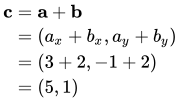
Suppose c is the sum of these two vectors, so that c = a + b. This means that .

Here is an example of addition of two vectors, using their component forms:

This method works for all vectors, not just two dimensional ones.

How to multiply vectors

Using the dot product

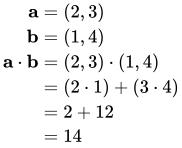
The dot product is one method to multiply vectors. It produces a scalar. It uses component form:

Using the cross product

The cross product is another method to multiply vectors. Unlike dot product, it produces a vector. Using component form:

Here, means the length of , and is the unit vector at right angles to both and .

Multiplying by a scalar

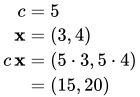
To multiply a vector by a scalar (a normal number), you multiply the number by each component of the vector:

An example of this is

References

  1. ↑ "Comprehensive List of Algebra Symbols". Math Vault. 2020-03-25. Retrieved 2020-08-19.
  2. ↑ Weisstein, Eric W. "Vector". mathworld.wolfram.com. Retrieved 2020-08-19.
  3. 1 2 3 "Vectors". www.mathsisfun.com. Retrieved 2020-08-19.
  4. ↑ "vector | Definition & Facts". Encyclopedia Britannica. Retrieved 2020-08-19.
  5. ↑ "1.1: Vectors". Mathematics LibreTexts. 2013-11-07. Retrieved 2020-08-19.