Kurdistan
Kurdistan | |
|---|---|
 | |
Anthem:
| |
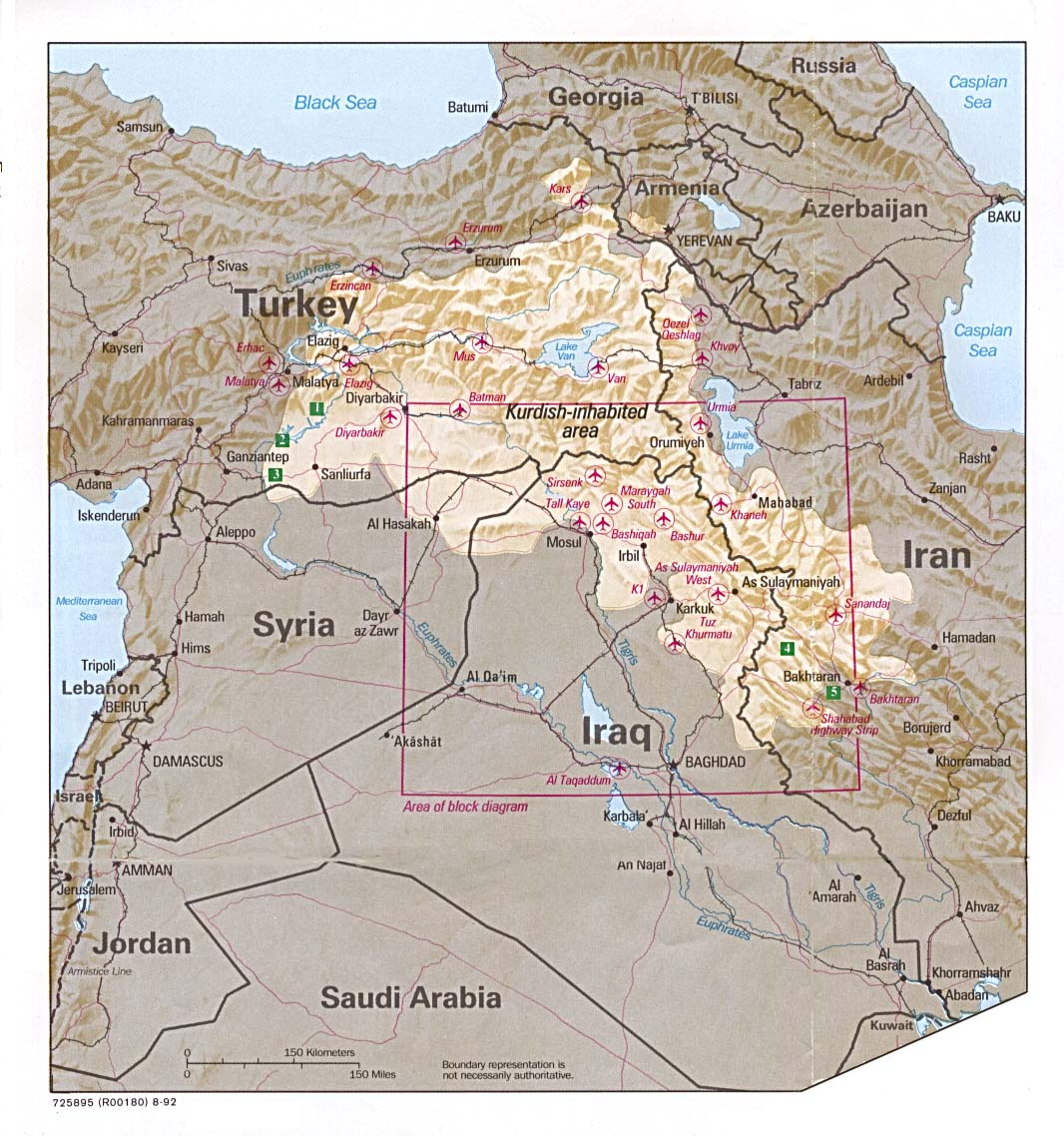
 Kurdish-inhabited areas (according to the CIA, 1992) | |
| Status | Stateless nation |
| Languages |
|
| Demonym(s) | Kurd |
| Today part of |
|
Kurdistan (Kurdish: کوردستان, romanized: Kurdistān, lit. 'Land of the Kurds'; [ˌkʊɾdɪˈstɑːn] (ⓘ)), or Greater Kurdistan, is the region in the Middle East where the Kurds inhabit and the Kurdish culture, languages, and national identity have historically been based.
Geographically, Kurdistan is located between the northwestern Zagros and the eastern Taurus mountain ranges. Kurdistan is home to many religions with the main ones being Islam, Yazidism, Christianity, Alevism, and Yarsanism.
Geography
Kurdistan is made up of four regions: southeastern Turkey (Northern Kurdistan), northern Iraq (Southern Kurdistan), northwestern Iran (Eastern Kurdistan), and northeastern Syria (Western Kurdistan).
Some definitions also include parts of southern Transcaucasia. Some Kurdish nationalist organizations seek to create an independent nation state having some or all of these areas, while others want more autonomy within the existing national borders.
Naming
Historically, the word "Kurdistan" is first written in 11th-century Seljuk records Many Kurdish dynasties, emirates, principalities, and chiefdoms were established from the 8th to 19th centuries.[source?]
The 20th century saw the establishment of the short-lived areas of the Kurdish state (1918–1919), Kingdom of Kurdistan (1921–1924), Kurdistansky Uyezd i.e. "Red Kurdistan" (1923–1929), Republic of Ararat (1927–1930), and Republic of Mahabad (1946). The Corduene was also used to refer to the region.[source?]
Self-rule
Iraqi Kurdistan first gained autonomous status in a 1970 agreement with the Iraqi government, and its status was re-confirmed as the autonomous Kurdistan Region in Iraq in 2005. There is also a Kurdistan Province in Iran, but it has no autonomous control.[source?]
Kurds fighting in the Syrian Civil War were able to take control of large parts of northern Syria and establish self-governing regions in the Autonomous Administration of North and East Syria, namely the Rojava, where they want autonomy in a hypothetical post-war federal Syria.
References
- "Kurdish lands". Retrieved 6 November 2019.
- "The Kurdish lands". Library of Congress. Retrieved 6 November 2019.
- ↑ "Kurdish lands". Retrieved 6 November 2019.
- ↑ "The Kurdish lands". Library of Congress. Retrieved 6 November 2019.
- ↑ "Kurdistan". Encyclopædia Britannica Online. Retrieved 29 July 2010.
- ↑ Turkey demands Google remove Greater Kurdistan map by Rudaw, December 25, 2018
- ↑ Kaya, Zeynep (2020). Mapping Kurdistan: Territory, Self-Determination and Nationalism. Cambridge University Press. pp. 2, 137, 177, 197.
- ↑ Zaken, Mordechai (2007). Jewish Subjects and Their Tribal Chieftains in Kurdistan: A Study in Survival. Leiden, The Netherlands: BRILL. pp. 1–2. ISBN 9789004161900.
Kurdistan was never a sovereign state, though the area with an ethnic and linguistic majority of Kurdish population is defined as Kurdistan.
- 1 2 3 4
- van Bruinessen, Martin (October 4, 1991). Agha, Shaikh and State: The Social and Political Structures of Kurdistan (1 ed.). Bloomsbury Publishing. ISBN 9781856490191. Retrieved December 10, 2024.
- Meho, Lokman I. "The Kurds and Kurdistan: a general background" (PDF). International Journal of Kurdish Studies. 11. Retrieved December 10, 2024.
- Dahlman, Carl (2002). "The Political Geography of Kurdistan". Eurasian Geography and Economics. 43 (4): 271–299. doi:10.2747/1538-7216.43.4.271. Retrieved December 10, 2024.
Published online: 10 May 2013
- M. T. O'Shea, Trapped between the map and reality: geography and perceptions of Kurdistan, 258 pp., Routledge, 2004. (see p. 77)
- Kirmanj, Sherko (2013). "Kurdistan Region: A Country Proile" (PDF). Journal of International Studies. Retrieved December 10, 2024.
- Galip, Özlem Belçim (April 24, 2015). Imagining Kurdistan: Identity, Culture and Society (1 ed.). Bloomsbury Publishing. ISBN 9780857738240. Retrieved December 10, 2024.
- ↑ Bois, Th; Minorsky, V.; MacKenzie, D. N. (2002). "Kurds, Kurdistān". Encyclopaedia of Islam (2 ed.). BRILL. ISBN 9789004161214.
At present, the different provinces of Kurdistān cover around 190,000 km2 in Turkey, 125,000 km2 in Iran, 65,000 km2 in Irāḳ, and 12,000 km2 in Syria. The total area of Kurdistān can then be estimated at approximately 392,000 km2.
{{cite journal}}: CS1 maint: periodical has ISBN (link) - ↑ Bengio, Ofra (2014). Kurdish Awakening: Nation Building in a Fragmented Homeland. University of Texas Press. p. 2.
Hence the terms: rojhalat (east, Iran), bashur (south, Iraq), bakur (north, Turkey), and rojava (west, Syria).
- ↑ Kurdistan (1 ed.). Oxford University Press. 2014. doi:10.1093/acref/9780199546091.001.0001. ISBN 9780199546091.
Extensive mountainous and plateau region in sw Asia, inhabited by the Kurds and including parts of E Turkey, NE Iran, N Iraq, NE Syria, S Armenia and E Azerbaijan.
{{cite book}}:|journal=ignored (help) - ↑ Hamit Bozarslan “The Kurdish Question: Can it be solved within Europe?”, page 84 “The years of silence and of renewal” in Olivier Roy, ed. Turkey Today: A European Country?.
- ↑ Mitchell 2010.
- ↑ Iraqi Constitution, Article 113.
- ↑ "Kurds seek autonomy in democratic Syria". BBC. 16 August 2012.
Other sources
- Bois, Th; Minorsky, V.; MacKenzie, D. N. (2002) [1960]. "Kurds, Kurdistān". Encyclopaedia of Islam (2 ed.). BRILL. ISBN 9789004161214.
At present, the different provinces of Kurdistān cover around 190,000 km2 in Turkey, 125,000 km2 in Iran, 65,000 km2 in Irāḳ, and 12,000 km2 in Syria. The total area of Kurdistān can then be estimated at approximately 392,000 km2.
{{cite journal}}: CS1 maint: periodical has ISBN (link) - Watts, Nicole F. (2010). Activists in Office: Kurdish Politics and Protest in Turkey (Studies in Modernity and National Identity). Seattle: University of Washington Press. p. 167. ISBN 978-0-295-99050-7.
The overwhelming majority of voters supporting pro-Kurdish candidates came from thirteen provinces: Ağri, Bingöl, Bitlis, Diyarbakır, Hakkari, Mardin, Muş, Siirt, Tunceli, Van, Batman, Șırnak, and Igdır. In all these provinces the population is at least 50 percent Kurdish, and in all these provinces support for the parties was at least 20 percent in 2002. [...] In addition, provinces with sizeable Kurdish minorities such as Urfa (where about 47 percent of the population is estimated to be Kurdish) and Kars (about 20 percent Kurdish) also showed higher levels of support for Kurdish candidates and parties than areas in which Kurds constituted a small percentage of the population.
- Courbage, Youssef; Todd, Emmanuel (2011). A Convergence of Civilizations: The Transformation of Muslim Societies Around the World. Columbia University Press. pp. 74. ISBN 978-0-231-15003-3.
Kurds are also a majority of the population in the provinces of Kermanshah, West Azerbaijan, and Ilam.