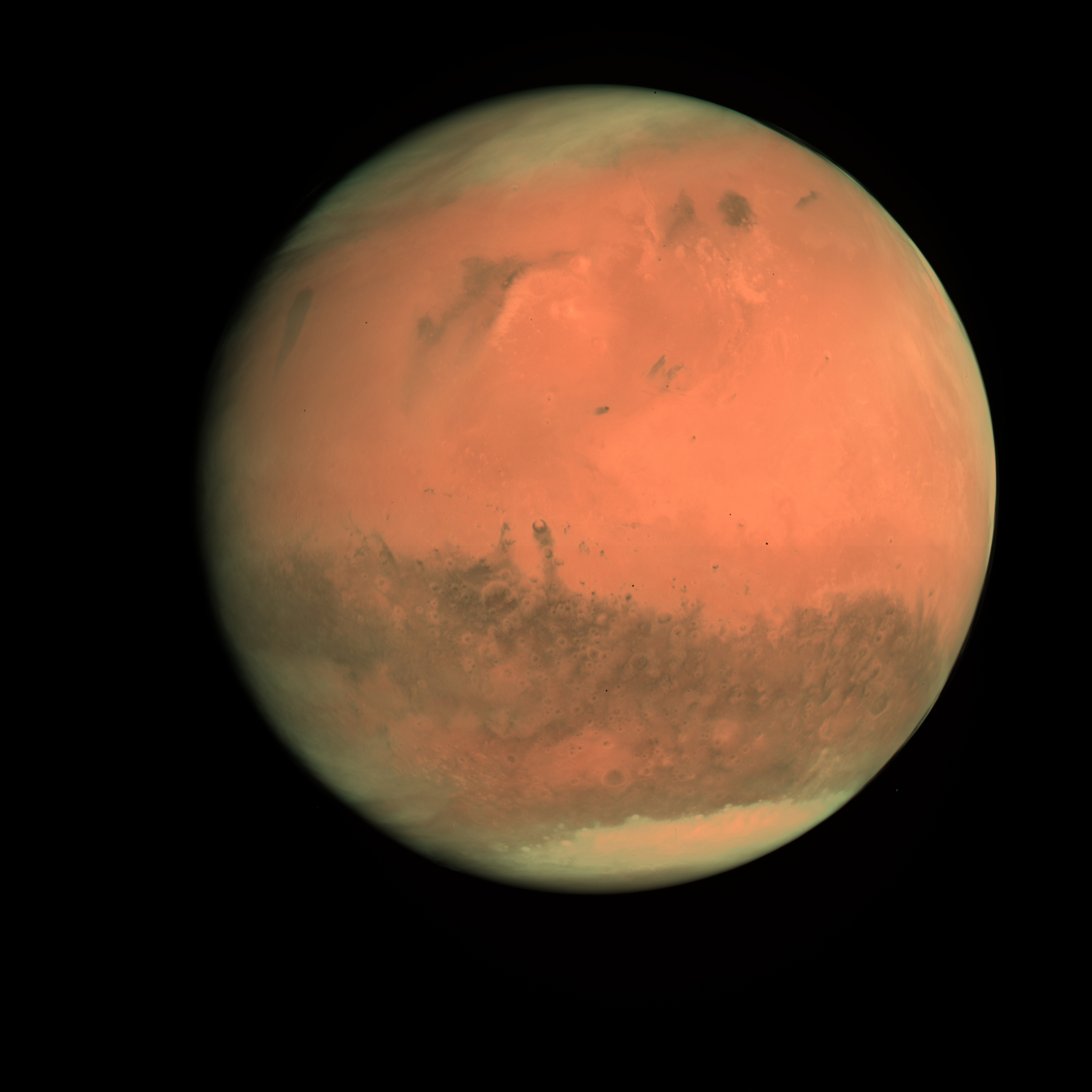
Mars flyby

A Mars flyby is when a spacecraft passes near the planet Mars, but does not enter orbit or land on it. Unmanned (no humans on board) space probes have used this method to collect data on Mars and other worlds. A spacecraft that is built for a flyby is also known as a "flyby bus" or "flyby spacecraft".
List of Mars flybys
- Dawn, closest approach (2009) was 549 km.
- Rosetta within 250 km
- Nozomi
- Mariner program spacecraft
- Mariner 4 (1965, the first successful Mars flyby), Mariner 6, and Mariner 7 returned data from Mars flybys
- Mars program spacecraft
- Two Mars flyby attempts were made in 1960 under Mars 1M (Mars 1960A and Mars 1960B).
- The third attempt at a Mars flyby was the Soviet Mars 2MV-4 No.1, also called Mars 1962A or Sputnik 22, which launched in 1962 as part of the Mars program. but it was destroyed in low Earth orbit due to rocket failure.
- Mars 1 also launched in 1962 but communications failed before it reached Mars.
- Mars 4 achieved a flyby in 1974 and detected a night-side ionosphere, although by that time Mars was already orbited by other spacecraft.
- Mars 6 and 7 were Mars landers carried by flyby buses.
References
- ↑ Page 15-16 in Chapter 3 of David S. F. Portree's Humans to Mars: Fifty Years of Mission Planning, 1950 - 2000, NASA Monographs in Aerospace History Series, Number 21, February 2001. Available as NASA SP-2001-4521.
- 1 2 Space probe performs Mars fly-by - BBC
- ↑ Joseph A. Angelo - Encyclopedia Of Space And Astronomy (2006) - Page 171
- ↑ Rayman, Marc D. "Dawn Journal: Aiming away from a bull's eye at Mars". The Planetary Society. Archived from the original on 2011-07-16. Retrieved 2010-03-21.
- ↑ Malik, Tariq (February 18, 2009). "Asteroid-Bound Probe Zooms Past Mars". Space.com. Retrieved 2010-03-21.
- ↑ ESA - Rosetta successfully swings-by Mars,
- ↑ "NSSDC - Nozomi". Archived from the original on 2010-11-14. Retrieved 2012-08-09.
- ↑ McDowell, Jonathan. "Launch Log". Jonathan's Space Page. Retrieved 29 July 2010.
- ↑ Zak, Anatoly. "Russia's unmanned missions to Mars". RussianSpaecWeb. Retrieved 29 July 2010.
- ↑ Wade, Mark. "Mars". Encyclopedia Astronautica. Retrieved 29 July 2010.
- 1 2 The Soviet Mars program Archived 2013-10-13 at the Wayback Machine, Professor Chris Mihos, Case Western Reserve University
- ↑ "NASA - Mars 6". Archived from the original on 2017-02-27. Retrieved 2012-08-09.