Gerry Conway
| Gerry Conway | |
|---|---|
 Conway 2019'da Phoenix Çizgi Roman Fuarı'nda | |
| Doğum | Gerard Francis Conway 10 Eylül 1952 Brooklyn, New York, ABD |
| Ölüm | 27 Nisan 2026 (73 yaşında) New York Şehri, New York, ABD |
| Milliyet | Amerikalı |
| Çalışma alan(lar)ı | Çizgi roman sanatçısı ve yazar |
| Önemli çalışmaları | Punisher İnanılmaz Örümcek Adam Justice League of America Firestorm Batman Marvel Super-Heroes Jason Todd Power Girl Bayan Marvel Killer Croc Süperman Law & Order Gwen Stacy'nin Ölümü |
| Ödülleri |
|
| Eşi |
|
Gerard Francis Conway (d. 10 Eylül 1952 –ö. 27 Nisan 2026), Amerikalı çizgi roman sanatçısı ve yazar.
Hayatı
Conway, 10 Eykül 1952'de Brooklyn, New York'da doğdu. New York Üniversitesi'nde öğrenim gördü. Özellikle Marvel ve DC Comics için hazılardığı hikayelerle tanınan sanatçı Marvel evreninin en ünlü anti-kahramanlarından birisi olan Frank Castle'ın ("Punisher") yaratıcısıdır. Aynı zamanda; İnanılmaz Örümcek Adam, Justice League of America, Firestorm, Batman, Marvel Super-Heroes, Jason Todd, Power Girl, Bayan Marvel, Killer Croc, Süperman, Law & Order ve Gwen Stacy'nin Ölümü gibi projelerde çalıştı. Çalışmalarıyla Inkpot Ödülü'nü (2013) alırken adı ise Eisner Şöhretler Holü'ne (2026) dahil edildi.
Üç evliliğinden iki çocuğu bulunan Conway, 27 Nisan 2026'da memleketi New York Şehri, New York'ta doğal nedenlerden 73 yaşında öldü.
Kaynakça
- ↑ "Inkpot Award". 29 Ocak 2017 tarihinde kaynağından arşivlendi. Erişim tarihi: 29 Nisan 2026.
- ↑ "isfdb.org; Retrieved August 19, 2024". 31 Ocak 2025 tarihinde kaynağından arşivlendi. Erişim tarihi: 29 Nisan 2026.
- ↑ Manning, Matthew K. (2014). "1980s". Dougall, Alastair (Ed.). Batman: A Visual History. London, United Kingdom: Dorling Kindersley. s. 138. ISBN 978-1465424563.
Gerry Conway and artist Don Newton had become the regular team on Detective Comics at the tail end of 1980. By the middle of [1981], Conway had also taken over the writing in Batman. With the same writer handling both main Batman books, easy crossovers between the two titles soon became possible.
- ↑ Shaw, Scott "Captain Carrot and His Amazing Zoo Crew! Vol. 1, #1" 21 Ocak 2012 tarihinde Wayback Machine sitesinde arşivlendi., OddBallComics.com #1180, October 8, 2007
- ↑ Greenberger, Robert (August 2017). "It Sounded Like a Good Idea at the Time: A Look at the DC Challenge!". Back Issue!, 98. Raleigh, North Carolina: TwoMorrows Publishing. ss. 41-43.
- ↑ Thomas, Roy. "Roy's Rostrum" ("Bullpen Bulletins") in Marvel Super-Heroes #43 and other Marvel Comics cover-dated May 1974.
- ↑ "Gerard Conway". FOOM (1). Bahar 1973. s. 4. July 8, 2019 tarihinde kaynağından arşivlendi – Best, Daniel, ed., 20th Century Danny Boy vasıtasıyla.
- ↑ "Global Comics Database: Fantastic Four (Marvel, 1961 series) #50". 30 Mayıs 2024 tarihinde kaynağından arşivlendi. Erişim tarihi: 29 Nisan 2026.
- ↑ Conway, Gerry. "Since You Asked, and Even If You Didn't". (biographical capsule) Gerry Conway. April 23, 2011 tarihinde kaynağından arşivlendi.
- ↑ Grand Comics Database'de Gerry Conway and Grand Comics Database'de Gerry Conway
- ↑ Harvey, Allan (February 2008). "Black Widow: The Gloria Steinem of the Jump-Suit Set". Back Issue!, 26. Raleigh, North Carolina: TwoMorrows Publishing. s. 4.
- ↑ Sanderson, Peter (2008). "1970s". Gilbert, Laura (Ed.). Marvel Chronicle A Year by Year History. London, United Kingdom: Dorling Kindersley. s. 149. ISBN 978-0756641238.
[Savage Tales #1 was] notable for the debut of Marvel's mindless swamp monster, the Man-Thing, in an origin story written by Gerry Conway and illustrated by Gray Morrow.
- ↑ Sanderson "1970s" in Gilbert (2008), p. 154: "Roy Thomas came up with the idea for a series called 'I, Werewolf', narrated in the first person by a teenager who transformed into a werewolf. Stan Lee liked the concept but decided to name it 'Werewolf by Night'. The initial creative team on the series was scripter Gerry Conway and artist Mike Ploog."
- ↑ Sanderson "1970s" in Gilbert (2008), p. 155: "Following the revision of the Comics Code, Stan Lee was eager to do a comics series about the archetypal vampire, novelist Bram Stoker's Dracula. Based on a few ideas from Lee, Roy Thomas plotted the first issue of The Tomb of Dracula, which Gerry Conway then scripted. The interior art was penciled by Gene Colan."
- ↑ Manning, Matthew K. (2012). "1970s". Gilbert, Laura (Ed.). Spider-Man Chronicle Celebrating 50 Years of Web-Slinging. London, United Kingdom: Dorling Kindersley. s. 62. ISBN 978-0756692360.
[The Amazing Spider-Man #111] marked the dawning of a new era: writer Gerry Conway came on board as Stan Lee's replacement. Alongside artist John Romita, Conway started his run by picking up where Lee left off.
- ↑ Sanderson "1970s" in Gilbert (2008), p. 159: "In June [1973], Marvel embarked on a story that would have far-reaching effects. The Amazing Spider-Man artist John Romita, Sr. suggested killing off Spider-Man's beloved Gwen Stacy in order to shake up the book's status quo."
- ↑ Manning "1970s" in Gilbert (2012), p. 68: "This story by writer Gerry Conway and penciler Gil Kane would go down in history as one of the most memorable events of Spider-Man's life."
- ↑ David, Peter; Greenberger, Robert (2010). The Spider-Man Vault: A Museum-in-a-Book with Rare Collectibles Spun from Marvel's Web. Philadelphia, Pennsylvania: Running Press. s. 49. ISBN 978-0762437726.
The idea of beloved supporting characters meeting their deaths may be standard operating procedure now but in 1973 it was unprecedented...Gwen's death took villainy and victimhood to an entirely new level.
- ↑ Manning "1970s" in Gilbert (2012), p. 72: "Writer Gerry Conway and artist Ross Andru introduced two major new characters to Spider-Man's world and the Marvel Universe in this self-contained issue. Not only would the vigilante known as the Punisher go on to be one of the most important and iconic Marvel creations of the 1970s, but his instigator, the Jackal, would become the next big threat in Spider-Man's life."
- ↑ "Exclusive Gerry Conway Interview". fantasticfourheadquarters.co.uk. 2009. 18 Şubat 2017 tarihinde kaynağından arşivlendi. Erişim tarihi: 17 Ağustos 2016.
- ↑ Larnick, Eric (October 30, 2010). "The Rutland Halloween Parade: Where Marvel and DC First Collided". ComicsAlliance.com. January 11, 2012 tarihinde kaynağından arşivlendi. Erişim tarihi: 5 Aralık 2011.
- ↑ Cronin, Brian (October 1, 2010). "Comic Book Legends Revealed #280". ComicBookResources.com. January 16, 2012 tarihinde kaynağından arşivlendi. Erişim tarihi: 5 Aralık 2011.
- ↑ Amazing Adventures #16 (Jan. 1973) 13 Ocak 2016 tarihinde Wayback Machine sitesinde arşivlendi., Justice League of America #103 (Dec. 1972) 28 Eylül 2011 tarihinde Wayback Machine sitesinde arşivlendi., and Thor #207 (Jan. 1973) 31 Temmuz 2011 tarihinde Wayback Machine sitesinde arşivlendi. at the Grand Comics Database
- ↑ Thomas, Roy (April 2002). "All The Stars There Are in (Super-hero) Heaven!". Alter Ego. 3 (14). Raleigh, North Carolina: TwoMorrows Publishing. 15 Temmuz 2007 tarihinde kaynağından arşivlendi23 Haziran 2013.
- ↑ McAvennie, Michael; Dolan, Hannah, (Ed.) (2010). "1970s". DC Comics Year By Year A Visual Chronicle. Londra: Dorling Kindersley. s. 169. ISBN 978-0-7566-6742-9.
Along with artist Ric Estrada, [Gerry] Conway also introduced the DC Universe to the cousin of Earth-2's Superman, Kara Zor-L a.k.a. Power Girl.
- ↑ Levitz, Paul (2010). "The Bronze Age 1970–1984". 75 Years of DC Comics The Art of Modern Mythmaking. Cologne, Germany: Taschen America. s. 527. ISBN 9783836519816.
The revived All-Star introduced Power Girl, conceived as Supergirl's Earth-Two counterpart. With Wallace Wood and his renowned skill at 'cheesecake' determining the finished art, her breathtaking buxomness and 'peek-a-boo' décolletage were perhaps inevitable.
- ↑ McAvennie "1970s" in Dolan, p. 170 "The tale was written by Gerry Conway and drawn by Ross Andru, both among the few [at that time] to ever have worked on both Superman and Spider-Man...The result was a defining moment in Bronze Age comics."
- ↑ Abramowitz, Jack (April 2014). "1st Issue Special: It Was No Showcase (But It Was Never Meant To Be)". Back Issue!, 71. Raleigh, North Carolina: TwoMorrows Publishing. s. 45.
- ↑ Daniels, Les (1991). Marvel: Five Fabulous Decades of the World's Greatest Comics. New York, New York: Harry N. Abrams. s. 176. ISBN 0-8109-3821-9.
- ↑ "Gerry Conway on Englehart Leaving Marvel" (sidebar) in Riley, Shannon E. (September 2010). "The Man Who Saved the Justice League of America". Back Issue!, 45. Raleigh, North Carolina: TwoMorrows Publishing. s. 15.
- ↑ Schweier, Philip (August 2012). "Justice League, Then and Now with Gerry Conway and Dan Jurgens". Back Issue!, 58. Raleigh, North Carolina: TwoMorrows Publishing. ss. 65-70.
- ↑ Sanderson, Peter (September–October 1981). "Justice League #200 All-Star Affair". Comics Feature, 12/13. New Media Publishing. s. 17.
- ↑ Mangels, Andy (December 2012). "Kryptonian and Amazonian Not Living in Perfect Harmony". Back Issue!, 61. Raleigh, North Carolina: TwoMorrows Publishing. ss. 50-54.
- ↑ Hamerlinck, P.C. (December 2012). "When Worlds Collide The Colossal-Sized Confrontation Between Superman and Captain Marvel". Back Issue!, 61. Raleigh, North Carolina: TwoMorrows Publishing. ss. 65-68.
- ↑ McAvennie "1970s" in Dolan, p. 177 "Thanks to scripter Gerry Conway and artist Don Heck, the red, white, and blue shone like never before – on the steel-alloyed suit of the World War II cyborg, Steel."
- ↑ Wells, John (24 Ekim 1997). "'Lost' DC: The DC Implosion". Comics Buyer's Guide (1249). s. 133.
The Deserter...was given his own ongoing title at the 11th hour, only to perish amidst the other cancellations. The origin of tormented Civil War deserter Aaron Hope (by Gerry Conway, Dick Ayers, and Romeo Tanghal) appeared only in Cancelled Comic Cavalcade #1.
- ↑ Johnson, Dan (April 2014). "Showcase Presents Again". Back Issue!, 71. Raleigh, North Carolina: TwoMorrows Publishing. ss. 54-55.
Gerry Conway's the Deserter, a Western adventure that would have featured interior art by Dick Ayers and Romeo Tanghal and a cover by Joe Kubert, was originally going to be a three-issue run in Showcase #107–109. Even before Showcase's cancellation, it was greenlit as an ongoing series until the DC Implosion killed it altogether.
- ↑ Wells p. 134: "After being touted in house ads during the summer, details regarding The Vixen #1 appeared in a 'Daily Planet' text page in Batman #305 and The Flash #267. Ultimately, 'Who Is The Vixen?' was printed only in Cancelled Comic Cavalcade #2."
- ↑ Manning, Matthew K. "1980s" in Dolan, p. 209 "The prestigious Justice League of America got a bit easier to join, thanks to writer Gerry Conway and artist Chuck Patton. Marking the debut of camouflaging hero Gypsy, the shockwave-casting Vibe, and the second generation hero Steel, this landmark comic saw many of the more famous League members step down in order to make way for a younger roster to carry on their legacy."
- ↑ MacDonald, Heidi (23 Ocak 2026). "Eisner Awards Hall of Fame inducts 18 Judges Choice creators". Comics Beat. 31 Ocak 2026 tarihinde kaynağından arşivlendi. Erişim tarihi: 29 Nisan 2026.
- ↑ Sources disagree on the spelling, sometimes even within the same source: The cover of the single issue itself appears to spell it "NightGlider". The cover of Victory #1 likewise spells it as one word, though in an all-caps typeface. The Grand Comics Database entry 16 Ocak 2009 tarihinde Wayback Machine sitesinde arşivlendi. spells it as both "Nightglider" and "Night Glider".
- ↑ Rogers, Vaneta (March 13, 2009). "The End? Gerry Conway on The Last Days of Animal Man". Newsarama. June 4, 2011 tarihinde kaynağından arşivlendi.
- ↑ Campbell, Josie (April 1, 2011). "WC11: Exclusive – Legendary Creators Speak About Retro-Active". Comic Book Resources. 14 Mayıs 2011 tarihinde kaynağından arşivlendi. Erişim tarihi: March 31, 2012.
- ↑ Renaud, Jeffrey (17 Mart 2016). "Conway Explains How "Legends of Tomorrow" Reignited His Passion for Firestorm". Comic Book Resources. 21 Mayıs 2017 tarihinde kaynağından arşivlendi. Erişim tarihi: 17 Mart 2016.
- ↑ Handley, Rich (2010). "Star Trek Los Angeles Times Syndicate newspaper comic strip". Star Trek Communicator #121 via Star Trek Comics Checklist. June 19, 2010 tarihinde kaynağından arşivlendi.
- ↑ Radulovic, Petrana (11 Haziran 2019). "The abandoned X-Men movie of the 1980s isn't missed by anyone involved". Polygon. 11 Haziran 2019 tarihinde kaynağından arşivlendi. Erişim tarihi: 14 Haziran 2019.
- ↑ Kendall, G. (11 Ağustos 2019). "When Batman: The Animated Series Toured Crime Alley". Comic Book Resources. 12 Ağustos 2019 tarihinde kaynağından arşivlendi. Erişim tarihi: 11 Ağustos 2019.
- ↑ "Gerry Conway Biography (1952-)". FilmReference.com. 2 Aralık 2016 tarihinde kaynağından arşivlendi. Erişim tarihi: 10 Aralık 2016.
- ↑ Conway, Gerry (17 Eylül 2006). "Immigration, Part One". Conwayscorner.blogspot.com. July 8, 2011 tarihinde kaynağından arşivlendi. Erişim tarihi: October 10, 2009.
- ↑ Buttery, Jarrod (February 2014). "Hulk Smash!: The Incredible Hulk in the 1970s". Back Issue!, 70. Raleigh, North Carolina: TwoMorrows Publishing. s. 9.
- ↑ Dominguez, Noah (31 Ağustos 2023). "Punisher Co-Creator Gerry Conway Reveals Triumph Over Cancer Diagnosis". Superhero Hype. 31 Ağustos 2023 tarihinde kaynağından arşivlendi. Erişim tarihi: 1 Eylül 2023.
- ↑ Johnston, Rich (1 Eylül 2023). "The Punisher's Gerry Conway On His Cancer, Induced Coma And Surgery". Bleeding Cool. 2 Eylül 2023 tarihinde kaynağından arşivlendi. Erişim tarihi: 1 Eylül 2023.
- ↑ Loving, Casey (27 Nisan 2026). "Gerry Conway, Comic Creator of The Punisher and Ms. Marvel, Dies at 73" (İngilizce). TheWrap. 27 Nisan 2026 tarihinde kaynağından arşivlendi. Erişim tarihi: 27 Nisan 2026.
- ↑ "Remembering Gerry Conway, 1952–2026" (İngilizce). Marvel Comics. 27 Nisan 2026. 27 Nisan 2026 tarihinde kaynağından arşivlendi. Erişim tarihi: 27 Nisan 2026.
Dış bağlantılar

- A Conversation with Gerry Conway (Comic Geek Speak: Episode 701, Podcast)
- Comic Book DB'te Gerry Conway
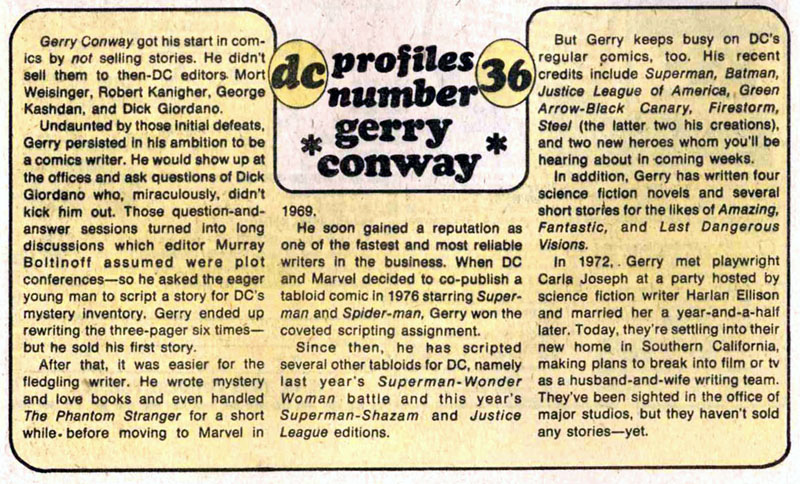
- "DC Profiles #36: Gerry Conway" at the Grand Comics Database
- Bibliography on the Internet Speculative Fiction Database
- IMDb'de Gerry Conway
- Gerry Conway interview at Fantastic Four Headquarters
- Gerry Conway 29 Aralık 2018 tarihinde Wayback Machine sitesinde arşivlendi. at Mike's Amazing World of Comics
- Gerry Conway at the Unofficial Handbook of Marvel Comics Creators
- Women in Refrigerators: "Gerry Conway Responds"
- The New York Times- Movies: Gerry Conway


 | Sanatçı ile ilgili bu madde taslak seviyesindedir. Madde içeriğini genişleterek Vikipedi'ye katkı sağlayabilirsiniz. |
  | Bir Amerikalının biyografisi ile ilgili bu madde taslak seviyesindedir. Madde içeriğini genişleterek Vikipedi'ye katkı sağlayabilirsiniz. |