The Aero Commander 500 family (also known as the Twin Commander) is a series of light twin piston-engined and turboprop aircraft designed and originally produced by the Aero Design and Engineering Company in the late 1940s, renamed the Aero Commander company in 1950, and later a division of Rockwell International in 1965. Final production occurred in 1986 under the Gulfstream Aerospace name.
The initial production version, which was first delivered in 1951, was the 200mph (320km/h; 170kn), seven-seat Aero Commander 520. Numerous early aircraft were sold to military operators, including the United States Air Force and the United States Army. One was used as the presidential transport aircraft, Air Force One, for Dwight D. Eisenhower between 1956 and 1960. The Belgian Air Force also flew one as the personal transport of Baudouin of Belgium between 1961 and 1973. The Aero Commander was also operated by various types of civil operators, including as a business aircraft and cargo aircraft. During its later service life, the Federal Aviation Administration (FAA) looked into the aircraft's main wing spar, which was believed to be susceptible to stress fatigue and subsequent cracking, thus allegedly resulting in several fatal crashes.
Further development of the Aero Commander proceeded throughout the type's production life of almost 40 years. In 1967, an improved version of that aircraft, the 500S Shrike Commander, was launched. Several of the larger variants have been given their own model names and designations, ranging up to the 330mph (530km/h; 290kn), 11-seat Model 695B/Jetprop 1000B turboprop.
Design and development
The first model, the five-seat 520, was certified in January 1952 with two 260 HP Lycoming GO-435s
The concept for the Commander light business twin was conceived by Ted Smith, a project engineer at the Douglas Aircraft Company. Working part-time after hours throughout 1944, a group of engineers that worked on the Douglas A-20 Havoc came together to form the Aero Design and Engineering Company with the goal of designing and producing this envisioned aircraft, which would have a layout similar to their A-20 bomber. Originally, the new company was going to build three pre-production aircraft, but as the first aircraft was being built, they decided to build just one prototype. The final configuration was completed in July 1946 and was designated the Model L3805.
RegisteredNX1946, the prototype first flew on 23 April 1948. The L3805 accommodated up to five people and was powered by a pair of Lycoming O-435-A piston engines. It was an all-metal high-wing monoplane with retractable undercarriage and used several components sourced from a Vultee BT-13 Valiant. The market segment planned for this aircraft included small feeder airliners, aided by its range of 1,000 miles; however, in practice, the majority of customer demand came from the private business aircraft sector as well as military operators. Walter Beech test flew the aircraft in 1949 and expressed interest in buying the project, but ultimately chose to pass on the aircraft to instead develop the Beechcraft Twin Bonanza. Fairchild Aircraft also evaluated the prototype at its headquarters in Hagerstown, Maryland.
The prototype successfully validated the aircraft's design. The company secured a lease on a new 26,000 square feet (2,400m2) factory at Bethany near Oklahoma City to build a production version, which was certified on 30 June 1950. Nearly 10,000 hours of redesign work took place to produce the initial production aircraft, which was equipped with more powerful Lycoming GO-435-C2 engines, which had a combined rating of 520 horsepower (390kW). The first of these production aircraft, which was named the Commander 520, was rolled out of the Bethany factory in August 1951. Serial number 1 was briefly used as a demonstrator before being sold in October 1952 to the Asahi Shimbun Press Company of Tokyo.[citation needed]
In terms of its general configuration, the Aero Commander 500 is an all-metal twin-engined light transport aircraft, fitted with a high-mounted cantilever wing and furnished with retractable landing gear. The aircraft is primarily composed of aluminium and uses semi-monocoque construction. Later-built models, such as the Shrike Commander 500S, were outfitted with an avionics suit to facilitate all-weather flight, and could be optionally equipped with deicing boots for use in cold climates. The Shrike Commander model could accommodate a seven-seat cabin configuration if a rear bench seat was fitted. Numerous amenities could also be fitted in the cabin, including curtains, a fold-away desk, and storage cabinets. On later models, the fuselage was stretched, the gross weight increased, and more powerful engines were fitted.
While not a typical use of the type, the aircraft's favourable handling capabilities at both high and low speeds, even when flow with a single working engine, led to it being occasionally performing aerobatic manoeuvress. While such display aircraft did not typically require without major modifications, they were sometimes fitted with propeller unfeathering systems as well as smoke generators. As all of the fuel tanks are interconnected, there was no need for pilots to perform either tank selection or cross-feeding. The landing gear had been designed for use on aircraft twice the size of the Aero Commander, making it relatively sturdy and well-suited to use from unprepared airstrips.
In US military service, it was initially designated the L-26, though in 1962 this was changed to U-4 for the United States Air Force and U-9 for the United States Army.
Under ownership of Rockwell in the 1960s, World War II pilot R. A. "Bob" Hoover demonstrated the Shrike Commander 500S for decades in a variety of "managed energy" routines, including single-engine and engine-out aerobatics. His Shrike Commander is displayed in the colors of his last sponsor, Evergreen International Aviation, at the Steven F. Udvar-Hazy Center of the SmithsonianNational Air and Space Museum. Bob Odegaard continued the tradition in 2012, flying a 1975 Shrike 500S in a Bob Hoover tribute routine.
One U-4B was operated as Air Force One, the presidential transport aircraft, for Dwight D. Eisenhower between 1956 and 1960. Often personally flown by Eisenhower, it was the first presidential aircraft to be powered by only two engines as well as the first to wear the now-familiar blue-and-white livery. Also used to transport other senior politicians, such as the Secretary of Defense and the Secretary of the Air Force, it was later transferred to the USAF Academy’s skydiving team. This aircraft is now owned by the Commemorative Air Force.
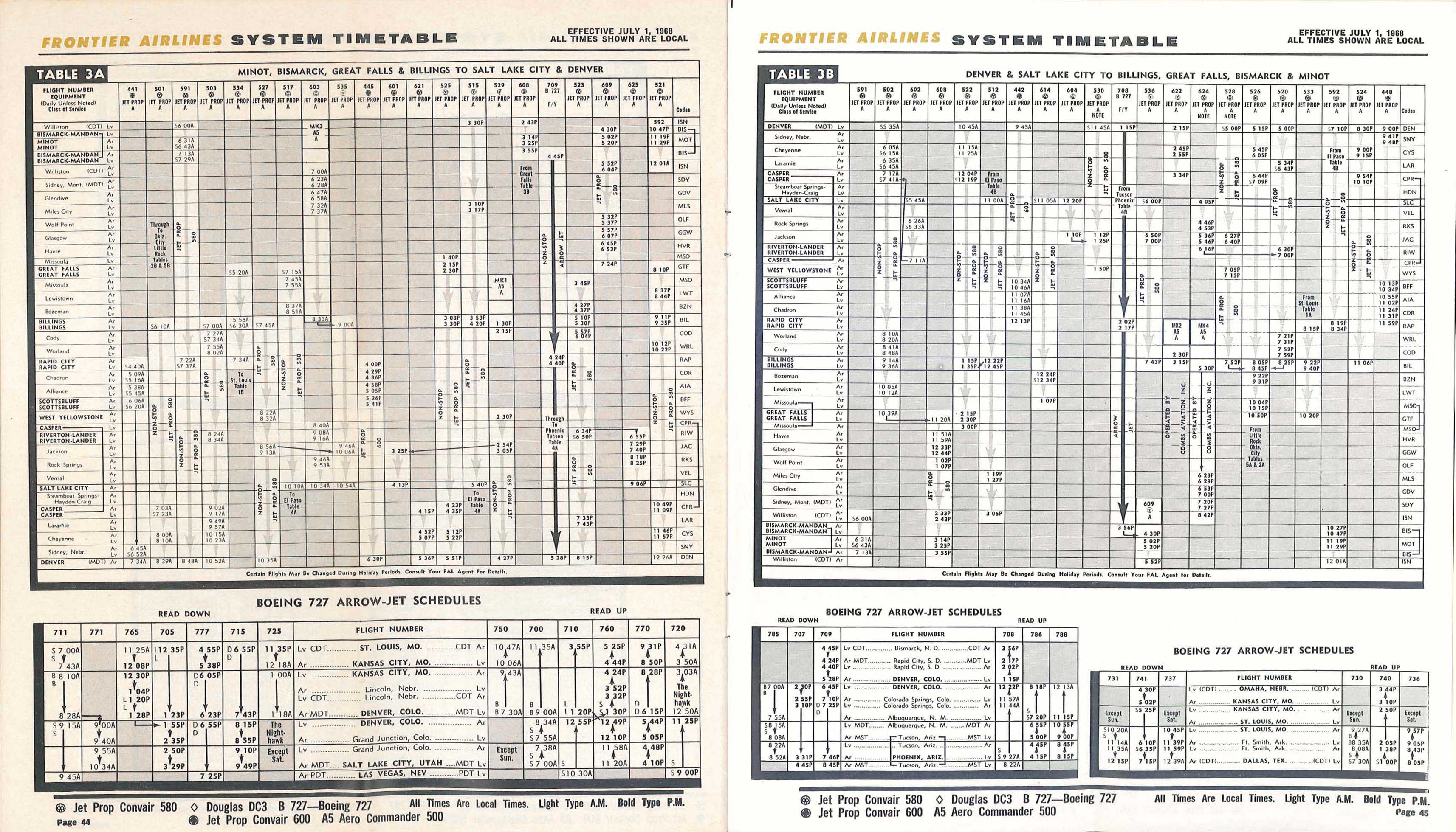
According to the July 1, 1968, Frontier Airlines system timetable, series 500 aircraft were being operated on scheduled passenger flights by Combs Aviation on behalf of Frontier via a contract agreement with service to several smaller communities in Montana and Wyoming at this time.
The unpressurized, long-fuselage 680FL was operated as a small package freighter by Combs Freightair in the 1970s and 1980s, and by Suburban Air Freight in the 1980s and 1990s. The aircraft was popular with pilots, because it was extremely "pilot friendly" and with its 380hp (280kW) supercharged engines did well in icing meteorological conditions. A number are still operated on contracts for cargo and fire control applications, as their piston engines offer good fuel specifics at low altitudes and longer loiter times. Suburban retired their last 680FLs in the first half of 2024.
Wing spar fatigue
In June 1991, senior company engineers met with Federal Aviation Administration (FAA) officials to discuss concerns over the Aero Commander's main wing spar, which was believed to be susceptible to stress fatigue and subsequent cracking, and was believed to have resulted in a number of fatal crashes. From approximately 1961 to 1993, 24 aircraft crashed when spar failures caused the loss of the wing in flight. 35 more spars were found cracked during inspections.
Single-engine safety
In 1950, when the developers were working to satisfy Civil Aeronautics Authority (CAA) regulations for certification of the 500, they chose a novel method of demonstrating its single-engine safety and performance: they removed one of the two-bladed propellers, secured it in the aft cabin, and flew from Bethany to Washington, D.C., on one engine. There they met with CAA personnel, then replaced the propeller and returned to Oklahoma in the conventional manner. The flight received nationwide coverage in the press.
In 1979, the National Transportation Safety Board reviewed light-twin engine-failure accidents, involving the 24 most popular model-groups of light twins between 1972 and 1976. They found that the piston-engined twin-Commanders had averaged slightly over 3.4 engine-failure accidents per hundred-thousand hours, the second worst number of all aircraft under review. The most engine failures were suffered by the small-engine versions of the Piper Apache, at 6.9 failures per hundred thousand hours; the third-worst, the Beechcraft Travel Air, averaged 2.9 failures; the average for all models was only 1.6.
Countering the statistical evidence, Rockwell demonstration pilot Bob Hoover's airshow stunt routine, with the Shrike Commander, included a full aerobatic routine performed first with both engines, then with one engine out (and the critical engine, at that), then both engines out, and gliding. Then in his final airshow performance, in a demonstration of conservation of momentum, he landed. The Shrike Commander dead stick (engines off), coasted the airplane down the runway then from the runway and taxied to the audience.
The turboprop twin-Commanders—with much more powerful engines (and most with longer bodies, allowing greater rudder leverage, critical for single-engine control) – came out on the opposite end of the rankings, with one of the lowest rates of engine-failure accidents of all "light" twins examined, at only 0.4 per hundred-thousand hours.
Variants
Certified from 1954, the seven-seat 560 is powered by two 270–295hp (201–220kW)Lycoming GO-480s.
From 1955, the 680 has Supercharged 340–380hp (250–280kW)Lycoming GSO-480s.
520 with more power, increased weight, swept tail, plus revised wing, landing gear, fuselage, and primary control system
560A
1955-07-01
6A1
2× GO-480-D/C/G
2× 275
6000
7
156
560 with longer fuselage, revised engine installation, wing, landing gear, fuel and oil systems
560E
1957-02-21
6A1
2× GO-480-C/G
2× 295
6500
7
223
93
560A with Larger wings and greater payload, revised engine installation, wing, wheel and brake installation, fuel system with outboard tanks, and landing gear location
On 19 June 1964 Senator Ted Kennedy was a passenger in an Aero Commander 680 airplane flying in bad weather from Washington, D.C., to Massachusetts. It crashed into an apple orchard in the western Massachusetts town of Southampton on the final approach to the Barnes Municipal Airport near Westfield. The pilot and Edward Moss, one of Kennedy's aides, were killed. Kennedy suffered a severe back injury, a punctured lung, broken ribs and internal bleeding.
World War II hero and actor Audie Murphy died in an Aero Commander 680 crash while flying as a passenger on 28 May 1971. The aircraft was flying in bad weather at night and was on approach to Roanoke, Virginia when it flew into the side of Brush Mountain outside Blacksburg, Virginia, West of Roanoke. Four others and the pilot were also killed.
On the evening of May 19, 1973, kidney transplant pioneer, Dr. David M. Hume was killed after he lost control of his Aero Commander 560-F twin. He departed with a special (night) VFR clearance into marginal and rapidly deteriorating visual weather conditions. A low cloud ceiling and emerging fog were among conditions deemed to have caused his spatial disorientation about four minutes into his climb out of Van Nuys Airport. Hume lost control of his plane ending in a fatal crash a few miles north of the airport in the Granada Hills district of Greater Los Angeles.
On Sunday 2 October 1994, an Aero Commander 690 operated by Seaview Air as Flight CD111 departed from Williamtown, New South Wales, on a flight to Lord Howe Island. Eight passengers, including honeymooners and a family with two children, boarded the single-pilot aircraft. 30 minutes after departure a distress call was made by the pilot with no future communications made. Only some minor wreckage was ever recovered. During the investigation a number of safety breaches by the operator were discovered including regular operations with overweight aircraft, inaccessible safety equipment & illegal regular public transport operations when the operator was only approved to operate charter flights. The incident was a significant one to occur in Australia and led to a $20 million royal commission which resulted in fundamental changes to the governing aviation body in Australia.
On 24 June 2026, while responding to a wildfire, an Aero Commander 690C (registration C-FNRP, Callsign "Bird Dog 104") operated by Buffalo Airways, crashed 50 km from Fort Simpson, NT, Canada, with all 3 crewmembers killed. The plane was dispatched as a Bird Dog to the wildfire, consisting on aerial supervision and coordinating the air tankers and helicopters in the fire airspace.
Bergqvist, Pia (2 November 2012). "Grand Renaissance Commander". Flying magazine. Archived from the original on 17 May 2021. Retrieved 17 May 2021. A rugged high-performance airplane with more than just a face lift

.jpg)

.jpg)

.jpg)


.jpg)

.jpg)