In mathematics, the Askey scheme is a way of organizing orthogonal polynomials of hypergeometric or basic hypergeometric type into a hierarchy. For the classical orthogonal polynomials discussed in Andrews & Askey (1985), the Askey scheme was first drawn by Labelle (1985) and by AskeyandWilson(1985), and has since been extended by Koekoek & Swarttouw (1998) and Koekoek, Lesky & Swarttouw (2010) to cover basic orthogonal polynomials.
Askey scheme for hypergeometric orthogonal polynomials
Koekoek, Lesky & Swarttouw (2010) give the following version of the Askey scheme:
While there are several approaches to constructing still more general families of orthogonal polynomials, it is usually not possible to extend the Askey scheme by reusing hypergeometric functions of the same form. For instance, one might naively hope to find new examples given by
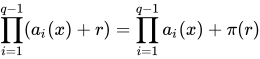
above which corresponds to the Wilson polynomials. This was ruled out in Cheikh, Lamiri & Ouni (2009) under the assumption that the are degree 1 polynomials such that
for some polynomial .
References
↑Andrews, George E.; Askey, Richard (1985), "Classical orthogonal polynomials", in Brezinski, C.; Draux, A.; Magnus, Alphonse P.; Maroni, Pascal; Ronveaux, A. (eds.), Polynômes orthogonaux et applications. Proceedings of the Laguerre symposium held at Bar-le-Duc, October 15–18, 1984., Lecture Notes in Math., vol.1171, Berlin, New York: Springer-Verlag, pp.36–62, doi:10.1007/BFb0076530, ISBN978-3-540-16059-5, MR0838970
↑Labelle, Jacques (1985), "Tableau d'Askey", in Brezinski, C.; Draux, A.; Magnus, Alphonse P.; Maroni, Pascal; Ronveaux, A. (eds.), Polynômes Orthogonaux et Applications. Proceedings of the Laguerre Symposium held at Bar-le-Duc, Lecture Notes in Math., vol.1171, Berlin, New York: Springer-Verlag, pp.xxxvi–xxxvii, doi:10.1007/BFb0076527, ISBN978-3-540-16059-5, MR0838967
↑Cheikh, Y. Ben; Lamiri, I.; Ouni, A. (2009), "On Askey-scheme and d-orthogonality, I: A characterization theorem", Journal of Computational and Applied Mathematics, 233: 621–629