Originally published by DEC in 1973 as 101 BASIC Computer Games, the book was so popular that it had two more printing runs, the last in March 1975. The programs in these books were mostly written in the BASIC dialect found on Digital's minicomputers, although some could not be converted and appeared in different dialects like Dartmouth BASIC.
In 1974, Ahl left DEC. He purchased the rights to the book and republished it under the new name. With the release of the first microcomputers, and Microsoft BASIC soon after, the collection added several new games, removed some, and those that remained from the original were ported to this dialect. By the early 1980s, with tens of millions of home computers in the market, it had become the first computer book to sell a million copies.
History
Around 1971, Ahl ported two popular early mainframe games from DEC's FOCAL language to BASIC: Hamurabi and Lunar Lander. He published the BASIC versions in DEC's educational newsletter, EDU, which he edited. Their popularity was such that he called for more submissions for future editions of the newsletter, and quickly gathered many, with a considerable group of them coming from high school students.
The wide availability of BASIC on various platforms, notably the Data General Nova and HP 2100 series, led to considerable porting effort to and from the DEC platform. In July 1973, Ahl published a selection of these submissions as 101 BASIC Computer Games, which quickly sold out. This led to two further printing runs in April 1974 and March 1975. Ahl later noted that number "was far more books than there were computers around, so people were buying three, four, five of them for each computer."
In 1974, Ahl left DEC to start Creative Computing magazine. The next year saw the launch of the first microcomputers and 101 became quite popular with the owners of these machines. The release of the "1977 Trinity" machines (Apple II, Commodore PET, and TRS-80) was soon followed by a great many new competing microcomputer platforms featuring BASIC, along with the userbase to go with them, and demand for the book led to a second edition in 1978. This version removed non-DEC games, replaced them with some of the many submissions he had over the years, and ported those that remained into MS-BASIC format. By 1979, it had sold over 1 million copies, the first computer book to do so.
Sales remained strong for years, and spawned similar collections in More Basic Computer Games (1979), and Big Computer Games (1984) and Basic Computer Adventures (1984), with translations into six languages.
The first version, 101 went into a second printing and eventually sold 10,000 copies. Ahl later noted that “was far more books than there were computers around, so people were buying three, four, five of them for each computer.”
The second version, BASIC, was re-printed many times and was the first computer book to sell a million copies. Harry McCracken called it "The single most influential book of the BASIC era".
The games are also compilable and playable with the Microsoft Small Basic development environment for children. Computer Science for Kids has released a 2010 Small Basic Edition of the classic Basic Computer Games book called Basic Computer Games: Small Basic Edition.
A project started on GitHub in 2021 to port the games in these books to modern languages.
Program listings from the second ("microcomputer") edition, and from More Basic Computer Games, can be run by the open-source Brassica interpreter in R or Python.
Ahl, David H., ed. (July 1973). 101 BASIC Computer Games. Maynard, Massachusetts: Digital Equipment Corporation. OCLC220506154. Retrieved 21 June 2026.—No general credit for Ahl as editor (or to any individual for anything) in the book itself. (He does appear in the credits for individual games.) This edition does not appear to have any ISBN or LCCN. The link is to a scan of the March 1975 third printing, which has a different cover and an updated copyright notice
The original edition. All programs are written in one of a variety of pre-microcomputer BASICs. All program titles are SIXBIT-compatible.
By 1975 two supplements had been published (both crediting Ahl as author):
Two variant editions have ported the listings to another BASIC dialect:
Ahl, David H., ed. (July 1979). BASIC Computer Games: TRS-80™ Edition. Illustrations by Sandy Dean. Morristown, New Jersey: Creative Computing Press. ISBN0-916688-40-2. Retrieved 23 June 2026.—The ISBN for this book was, incorrectly, reused for 1984's Big Computer Games (see below), and all ISBN databases now seem to associate it with that book only. The copyright page states that the book was published for Radio Shack
Ahl, David H., ed. (2010). BASIC Computer Games (Small Basiced.). Maple Valley, WA: Kidware Software.—Neither full library data nor the book itself seem to be available from the publisher page
Foreign language translations
Ahl, David H., ed. (1982). BASIC-Computer-Spiele. Band 1 (in German). Vol.1. Translated by Black, Wolfgang J. Program conversion by Steve North; illustrations by George Beker. Düsseldorf: Sybex. ISBN3-88745-009-4.
Ahl, David H., ed. (1982). Jeux d’ordinateur en BASIC: version microordinateur (in French). Translated by Besse, Bernard; Boyd, Isabelle; Sumpf, Virginie. Program conversion by Steve North; cover art by Jean-François Pénichoux; interior illustrations by George Beker. Paris; Berkeley; Düsseldorf: Sybex France. ISBN2-902414-46-3. Retrieved 23 June 2026.
Ahl, David H., ed. (1984). Dataspel i BASIC (in Swedish). Translated by Thorell, Jerker. Program conversion by Steve North; illustrations by George Beker. Stockholm: Pagina. ISBN9186200054. OCLC185921593.
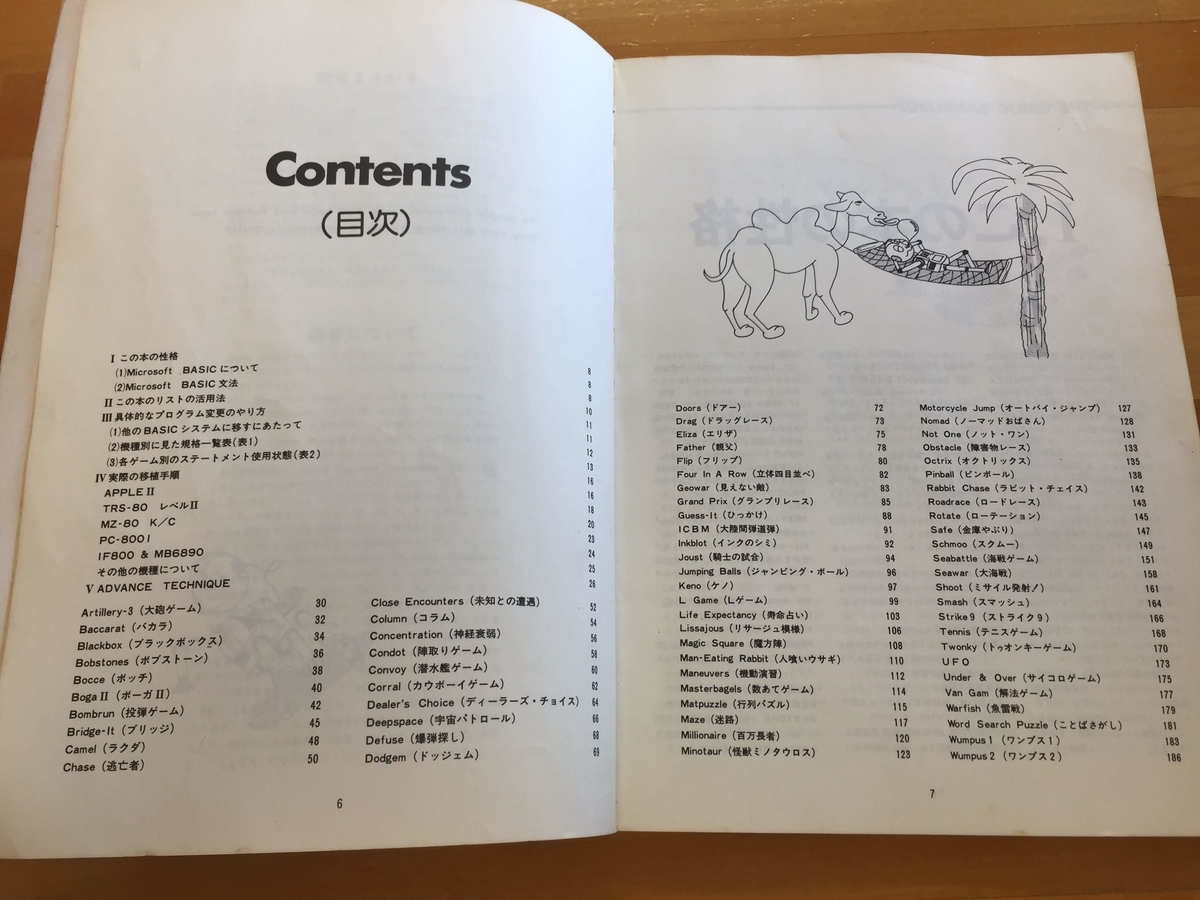
Ahl, David H., ed. (1979). Basic computer games: マイクロコンピュータゲーム集日本語版 (in Japanese). Tokyo: ASCII Publishing. OCLC672648883.
A partial translation (using parallel text in places) adapted from the plates (cover and interior) of the first Creative Computing printing illustrated by Sandy Dean. Only seventy of the games are included.
The Danish edition was published in three volumes:
Ahl, David H., ed. (1986). Basic computerspil. Bind 1. Basic computerspil. (in Danish). Vol.1. Translated by Borup, Christian. Program conversion by Steve North; cover by Jesper Bach Jensen; internal illustrations by George Beker. Copenhagen: Borgen. ISBN87-418-7419-6.
Ahl, David H., ed. (1986). Basic computerspil. Bind 2. Basic computerspil. (in Danish). Vol.2. Translated by Borup, Christian. Program conversion by Steve North; cover by Jesper Bach Jensen; internal illustrations by George Beker. Copenhagen: Borgen. ISBN87-418-7685-7.
Ahl, David H., ed. (1986). Basic computerspil. Bind 3. Basic computerspil. (in Danish). Vol.3. Translated by Borup, Christian. Program conversion by Steve North; illustrations by George Beker. Copenhagen: Borgen. ISBN87-418-7686-5.
Ahl, David H., ed. (May 1980). More BASIC Computer Games: TRS-80™ Edition. Program conversion by Steve North; illustrations by George Beker; preface by Christopher Cerf. Morristown, New Jersey: Creative Computing Press. ISBN0-916688-19-4. Retrieved 24 June 2026.—The first printing gives the title as BASIC Computer Games Volume II: TRS-80™ Edition; adapts the cover design of BASIC Computer Games' TRS-80 edition with its Sandy Dean illustration (though the interior art is Becker's); and again says on the copyright page that the book was published for Radio Shack
Foreign language translations
Ahl, David H., ed. (1982). BASIC-Computer-Spiele. Band 2 (in German). Vol.2. Translated by Black, Wolfgang J. Program conversion by Steve North; illustrations by George Beker. Düsseldorf: Sybex. ISBN3-88745-010-8.
Ahl, David H., ed. (1982). Nouveaux jeux d’ordinateur en BASIC (in French). Translated by Gourlet, Jacques. Program conversion by Steve North; cover art by Jean-François Pénichoux; interior illustrations by George Beker. Paris; Berkeley; Düsseldorf: Sybex France. ISBN2-902414-47-1. Retrieved 23 June 2026.
Again uses Sandy Dean illustrations. Only 70 of the 84 games reproduced.
Ahl, David H., ed. (1984). Big Computer Games. Art direction by Patrick Calkins. Illustrations and production by Eugene Bickness, Chris DeMilia, Peter Kelley and Diana Negri Rudio. Morris Plains, New Jersey: Creative Computing Press. ISBN0916688402. LCCN84012730. OCLC10914568. Retrieved 22 June 2026.—The ISBN for this book was, incorrectly, reused from 1979's BASIC Computer Games: TRS-80 Edition (see above)
Ahl identifies this as part of the BASIC Computer Games series in the preface (and all of the games are indeed in BASIC).
Somewhat similar to Big Computer Games in particular, but not identified as part of the BASIC Computer Games series. All programs were written for the book by Ahl.
BASIC趣味程序选(一)[Selected Fun BASIC Programs] (in Chinese). Vol.1. Tsinghua University Press. 2 February 1985. Retrieved 24 June 2026.—Includes programs translated from BASIC Computer Games and other non-Chinese sources as well as new programs; cover illustrated with modified versions of Becker's art