You can help expand this article with text translated from the corresponding article in Chinese. (July 2026) Click [show] for important translation instructions.
View a machine-translated version of the Chinese article.
Machine translation, like DeepL or Google Translate, is a useful starting point for translations, but translators must follow the LLM translation guideline, revise errors as necessary and confirm that the translation is accurate, rather than simply copy-pasting machine-translated text into the English Wikipedia.
Do not translate text that appears unreliable or low-quality. If possible, verify the text with references provided in the foreign-language article.
You must provide copyright attribution in the edit summary accompanying your translation by providing an interlanguage link to the source of your translation. A model attribution edit summary is Content in this edit is translated from the existing Chinese Wikipedia article at [[:zh:笃斯越橘]]; see its history for attribution.
You may also add the template {{Translated|zh|笃斯越橘}} to the talk page.
Vaccinium uliginosum (bog bilberry, bog blueberry, alpine blueberry or western blueberry) is a Eurasian and North American flowering plant in the heath family. The berries are edible.
Description
Vaccinium uliginosum is a small deciduous shrub growing to 10–75 centimetres (4–30in) tall, rarely 1 metre (3 feet) tall, with brown stems (unlike the green stems of the closely related bilberry). The leaves are oval, 4–30 millimetres (1⁄8–1+1⁄8in) long and 2–15mm (1⁄16–9⁄16in) wide, blue-green with pale net-like veins, with a smooth margin and rounded apex.
The flowers are pendulous, urn-shaped, pale pink, 4–6mm (3⁄16–1⁄4in) long, produced in mid-spring. The fruit is a dark blue-black berry5–8mm (3⁄16–5⁄16in) in diameter, with sweet white flesh, ripe in late summer. Cytology is 2n = 24. Its fruit persists for an average of 26.1 days, and bears an average of 24.7 seeds per fruit. The fruit averages 86.8% water, with the dry weight including 38.4% carbohydrates and 3.9% lipids.
Subspecies
Three subspecies and one variety are accepted by the Plants of the World Online (POWO) database, but not all authorities distinguish them. Only the nominate subspecies of V.uliginosum subsp. uliginosum is relatively widely accepted.
Vaccinium uliginosum var. japonicum T.Yamaz. — Japan
A fourth subspecies Vaccinium uliginosum subsp. microphyllum Lange is sometimes accepted for Arctic plants; POWO treat it as a synonym of the nominate subspecies.
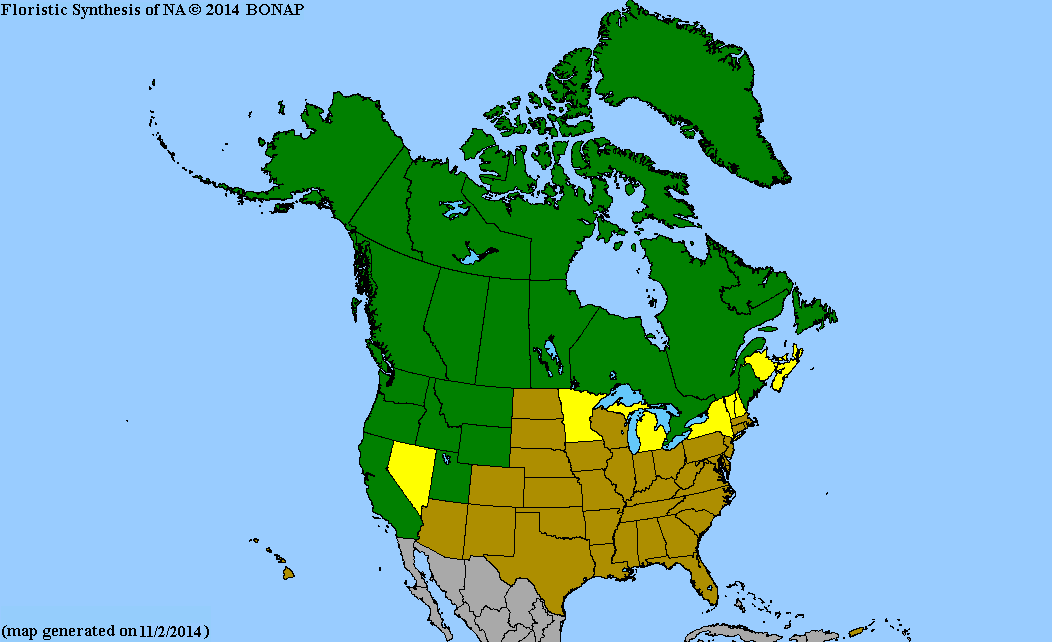
It grows on wet acidic soils on heathland, moorland, tundra, and in the understory of coniferous forests, from sea level in the Arctic, up to 3,400m (11,200ft) altitude in the south of the range. It is also occasionally found on calcareous soils on mountain ledges.
V. uliginosum can survive long, severe climatic oscillations.
Uses
The berries can be eaten raw or cooked, used to make jelly or pies, or dried to make pemmican.
↑Kartesz, John T. (2014). "Vacciniumuliginosum". State-level distribution map from the North American Plant Atlas (NAPA). Biota of North America Program (BONAP).
↑De Witte, LC; Armbruster, GFJ; Gielly, L; Taberlet, P; Stocklin, J (2011-11-10). "AFLP markers reveal high clonal diversity and extreme longevity in four key arctic-alpine species". Molecular Ecology. 21 (5): 1081–1097. doi:10.1111/j.1365-294x.2011.05326.x. ISSN0962-1083. PMID22070158.
↑Nyerges, Christopher (2017). Foraging Washington: Finding, Identifying, and Preparing Edible Wild Foods. Guilford, CT: Falcon Guides. ISBN978-1-4930-2534-3. OCLC965922681.
Further reading
Blamey, M.; Grey-Wilson, C. (1989). Flora of Britain and Northern Europe. Hodder & Stoughton.
Ehrlén, Johan; Eriksson, Ove (1991). "Phenological variation in fruit characteristics in vertebrate-dispersed plants". Oecologia. 86 (4): 463–470. doi:10.1007/BF00318311. ISSN0029-8549.

 Bog bilberries on branches
 Close-up of bog bilberries in Eastern Siberia
 Bog bilberry liquor (left) produced in North Korea