If n = 2p where p is a prime number other than 2, then
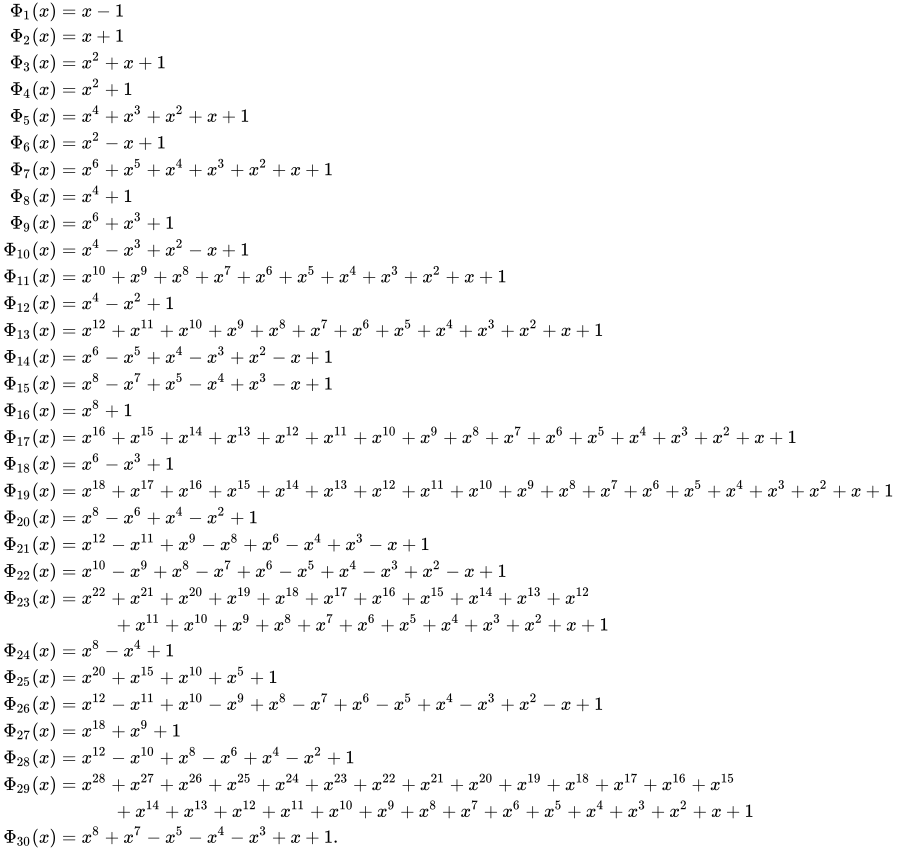
For n up to 30, the cyclotomic polynomials are:
The case of the 105th cyclotomic polynomial is interesting because 105 is the least positive integer that is the product of three distinct odd prime numbers (3×5×7) and this polynomial is the first one that has a coefficient other than 1, 0, or −1:
Properties
Fundamental tools
The cyclotomic polynomials are monic polynomials with integer coefficients that are irreducible over the field of the rational numbers. Except for n equal to 1 or 2, they are palindromes of even degree.
The degree of , or in other words the number of nth primitive roots of unity, is , where is Euler's totient function.
The fact that is an irreducible polynomial of degree in the ring is a nontrivial result due to Gauss. Depending on the chosen definition, it is either the value of the degree or the irreducibility which is a nontrivial result. The case of prime n is easier to prove than the general case, thanks to Eisenstein's criterion.
A fundamental relation involving cyclotomic polynomials is
which means that each n-th root of unity is a primitive d-th root of unity for a unique d dividing n.
This provides a recursive formula for the cyclotomic polynomial , which may be computed by dividing by the cyclotomic polynomials for the proper divisors d dividing n, starting from :
These formulas may be applied repeatedly to get a simple expression for any cyclotomic polynomial in terms of a cyclotomic polynomial of square free index: If q is the product of the prime divisors of n (its radical), then
This allows formulas to be given for the nth cyclotomic polynomial when n has at most one odd prime factor: If p is an odd prime number, and and m are positive integers, then
For other values of n, the computation of the nth cyclotomic polynomial is similarly reduced to that of where q is the product of the distinct odd prime divisors of n. To deal with this case, one has that, for p prime and not dividing n,
Integers appearing as coefficients
The problem of bounding the magnitude of the coefficients of the cyclotomic polynomials has been the object of a number of research papers.
If n has at most two distinct odd prime factors, then Migotti showed that the coefficients of are all in the set {1, −1, 0}.
The first cyclotomic polynomial for a product of three different odd prime factors is it has a coefficient −2 (see above). The converse is not true: only has coefficients in {1, −1, 0}.
If n is a product of more different odd prime factors, the coefficients may increase to very high values. E.g., has coefficients running from −22 to 23; also , the smallest n with 6 different odd primes, has coefficients of magnitude up to 532.
Let A(n) denote the maximum absolute value of the coefficients of . It is known that for any positive k, the number of n up to x with A(n) > nk is at least c(k)⋅x for a positive c(k) depending on k and x sufficiently large. In the opposite direction, for any function ψ(n) tending to infinity with n we have A(n) bounded above by nψ(n) for almost all n.
A combination of theorems of Bateman and Vaughan states that:10 on the one hand, for every , we have
for all sufficiently large positive integers , and on the other hand, we have
for infinitely many positive integers . This implies in particular that univariate polynomials (concretely for infinitely many positive integers ) can have factors (like ) whose coefficients are superpolynomially larger than the original coefficients. This is not too far from the general Landau-Mignotte bound.
Gauss's formula
Let n be odd, square-free, and greater than 3. Then:
for certain polynomials An(z) and Bn(z) with integer coefficients, An(z) of degree φ(n)/2, and Bn(z) of degree φ(n)/2 − 2. Furthermore, An(z) is palindromic when its degree is even; if its degree is odd it is antipalindromic. Similarly, Bn(z) is palindromic unless n is composite and n ≡ 3 (mod 4), in which case it is antipalindromic.
The first few cases are
Lucas's formula
Let n be odd, square-free and greater than 3. Then
for certain polynomials Un(z) and Vn(z) with integer coefficients, Un(z) of degree φ(n)/2, and Vn(z) of degree φ(n)/2 − 1. This can also be written
If n is even, square-free and greater than 2 (this forces n/2 to be odd),
for Cn(z) and Dn(z) with integer coefficients, Cn(z) of degree φ(n), and Dn(z) of degree φ(n) − 1. Cn(z) and Dn(z) are both palindromic.
The first few cases are:
Sister Beiter conjecture
The Sister Beiter conjecture is concerned with the maximal size (in absolute value) of coefficients of ternary cyclotomic polynomials where are three odd primes.
Cyclotomic polynomials over a finite field and over the p-adic integers
Over a finite field with a prime number p of elements, for any integer n that is not a multiple of p, the cyclotomic polynomial factorizes into irreducible polynomials of degree d, where is Euler's totient function and d is the multiplicative order of p modulo n. In particular, is irreducible if and only ifp is a primitive root modulo n, that is, p does not divide n, and its multiplicative order modulo n is , the degree of .
These results are also true over the p-adic integers, since Hensel's lemma allows lifting a factorization over the field with p elements to a factorization over the p-adic integers.
If x takes any real value, then for every n ≥ 3 (this follows from the fact that the roots of a cyclotomic polynomial are all non-real, for n ≥ 3).
For studying the values that a cyclotomic polynomial may take when x is given an integer value, it suffices to consider only the case n ≥ 3, as the cases n = 1 and n = 2 are trivial (one has and ).
The values that a cyclotomic polynomial may take for other integer values of x is strongly related with the multiplicative order modulo a prime number.
More precisely, given a prime number p and an integer b coprime with p, the multiplicative order of b modulo p, is the smallest positive integer n such that p is a divisor of For b > 1, the multiplicative order of b modulo p is also the shortest period of the representation of 1/p in the numeral baseb (see Unique prime; this explains the notation choice).
The definition of the multiplicative order implies that, if n is the multiplicative order of b modulo p, then p is a divisor of The converse is not true, but one has the following.
If n > 0 is a positive integer and b > 1 is an integer, then (see below for a proof)
where
k is a non-negative integer, always equal to 0 when b is even. (In fact, if n is neither 1 nor 2, then k is either 0 or 1. Besides, if n is not a power of 2, then k is always equal to 0)
g is 1 or the largest odd prime factor of n.
h is odd, coprime with n, and its prime factors are exactly the odd primes p such that n is the multiplicative order of b modulo p.
This implies that, if p is an odd prime divisor of then either n is a divisor of p − 1 or p is a divisor of n. In the latter case, does not divide
It follows from above factorization that the odd prime factors of
are exactly the odd primes p such that n is the multiplicative order of b modulo p. This fraction may be even only when b is odd. In this case, the multiplicative order of b modulo 2 is always 1.
There are many pairs (n, b) with b > 1 such that is prime. In fact, Bunyakovsky conjecture implies that, for every n, there are infinitely many b > 1 such that is prime. See (sequence A085398 in the OEIS) for the list of the smallest b > 1 such that is prime (the smallest b > 1 such that is prime is about , where is Euler–Mascheroni constant, and is Euler's totient function). See also (sequence A206864 in the OEIS) for the list of the smallest primes of the form with n > 2 and b > 1, and, more generally, (sequence A206942 in the OEIS), for the smallest positive integers of this form.
Proofs
Values of If is a prime power, then
If n is not a prime power, let we have and P is the product of the for k dividing n and different of 1. If p is a prime divisor of multiplicity m in n, then divide P(x), and their values at 1 are m factors equal to p of As m is the multiplicity of p in n, p cannot divide the value at 1 of the other factors of Thus there is no prime that divides
Ifnis the multiplicative order ofbmodulop, then By definition, If then p would divide another factor of and would thus divide showing that, if there would be the case, n would not be the multiplicative order of b modulo p.
The other prime divisors ofare divisors ofn. Let p be a prime divisor of such that n is not be the multiplicative order of b modulo p. If k is the multiplicative order of b modulo p, then p divides both and The resultant of and may be written where P and Q are polynomials. Thus p divides this resultant. As k divides n, and the resultant of two polynomials divides the discriminant of any common multiple of these polynomials, p divides also the discriminant of Thus p divides n.
gandhare coprime. In other words, if p is a prime common divisor of n and then n is not the multiplicative order of b modulo p. By Fermat's little theorem, the multiplicative order of b is a divisor of p − 1, and thus smaller than n.
gis square-free. In other words, if p is a prime common divisor of n and then does not divide Let n = pm. It suffices to prove that does not divide S(b) for some polynomial S(x), which is a multiple of We take
The multiplicative order of b modulo p divides gcd(n, p − 1), which is a divisor of m = n/p. Thus c = bm − 1 is a multiple of p. Now,
As p is prime and greater than 2, all the terms but the first one are multiples of This proves that
Suppose is a finite list of primes congruent to modulo Let and consider . Let be a prime factor of (to see that decompose it into linear factors and note that 1 is the closest root of unity to ). Since we know that is a new prime not in the list. We will show that
Let be the order of modulo Since we have . Thus . We will show that .
Assume for contradiction that . Since
we have
for some . Then is a double root of
Thus must be a root of the derivative so
But and therefore This is a contradiction so . The order of which is , must divide . Thus
In the theory of combinatorial generating functions, the denominator of a rational function determines a linear recurrence for its power series coefficients. For example, the Fibonacci sequence has generating function
12Sanna, Carlo (2021), "A Survey on Coefficients of Cyclotomic Polynomials", arXiv:2111.04034 [math.NT]
↑Isaacs, Martin (2009), Algebra: A Graduate Course, AMS Bookstore, p.310, ISBN978-0-8218-4799-2
↑Maier, Helmut (2008), "Anatomy of integers and cyclotomic polynomials", in De Koninck, Jean-Marie; Granville, Andrew; Luca, Florian (eds.), Anatomy of integers. Based on the CRM workshop, Montreal, Canada, March 13-17, 2006, CRM Proceedings and Lecture Notes, vol.46, Providence, RI: American Mathematical Society, pp.89–95, ISBN978-0-8218-4406-9, Zbl1186.11010
↑Lidl, Rudolf; Niederreiter, Harald (2008), Finite Fields (2nded.), Cambridge University Press, p.65.
↑S. Shirali. Number Theory. Orient Blackswan, 2004. p. 67. ISBN81-7371-454-1
Further reading
Gauss's book Disquisitiones Arithmeticae [Arithmetical Investigations] has been translated from Latin into French, German, and English. The German edition includes all of his papers on number theory: all the proofs of quadratic reciprocity, the determination of the sign of the Gauss sum, the investigations into biquadratic reciprocity, and unpublished notes.