Memorial bust to Edward Pugin, in front of Granville House (formerly the Granville Hotel, Ramsgate). “In memory of Edward Welby Pugin, the gifted and accomplished son of Augustus Welby Pugin, one of England's greatest architects: born 11th March, 1834, died 5th June, 1875. This bust is erected by Edmund Francis Davis. 1879.”
Edward Welby Pugin (11 March 1834 – 5 June 1875) was an English architect, the eldest son of architect Augustus Welby Northmore Pugin and Louisa Barton. His father was an architect in the Gothic Revival style, and after his early death in 1852 Edward continued his practice. At the time of his own early death in 1875, Pugin had designed and completed more than one hundred Catholic churches. His brothers Cuthbert and Peter continued the practice as Pugin & Pugin.
Career
From c.1856 he developed a style independent of his father's, in which expansive spatial planning was combined with great detail.[citation needed] He designed churches and cathedrals primarily in the British Isles. However, commissions for his work were also received from countries throughout Western Europe, Scandinavia, and North America.
As his business grew, Pugin formed partnerships which turned out to be short-lived: with James Murray in Liverpool (1857 to 1860), with George Ashlin in Dublin (1860 to 1869), and with Joseph Hansom (1862 to 1863). He was bankrupted in 1873 by the failure of a business he was involved in, the Granville Hotel and spa at Ramsgate, Kent.
1856: Shrewsbury Cathedral, the Cathedral Church of Our Lady Help of Christians and Saint Peter of Alcantara, Town Walls, Shrewsbury (built as a cathedral)
1856: Our Lady Immaculate, St Domingo Road, Everton, Liverpool. Demolished. Lady Chapel of scheme for Liverpool Cathedral
1857–1859: Our Lady and St Hubert, Great Harwood, Lancashire
1858: Our Lady Help of Christians and attached Presbytery, Fortess Road, Kentish Town, London (both demolished - although the facade of the latter was rebuilt)
1866–1867: The Chapel of the Immaculate Conception, Ratcliffe College, Ratcliffe on the Wreake, Leicestershire; converted for school use in 1962 on the completion of a new, larger chapel
1856 Basilica of Our Lady in Dadizele, finished by Jean-Baptiste Bethune
1856 Castle of Loppem, in collaboration with James Murray and George Ashlin, finished by Jean-Baptiste Bethune
1861 country estate near Bruges for bishop Joannes Baptista Malou, demolished
Works with James Murray (1856–c. 1859)
Rugby Town Hall and Markets
Rugby Town Hall
The old Town Hall stood on the High Street. It was built in 1857, with an extension in 1919. The upper floor became a cinema (Vint's Palace) around 1913. A fire destroyed most of the building in 1921 and it was rebuilt as Woolworths, which opened in 1923 and closed in 2009.
Works in association with George Ashlin (1859-1869)
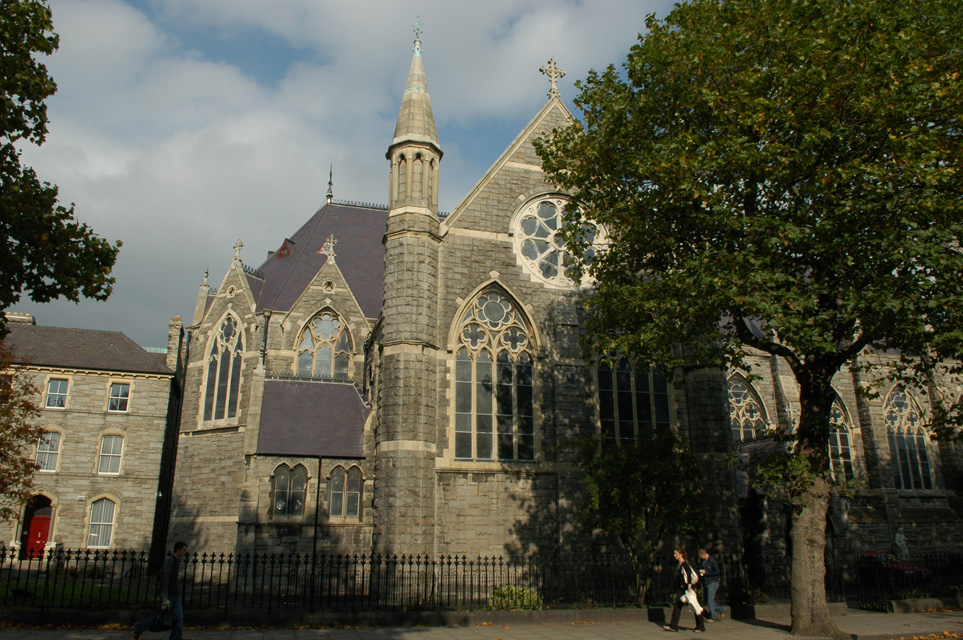
Regarded as Dublin's finest Victorian church, SS Augustine and John (John's Lane Church) in the Liberties area was designed by E. W. Pugin and executed by his partner George Ashlin for the Augustinian Fathers. It was built between 1862 and 1895. It has the tallest spire in Dublin (231ft), and occupies a prominent position on high ground overlooking the Liffey Valley. It has a striking polychromatic appearance, being built in granite with red sandstone dressings.
The eminent Gothic revivalist Ruskin is said to have praised it, describing it as a "poem in stone".
Statues of the apostles in the niches of the spire are by James Pearse, father of Padraig and Willie, who were executed after the 1916 Easter Rising.
There is stained glass from the Harry Clarke studios.
Jean van Cleven, 'The Eternal Château': bouwgeschiedenis en kunsthistorische analyse van het neogotische kasteel van Loppem, in V. van Caloen, J. van Cleven, J. Braet Het Kasteel van Loppem, Stichting Kunstboek, 2001
Roderick O'Donnell, E W Pugin, in Oxford Dictionary of National Biography, Lawrence Goldman (ed) vol 45, pp 525–6, 2001–2004.British Library General Reference Section YC.2009.b.1128
Further reading
Michael Fisher, Pugin-Land: A W N Pugin, Lord Shrewsbury and the Gothic Revival in Staffordshire, Stafford Fisher, 2002.
Rachel Hasted, Scarisbrick Hall – A Guide, Social History at Lancashire County Museum Service, 1984.
Frederick O'Dwyer, Ecclesiastical Architecture from 1829 in W.J. McCormack (ed) Modern Irish Culture, Oxford: Blackwell, 2001.
Frederick O'Dwyer, A Victorian Partnership – The Architecture of Pugin & Ashlin in John Graby (ed.) 150 Years of Architecture in Ireland, Dublin, Eblana Editions, 1989.
Jeanne Sheehy, The Rediscovery of Ireland's Past, The Celtic Revival 1830–1930. London, England, 1980.