Notes
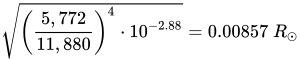
- ↑ Applying the Stefan–Boltzmann law with a nominal solar effective temperature of 5,772 K:
- .
- ↑ The star EGGR 37 was suspected to be a white dwarf by April 1934, but this was not confirmed until 1938.
| Observation data Epoch J2000.0 Equinox ICRS | |
|---|---|
| Constellation | Draco |
| Right ascension | 19h 00m 10.2534s |
| Declination | +70° 39′ 51.418″ |
| Apparent magnitude (V) | 13.19 |
| Characteristics | |
| Spectral type | DAP4.5 |
| U−B color index | -0.85 |
| B−V color index | +0.05 |
| Astrometry | |
| Proper motion (μ) | RA: +85.774 mas/yr Dec.: +505.050 mas/yr |
| Parallax (π) | 77.6525±0.0317 mas |
| Distance | 42.00 ± 0.02 ly (12.878 ± 0.005 pc) |
| Details | |
| Mass | 1.029 M☉ |
| Radius | 5,960 km |
| Luminosity | 0.013182 L☉ |
| Surface gravity (log g) | 8.67 cgs |
| Temperature | 12540±143 K |
| Age | (as white dwarf) 1.138 Gyr |
| Other designations | |
| GJ 742, AC +70 8247, G 260-15, LFT 1446, LHS 3424, LTT 15585, Grw+70 8247, WD 1900+705 | |
| Database references | |
| SIMBAD | data |
| ARICNS | data |
GRW +70 8247 is a white dwarf star located 42 light-years from Earth in the constellation Draco. With a magnitude of about 13 it is visible only through a large telescope.
Although photographed in the 19th century as part of the Carte du Ciel project, the star was not determined to be a white dwarf until G. P. Kuiper observed it in 1934. This makes it the fifth or sixth white dwarf discovered. At first, its spectrum was thought to be almost featureless, but later observation showed it to have unusual broad, shallow absorption bands. In 1970, when light that it emitted was observed to be circularly polarized, it became the first white dwarf known to have a magnetic field. In the 1980s, it was realized that the unusual absorption bands could be explained as hydrogen absorption lines shifted by the Zeeman effect.
{{cite journal}}: CS1 maint: multiple names: authors list (link){{cite journal}}: CS1 maint: multiple names: authors list (link){{cite journal}}: CS1 maint: multiple names: authors list (link)
 | This article about a white dwarf is a stub. You can help Wikipedia by adding missing information. |