Randomized algorithm
Consider the received word  which was corrupted by a noisy channel. The following is the algorithm description for the general case. In this algorithm, we can decode y by just declaring an erasure at every bad position and running the errors and erasure decoding algorithm for
 on the resulting vector.
Randomized_Decoder
Given :  .
- For every
 , compute
 .
- Set
 .
- For every , repeat : With probability
 , set ?,}
 otherwise set
 .
- Run errors and erasure algorithm for on
 .
Theorem 1. Let y be a received word such that there exists a codeword  such that
 . Then the deterministic GMD algorithm outputs
 .
Note that a naive decoding algorithm for concatenated codes can correct up to  errors.
- Lemma 1. Let the assumption in Theorem 1 hold. And if
 has
 errors and
 erasures (when compared with ) after Step 1, then

Remark. If 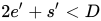 , then the algorithm in Step 2 will output . The lemma above says that in expectation, this is indeed the case. Note that this is not enough to prove Theorem 1, but can be crucial in developing future variations of the algorithm.
Proof of lemma 1. For every  define
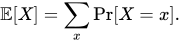
 This implies that
 Next for every , we define two indicator variables:
?\end{aligned}}}
 We claim that we are done if we can show that for every :
 Clearly, by definition
 Further, by the linearity of expectation, we get
 To prove (2) we consider two cases:
 -th block is correctly decoded (Case 1), -th block is incorrectly decoded (Case 2):
Case 1: 
Note that if  then
 , and
 implies
 and
 .
Further, by definition we have
 Case 2:
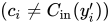
In this case,  and

Since  . This follows another case analysis when
 or not.
Finally, this implies
 In the following sections, we will finally show that the deterministic version of the algorithm above can do unique decoding of
 up to half its design distance.
Modified randomized algorithm
Note that, in the previous version of the GMD algorithm in step "3", we do not really need to use "fresh" randomness for each . Now we come up with another randomized version of the GMD algorithm that uses the same randomness for every . This idea follows the algorithm below.
Modified_Randomized_Decoder
Given : , pick  at random. Then every for every :
- Set .
- Compute
 .
- If
 , set ?,}
otherwise set .
- Run errors and erasure algorithm for on .
For the proof of Lemma 1, we only use the randomness to show that
 In this version of the GMD algorithm, we note that
 The second equality above follows from the choice of
 . The proof of Lemma 1 can be also used to show
 for version2 of GMD. In the next section, we will see how to get a deterministic version of the GMD algorithm by choosing from a polynomially sized set as opposed to the current infinite set
 .
Deterministic algorithm
Let  . Since for each
 , we have
 where
 for some
 . Note that for every
 , the step 1 of the second version of randomized algorithm outputs the same
 . Thus, we need to consider all possible value of
 . This gives the deterministic algorithm below.
Deterministic_Decoder
Given : , for every , repeat the following.
- Compute for .
- Set for every .
- If
 , set ?,}
otherwise set .
- Run errors-and-erasures algorithm for on . Let
 be the codeword in corresponding to the output of the algorithm, if any.
- Among all the output in 4, output the one closest to

Every loop of 1~4 can be run in polynomial time, the algorithm above can also be computed in polynomial time. Specifically, each call to an errors and erasures decoder of  errors takes
 time. Finally, the runtime of the algorithm above is
 where
 is the running time of the outer errors and erasures decoder.