Lemma
For all 
 and
 there exists an
 such that
 for all

Proof of lemma
By the surjectivity of
 it is possible to find
 with for
Now let

Every element of  satisfies
 and
 so it suffices to show that the intersection is nonempty.
Assume for contradiction that it is empty. Then  and by the Hahn–Banach theorem there exists a linear form
 such that
 and
 Then
 and therefore
 which is a contradiction.
Proof of theorem
Fix and  Examine the set

Let  be the embedding defined by
 where
 is the evaluation at
 map. Sets of the form
 form a base for the weak* topology, so density follows once it is shown
 for all such
 The lemma above says that for any
 there exists a such that

 and in particular
 Since
 we have
 We can scale to get
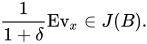 The goal is to show that for a sufficiently small we have

Directly checking, one has
\right|=\left|\varphi _{i}(x)-{\frac {1}{1+\delta }}\varphi _{i}(x)\right|={\frac {\delta }{1+\delta }}|\varphi _{i}(x)|.}](https://wikimedia.org/api/rest_v1/media/math/render/svg/ab146ff38f917cea1e9bf659df946071fe91bfc3)
Note that one can choose  sufficiently large so that
 for Note as well that
 If one chooses
 so that
 then

Hence one gets  as desired.


