145 G. Canis Majoris

145 G. Canis Majoris
Location of 145 G. Canis Majoris (circled in red)
Observation data
Epoch J2000      Equinox ICRS
Constellation Canis Major
Right ascension 07h 16m 36.83456s
Declination −23° 18′ 56.1383″
Apparent magnitude (V) 4.79
Characteristics
Spectral type K3Ib- or K4III
B−V color index 1.710
Astrometry
Radial velocity (Rv)+28.05±0.42 km/s
Proper motion (μ) RA: −3.816 mas/yr
Dec.: +3.896 mas/yr
Parallax (π)1.2155±0.0998 mas
Distance2,700 ± 200 ly
(820 ± 70 pc)
Absolute magnitude (MV)−4.03
Details
Mass7.8±0.5 M☉
Radius315 R☉
Luminosity23,660 L☉
Surface gravity (log g)0.70 cgs
Temperature3,986 K
Metallicity [Fe/H]0.03 dex
Rotational velocity (v sin i)7.4±1.0 km/s
Age35.4±2.0 Myr
Other designations
145 G. CMa, NSV 3503, CD−23°5189, HD 56577, HIP 35210, HR 2764, SAO 173349, WDS J07166-2319A
Database references
SIMBADdata

145 G. Canis Majoris (HD 56577) is a single K giant or supergiant star in the southern constellation of Canis Major. This star is Gould's 145th of Canis Major in his Uranometria Argentina. SIMBAD erroneously lists the star in its object query result as "* 145 CMa – Star".
Stellar properties

The spectral type of 145 G. Canis Majoris has been given as K4III in 1978, with the luminosity class "III" corresponding to a giant star. In 1989, the spectral type was revised to K3Ib, with a luminosity class Ib suggesting the star is at the lower luminosity range of supergiant stars.

Measurement of stellar properties such as radius, luminosity and mass depend on the star's distance, which is not well-known. The Hipparcos mission measured a parallax of 2.30±0.52 mas, resulting in a distance of 1,400±300 ly. Based on this distance, a luminosity 5,250 times that of the Sun (L☉) was calculated. From the luminosity and a temperature of 3,937±141 K, a radius of 156 ± 11 R☉ is obtained, and a mass and age of 1.90 M☉ and 1.05 Gyr have been obtained using the stellar parameters and isochrones. Those values are consistent with the star being a giant. However, parallax measurements by the Gaia spacecraft suggest the star is more distant than previously thought, hence has higher luminosity, radius and mass. A radius of 315 R☉ and a luminosity of 23,660 L☉ have been derived using the Gaia DR3 distance, suggesting the star is indeed a supergiant. At the Gaia DR2 parallax, the star should have a luminosity of 14,000 L☉, also rather high for a giant. Values for the mass and age at the Gaia distance have not been computed yet, but a 2012 study give 7.8±0.5 M☉ and 35.4±2.0 Myr.

The effective temperature of the star is around 4,000 K, which gives it an orange hue typical of K-type stars.

The star is one component of a close double, the other being HD 56578 which on its own would be a faint naked-eye star. The two are separated by 27″. The two stars appear to be unrelated and the close alignment accidental, with HD 56578 being a much closer and less luminous Am star.

Notes

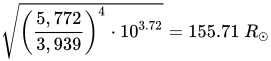
  1. ↑ Applying the Stefan–Boltzmann law with a nominal solar effective temperature of 5,772 K:
    .

References

  1. ↑ Roman, Nancy G. (1987). "Identification of a constellation from a position". Publications of the Astronomical Society of the Pacific. 99 (617): 695. Bibcode:1987PASP...99..695R. doi:10.1086/132034. Constellation record for this object at VizieR.
  2. 1 2 3 4 5 6 Vallenari, A.; et al. (Gaia collaboration) (2023). "Gaia Data Release 3. Summary of the content and survey properties". Astronomy and Astrophysics. 674: A1. arXiv:2208.00211. Bibcode:2023A&A...674A...1G. doi:10.1051/0004-6361/202243940. S2CID 244398875. Gaia DR3 record for this source at VizieR.
  3. 1 2 3 Luck, R. Earle (2015), "Abundances in the Local Region. I. G and K Giants", The Astronomical Journal, 150 (3): 88, arXiv:1507.01466, Bibcode:2015AJ....150...88L, doi:10.1088/0004-6256/150/3/88, S2CID 118505114.
  4. 1 2 Keenan, Philip C.; McNeil, Raymond C. (1989), "The Perkins catalog of revised MK types for the cooler stars", Astrophysical Journal Supplement Series, 71: 245, Bibcode:1989ApJS...71..245K, doi:10.1086/191373.
  5. 1 2 Houk, Nancy; Smith-Moore, M. (1978), Michigan Catalogue of Two-dimensional Spectral Types for the HD Stars, vol. 4, Ann Arbor: Dept. of Astronomy, University of Michigan, Bibcode:1988mcts.book.....H.
  6. 1 2 3 Brown, A. G. A.; et al. (Gaia collaboration) (August 2018). "Gaia Data Release 2: Summary of the contents and survey properties". Astronomy & Astrophysics. 616. A1. arXiv:1804.09365. Bibcode:2018A&A...616A...1G. doi:10.1051/0004-6361/201833051. Gaia DR2 record for this source at VizieR.
  7. ↑ Melnik, A. M.; Dambis, A. K. (2020). "Distance scale for high-luminosity stars in OB associations and in field with Gaia DR2. Spurious systematic motions". Astrophysics and Space Science. 365 (7): 112. arXiv:2006.14649. Bibcode:2020Ap&SS.365..112M. doi:10.1007/s10509-020-03827-0.
  8. 1 2 3 Tetzlaff, N.; et al. (January 2011), "A catalogue of young runaway Hipparcos stars within 3 kpc from the Sun", Monthly Notices of the Royal Astronomical Society, 410 (1): 190–200, arXiv:1007.4883, Bibcode:2011MNRAS.410..190T, doi:10.1111/j.1365-2966.2010.17434.x, S2CID 118629873.
  9. 1 2 3 4 5 Healy, Sarah; Horiuchi, Shunsaku; Colomer Molla, Marta; Milisavljevic, Dan; Tseng, Jeff; Bergin, Faith; Weil, Kathryn; Tanaka, Masaomi; Otero, Sebastián (2024-04-01). "Red supergiant candidates for multimessenger monitoring of the next Galactic supernova". Monthly Notices of the Royal Astronomical Society. 529 (4): 3630–3650. arXiv:2307.08785. Bibcode:2024MNRAS.529.3630H. doi:10.1093/mnras/stae738. ISSN 0035-8711.
  10. 1 2 Earle Luck, R. (2014-05-02). "PARAMETERS AND ABUNDANCES IN LUMINOUS STARS". The Astronomical Journal. 147 (6): 137. doi:10.1088/0004-6256/147/6/137. ISSN 0004-6256.
  11. ↑ De Medeiros, J. R.; et al. (2002), "A catalog of rotational and radial velocities for evolved stars. II. Ib supergiant stars", Astronomy and Astrophysics, 395: 97–98, arXiv:1312.3474, Bibcode:2002A&A...395...97D, doi:10.1051/0004-6361:20021214.
  12. ↑ "HD 56577". SIMBAD. Centre de données astronomiques de Strasbourg. Retrieved 2019-01-06.
  13. ↑ Eggleton, P. P.; Tokovinin, A. A. (September 2008), "A catalogue of multiplicity among bright stellar systems", Monthly Notices of the Royal Astronomical Society, 389 (2): 869–879, arXiv:0806.2878, Bibcode:2008MNRAS.389..869E, doi:10.1111/j.1365-2966.2008.13596.x, S2CID 14878976.
  14. ↑ Gould, B. A., (2009) Uranometria Argentina, (Reprinted and updated by Pilcher, F.)
  15. ↑ SIMBAD query * 145 CMa – Star
  16. ↑ van Leeuwen, F. (2007), "Validation of the new Hipparcos reduction", Astronomy and Astrophysics, 474 (2): 653–664, arXiv:0708.1752, Bibcode:2007A&A...474..653V, doi:10.1051/0004-6361:20078357, S2CID 18759600.
  17. ↑ "The Colour of Stars". Australia National Telescope Facility. 6 March 2024. Retrieved 2024-05-27.
  18. ↑ Mason, Brian D.; Wycoff, Gary L.; Hartkopf, William I.; Douglass, Geoffrey G.; Worley, Charles E. (2001), "The 2001 US Naval Observatory Double Star CD-ROM. I. The Washington Double Star Catalog", The Astronomical Journal, 122 (6): 3466, Bibcode:2001AJ....122.3466M, doi:10.1086/323920.
  19. ↑ Brown, A. G. A.; et al. (Gaia collaboration) (August 2018). "Gaia Data Release 2: Summary of the contents and survey properties". Astronomy & Astrophysics. 616. A1. arXiv:1804.09365. Bibcode:2018A&A...616A...1G. doi:10.1051/0004-6361/201833051. Gaia DR2 record for this source at VizieR.