Mathematical approaches
The IDF curves can take different mathematical expressions, theoretical or empirically fitted to observed event data. For each duration (e.g. 5, 10, 60, 120, 180 ... minutes), the empirical cumulative distribution function (ECDF), and a determined frequency or return period is set. Therefore, the empirical IDF curve is given by the union of the points of equal frequency of occurrence and different duration and intensity Likewise, a theoretical or semi-empirical IDF curve is one whose mathematical expression is physically justified, but presents parameters that must be estimated by empirical fits.
Empirical approaches
There is a large number of empirical approaches that relate the intensity (I), the duration (t) and the return period (p), from fits to power laws such as:
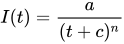
- Sherman's formula, with three parameters (a, c and n), which are a function of the return period, p:
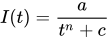
- Chow's formula, also with three parameters (a, c and n), for a particular return period p:
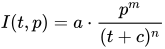
- Power law according to Aparicio (1997), with four parameters (a, c, m and n), already adjusted for all return periods of interest:
In hydrometeorology, the simple power law (taking ) is used as a measure of the time-structure of the rainfall:

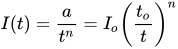
where is defined as an intensity of reference for a fixed time , i.e. , and is a non-dimensional parameter known as n-index. In a rainfall event, the equivalent to the IDF curve is called Maximum Averaged Intensity (MAI) curve.


Theoretical approaches
To get an IDF curves from a probability distribution, it is necessary to mathematically isolate the total amount or depth of the event, which is directly related to the average intensity and the duration , by the equation , and since the return period is defined as the inverse of , the function is found as the inverse of , according to:



- Power law with the return period, derived from the Pareto distribution, for a fixed duration :

- where the Pareto distribution constant has been redefined as, since it is a valid distribution for a specific duration of the event, it has been taken as.

- Function derived from the generalized Pareto distribution, for a given duration :

- Note that for y , the generalized Pareto distribution retrieves the simple form of the Pareto distribution, with . However, with the exponential distribution is retrieved.


- Function deduced from the Gumbel distribution and the opposite Gumbel distribution, for a given duration :

