Brittlebush grows up to 30 to 150 centimetres (12 to 59 inches) tall, with fragrant leaves3–10cm (1+1⁄4–4in) long, ovate to deltoid, and silvery tomentose. Arranged in loose panicles above the leafy stems, the capitula are 3–3.5cm (1+1⁄4–1+1⁄2in) in diameter. Each has 8–18 orange-yellow ray florets, 6–15 millimetres (1⁄4–9⁄16in) in length, and yellow or purple-brown disc florets. The fruit measures 3–6mm (1⁄8–1⁄4in) and no pappus is visible. During dry seasons the plant goes drought deciduous, shedding all of its foliage, relying on the water stored in its thick stems.
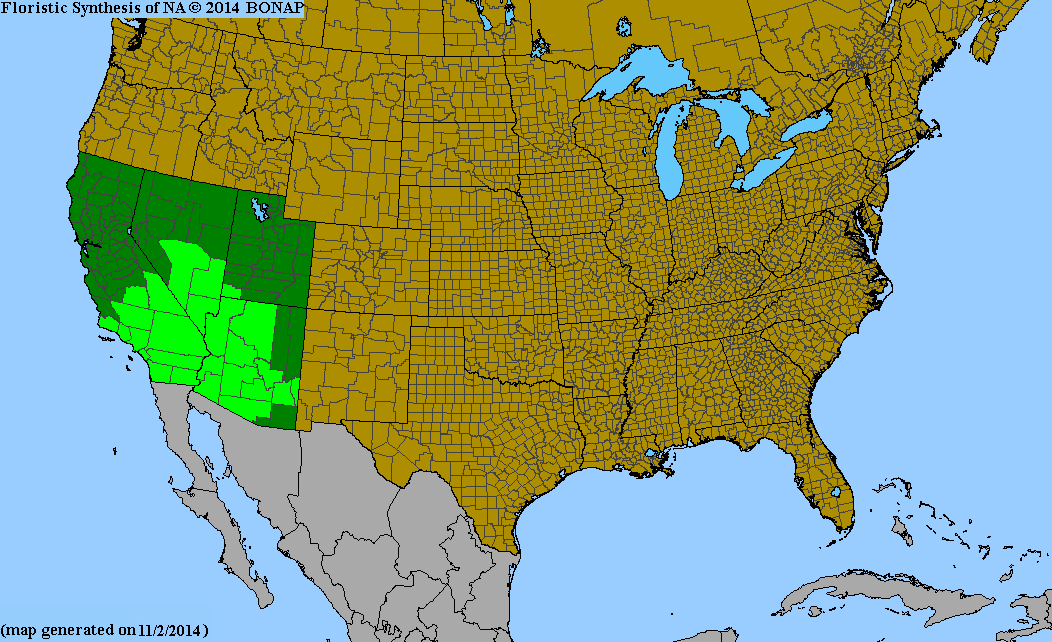
Encelia farinosa var. farinosa – yellow disc florets
Encelia farinosa var. phenicodonta (Blake) I.M.Johnston – purple-brown disc florets
Varieties formerly included E. f. var. radians, now regarded as a separate species E. radians Brandegee.
Etymology
The common name "brittlebush" comes from the brittleness of its stems. Other names include hierba del vaso (Spanish) and cotx (Seri). Another Spanish name for it is incienso because the dried sap was burned by early Spanish missions in the New World as incense.
It can be found in a variety of habitats from dry, gravelly slopes to open, sandy washes up to 1,000 metres (3,300 feet) above sea level. It requires a very sunny position in a deep very well-drained soil, and minimal winter frost.
It does well in cultivation often being used for border, erosion control, ground cover and massing. Recently the plant has spread dramatically in areas not natural to its distribution in large part because Caltrans has begun to use it in hydroseeding.[citation needed]
Uses
Brittlebush has a long history of uses by indigenous and pioneer peoples, including:
Glue: The resin collected from the base of the plant, yellowish to brown, can be heated and used as a glue. The O'odham and Seri use it for hafting, to hold points on arrows and harpoons.
Sealer: A different sort of resin collected from the upper stems is more gummy and generally a clear yellow. The Seri use this to seal pottery vessels.
Incense: Early Spanish friars learned that the resin made a highly fragrant incense, akin to frankincense in odor.
Toothbrush: Oldtime cowboys used brittlebush stem as a fine toothbrush.
Medicinal: Seri use brittlebush to treat toothache; the bark is removed, the branch heated in ashes, and then placed in the mouth to "harden" a loose tooth. The Cahuilla used brittlebush to treat toothaches as well, and used it as a chest pain reliever by heating the gum and applying it to the chest.
Waterproofing: It has been used to waterproof containers.
Varnish: It has been melted then used as a varnish.
12Gacsi/Morgan, April/Steve (January 1992). Deserts of the Southwest Self Guided Tour. Riverside, California: University of California, Riverside Botanic Gardens. p.10.
↑Gray, Reed; Bonner, James (19 March 1948). "Structure Determination and Synthesis of a Plant Growth Inhibitor, 3-Acetyl-6-methoxybenzaldehyde, Found in the Leaves of Encelia Farinosa". Journal of the American Chemical Society. 70 (3): 1249–1253. Bibcode:1948JAChS..70.1249G. doi:10.1021/ja01183a114. PMID18909201.
↑Bohm, Bruce A. (2009). The Geography of Phytochemical Races. Dordrecht: Springer. p.112. ISBN9781402090523.
↑Dunmire, William W. (2004). Gardens of New Spain: How Mediterranean Plants and Foods Changed America. Austin: University of Texas Press. ISBN978-0-292-70564-7.
12Soule, Jacqueline A. (2012). Father Kinos's Herbs: Growing & Using Them Today. Tucson: Tierra del Sol Institute Press. ISBN978-0-9758554-2-3.