He died of gunshot wounds received whilst on active service in France during World War I. He was remembered as being very popular, and "a cheery soul".
Early life
The son of Pietro Egidio "Peter" Bonelli (1844–1888), and Margaret née Williams (1850–1928), James Henry Bonelli was born at Maldon, Victoria on 17 December 1884.
He married Eliza 'Lila' Puncher (1885–1968) in 1912. They had one son, James Avenel 'Arie' Bonella (1913–2002).
Eliza's brother and Jim's brother-in-law, Private James Samuel Puncher (regimental number 482) was killed in action in France on 21 November 1916, serving with the 21st Battalion. He is buried at the AIF Burial Grounds north of Flers, Somme, France.
Football career
Bonella played in the Victorian Junior Association with Pembroke Football Club, South Melbourne, which was formed about 1889. It was noted in the game against Yarraville in August 1908, "if this player would only play more to his club mates, and not run so much, he would be one of the finest juniors playing".
Recruited from Pembroke, he played one senior match for the Melbourne Football Club, in the last match of the season, on a very muddy ground, against Fitzroy, at the Brunswick Street Oval on 5 September 1908.
There had been a two-week break between rounds 17 and 18 due to the 1908 Melbourne Carnival. Melbourne's Dick Fowler, recruited from Caulfield Grammar School, and Fitzroy's Tom Norton, recruited from Hawthorn, also played their first and only senior VFL matches on that day.
Bonella returned to Pembroke, and played for them in 1909, where in one May game he was given to have "played brilliant football".
Military service
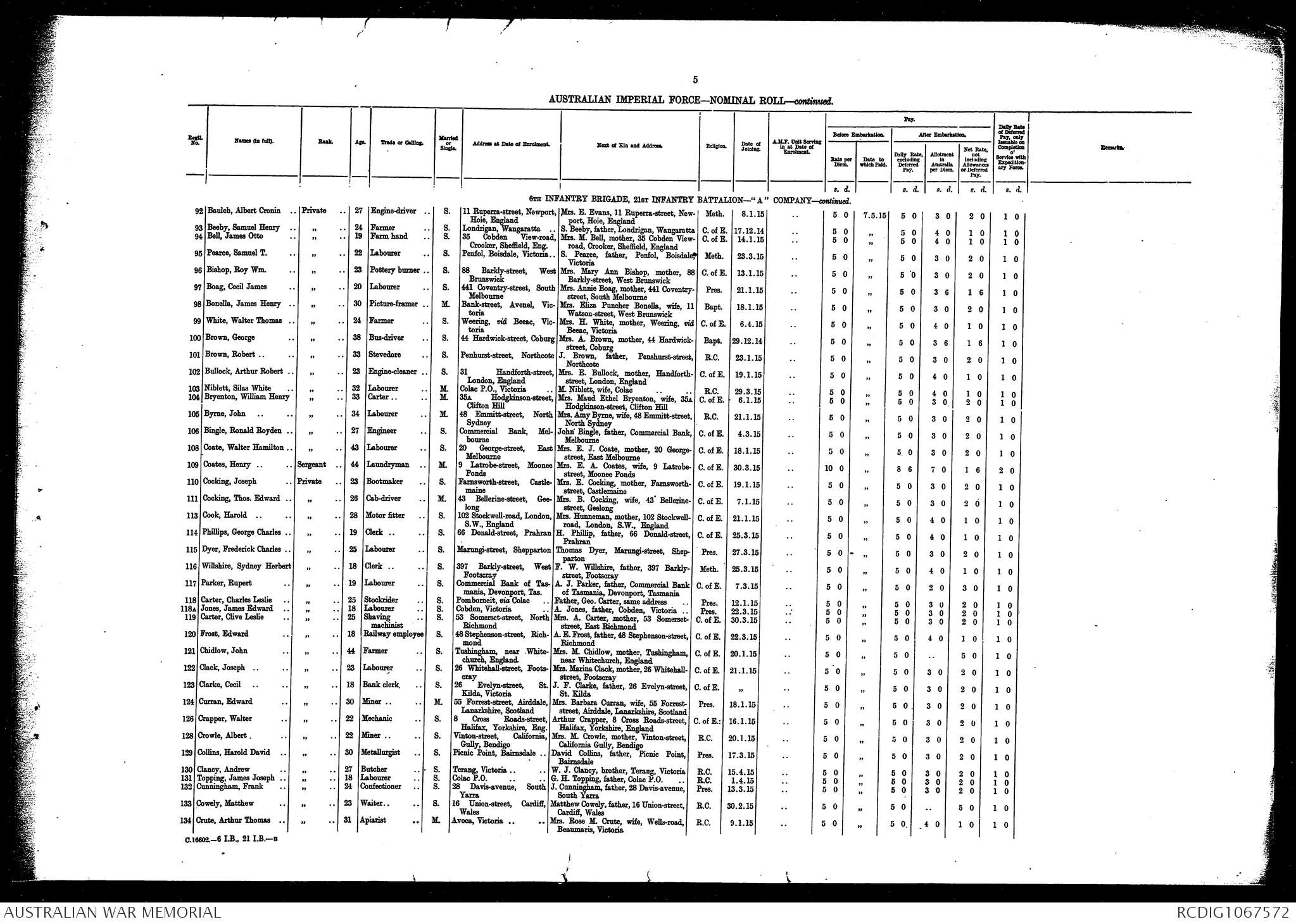
Working as a picture-framer, Bonella enlisted in the First Australian Imperial Force on 18 January 1915. At time of enlistment aged 31, he was given to be 5feet 5.75inches (1.67m) height, 123 pounds (56kg) weight, and a chest of 34 inches (86cm).
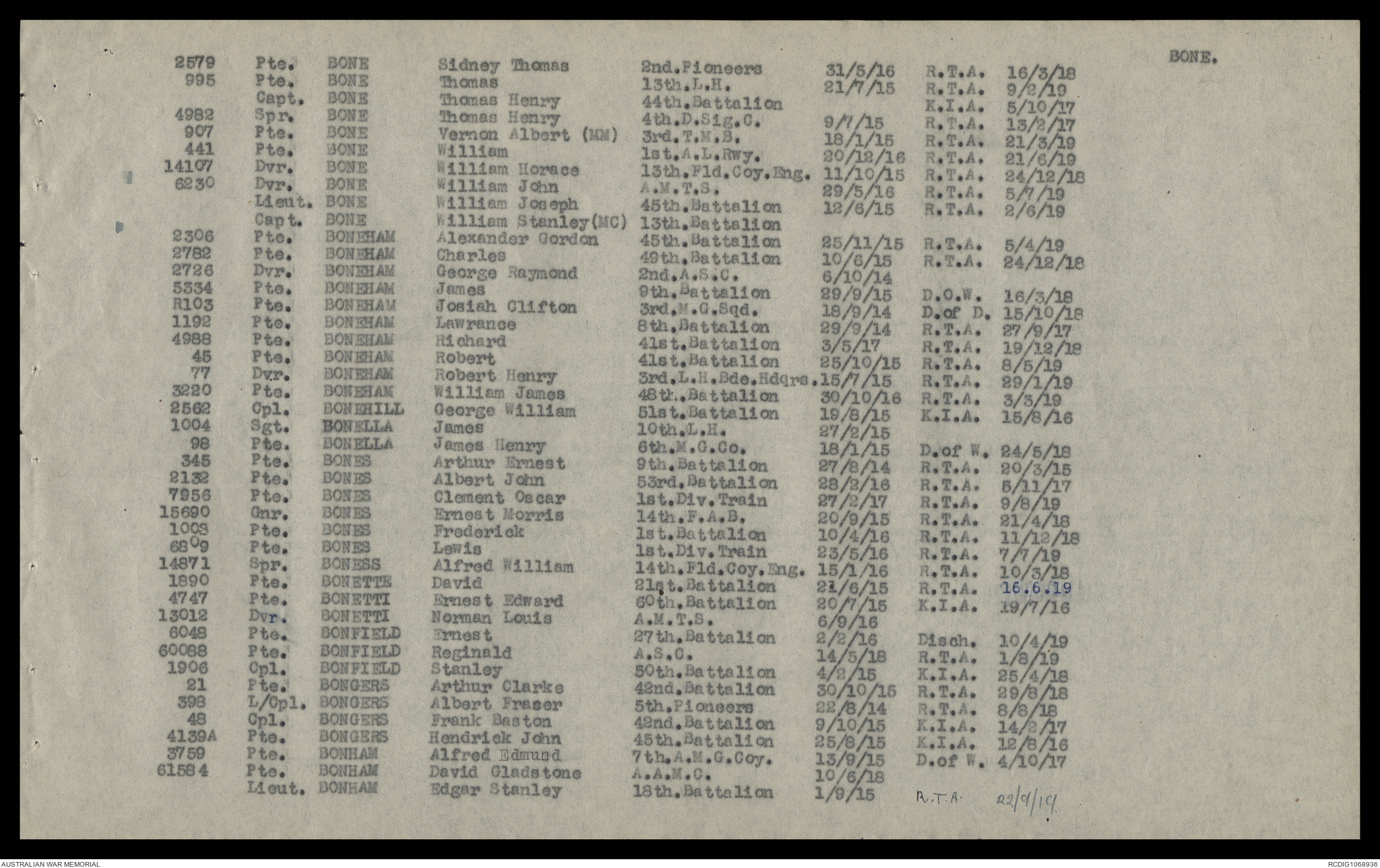
Embarking from Melbourne, Victoria, on HMAT Ulysses (A38) on 10 May 1915, he served overseas as a private in the 2nd Battalion, Australian Machine Gun Corps. He was on the HMAT Southland when it was torpedoed in the Aegean Sea on 2 September 1915.
Death
After three years active service in Gallipoli, Egypt, and France, at the time of the German spring offensive, Bonella was severely wounded in his left thigh, whilst in action with the 21st Battalion, A Company, on 20 May 1918. He was evacuated to a military hospital. Although he had been successfully operated upon on 21 May 1918, he died of his wounds on 24 May 1918.
Bonella is buried in section LXVIII (68), row D, grave 11 of Étaples Military Cemetery, northwest France.
↑Name: Bonilla. Father Pietro died at Kew Mental Hospital on 17 August 1888, his death (due to "brain disease") was registered under the name of "Peter Bonilla".
↑Name: Bonella. At the time of her death, she was known as "Bonella".
↑His father and mother were variously recorded as "Bonelli" and "Bonella", and James' birth (in 1885), his marriage (in 1912), and his son's birth (in 1913) were officially recorded with the family name "Bonelli".
↑Son Arie went onto enlist in World War II with Signals, with service number VX138567.
References
123"Our Heroes". Maldon News. No.2484. Victoria, Australia. 21 June 1918. p.3. Retrieved 30 April 2026– via National Library of Australia.
↑"Family Notices". The Age. No.22, 948. Victoria, Australia. 24 October 1928. p.1. Retrieved 30 April 2026– via National Library of Australia.