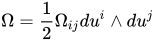
Definition
Suppose that (q1, ..., qn, p1, ..., pn) is a system of canonical coordinates on a phase space. If each of them is expressed as a function of two variables, u and v, then the Lagrange bracket of u and v is defined by the formula

The concept of Lagrange brackets can be expanded to that of matrices by defining the Lagrange matrix.
Consider the following canonical transformation:
Defining  , the Lagrange matrix is defined as
 , where
 is the symplectic matrix under the same conventions used to order the set of coordinates. It follows from the definition that:

The Lagrange matrix satisfies the following known properties: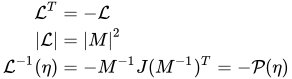 where the
 is known as a Poisson matrix and whose elements correspond to Poisson brackets. The last identity can also be stated as the following:
 Note that the summation here involves generalized coordinates as well as generalized momentum.
The invariance of Lagrange bracket can be expressed as:  , which directly leads to the symplectic condition:
 .