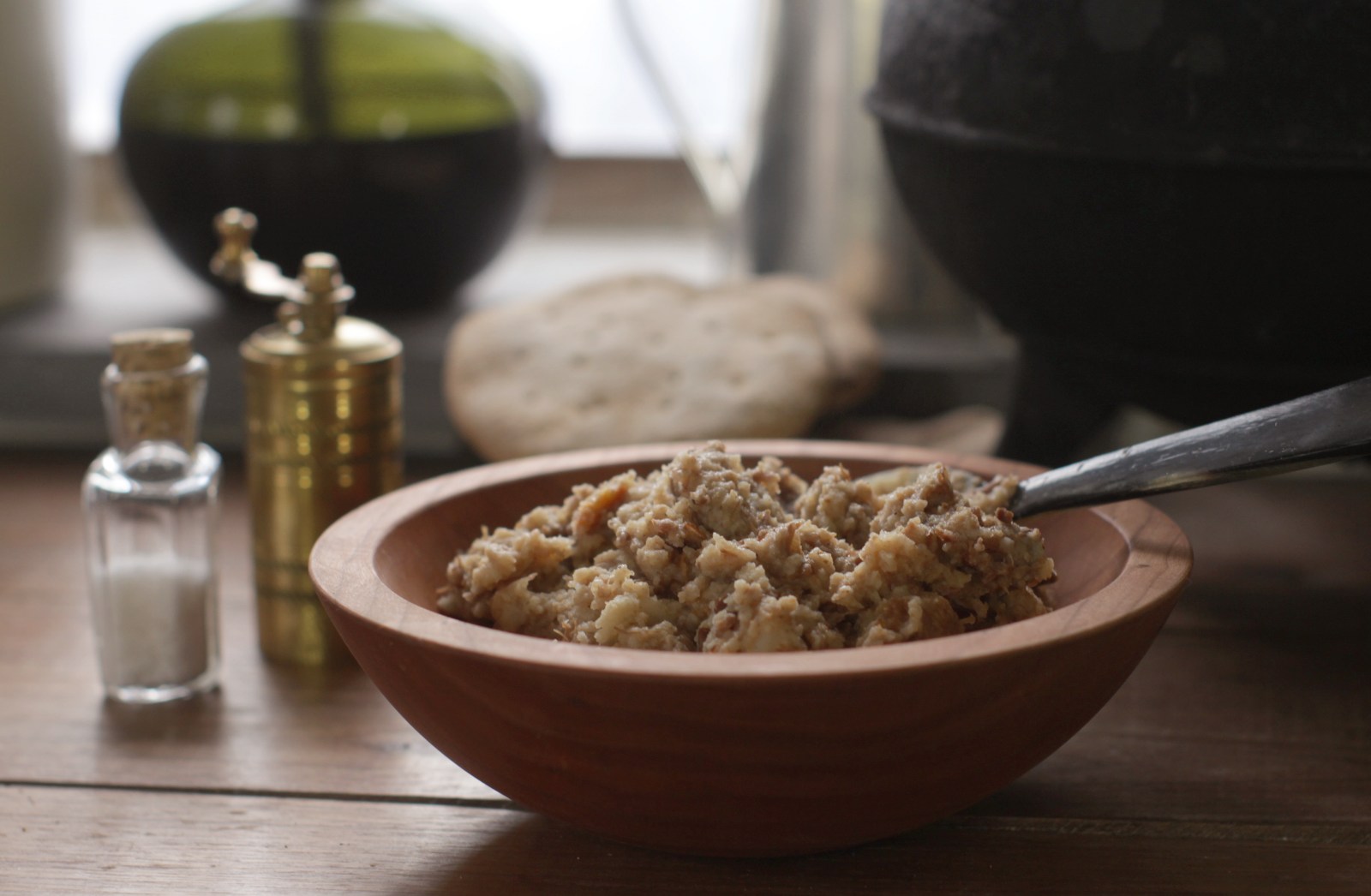
Lobscouse
| Type | Stew |
|---|---|
| Region or state | Northern Europe |
| Main ingredients | Meat, ship's biscuit |
| External image | |
|---|---|
 Lobscouse at savoring the past.net |
Lobscouse was a mariner’s dish in the Age of Sail and was a stew of salted meat and powdered ship's biscuit. It was common to multiple Northern European maritime countries.
It is referred to nautical literature, such as "The Wooden World", as well as fiction such as Patrick O'Brian's Aubrey and Maturin novels.
Etymology

Lobscouse is described as a sailors dish of meat stewed with vegetables and ships biscuit or the like. The oldest citation from the Oxford English Dictionary is from 1706 by the satirist Edward Ward, in "The Wooden World". Tobias Smollett refers to lob's course in 1750 in his novel, The Adventures of Peregrine Pickle, which may refer to prison food; 'Lob', and 'lobs pound', are dialect terms for a 'lout', and a 'lock-up', respectively. The roots of the word are unknown.
Lobscouse has given its name, though not its form, to a variety of dishes around Northern Europe and beyond, such as Norwegian Lapskaus (a meat and potato stew), German Labskaus (a kind of corned beef hash), Danish Skipperlabskovs (da), Swedish Lapskojs (sv) and Finnish Lapskoussi (fi), (all a kind of bubble and squeak), and Newfoundland Lobscouse (a cabbage soup).
Lobscouse is also linked (historically and etymologically) in the UK to "Scouse" (Merseyside), "Lobby" (Staffordshire), and "Lobsgows" (North Wales), all different kinds of stews using local meat, potato and vegetables.
Ingredients and variations
On a long sea voyage only foodstuffs that had been preserved were available, such as salted meat (beef or pork) and ship’s biscuit (bread that had been baked twice to drive out the moisture, and known as "hard tack"). Lobscouse was a stew of salt meat, broken ship’s biscuit, with onions, potatoes and other vegetables as available. The biscuit was prepared by being put in a bag and pounded with a marlinspike or other heavy tool to make a coarse flour: The ingredients were then boiled together to form a coarse savoury porridge.