Mega
A mega, ②, is already a very large number, since ② =
square(square(2)) = square(triangle(triangle(2))) =
square(triangle(22)) =
square(triangle(4)) =
square(44) =
square(256) =
triangle(triangle(triangle(...triangle(256)...))) [256 triangles] =
triangle(triangle(triangle(...triangle(256256)...))) [255 triangles] ~
triangle(triangle(triangle(...triangle(3.2317 × 10616)...))) [254 triangles]
...
Using the other notation:
mega = 
With the function  we have mega =
  where the superscript denotes a functional power, not a numerical power.
We have (note the convention that powers are evaluated from right to left):



 ≈
≈
Similarly:

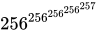

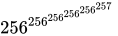

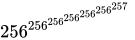
etc.
Thus:
- mega =
 , where
  denotes a functional power of the function
  .
.
Rounding more crudely (replacing the 257 at the end by 256), we get mega ≈  , using Knuth's up-arrow notation.
After the first few steps the value of  is each time approximately equal to
  . In fact, it is even approximately equal to
  (see also approximate arithmetic for very large numbers). Using base 10 powers we get:

 (
( is added to the 616)
 (
( is added to the
  , which is negligible; therefore just a 10 is added at the bottom)
...
- mega =
 , where
  denotes a functional power of the function
  . Hence
Moser's number
It has been proven that in Conway chained arrow notation,

and, in Knuth's up-arrow notation,

Therefore, Moser's number, although incomprehensibly large, is vanishingly small compared to Graham's number:

 a number n in a triangle means nn.
 a number n in a square is equivalent to "the number n inside n triangles, which are all nested."
 a number n in a pentagon is equivalent to "the number n inside n squares, which are all nested."
 , which is equivalent to the pentagon defined above.




