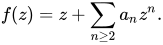
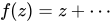
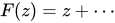
The statement concerns the Taylor coefficients of a univalent function, i.e., a one-to-one holomorphic function that maps the unit disk into the complex plane, normalized as is always possible so that and . That is, we consider a function defined on the open unit disk which is holomorphic and injective (univalent) with Taylor series of the form
Such functions are called schlicht [German for "natural, simple"]. The theorem then states that
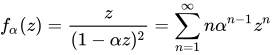
The Koebe function (see below) is a function for all , and it is schlicht, so the inequality bounding the th coefficient is sharp.
Schlicht functions
The normalizations
mean that
This can always be obtained by an affine transformation: starting with an arbitrary injective holomorphic function defined on the open unit disk and setting
A schlicht function is defined as an analytic function that is one-to-one and satisfies and . A family of schlicht functions are the rotated Koebe functions
with a complex number of absolute value . If is a schlicht function and for some
, then is a rotated Koebe function.
The condition of de Branges' theorem is not sufficient to show the function is schlicht, as the function
shows: it is holomorphic on the unit disc and satisfies for all , but it is not injective since
.
Littlewood (1925, theorem 20) proved that for all , showing that the Bieberbach conjecture is true up to a factor of Several authors later reduced the constant in the inequality below .
If is a schlicht function then is an odd schlicht function.
Littlewoodand Paley(1932) showed that its Taylor coefficients satisfy for all . They conjectured that can be replaced by as a natural generalization of the Bieberbach conjecture. The Littlewood–Paley conjecture easily implies the Bieberbach conjecture using the Cauchy inequality (also known as Cauchy's estimate) but it was soon disproved by Fekete & Szegő (1933), who showed there is an odd schlicht function with , and that this is the maximum possible value of . Isaak Milin later showed that can be replaced by , and Hayman showed that the numbers have a limit less than if is not a Koebe function (for which the are all ). So the limit is always less than or equal to , meaning that Littlewood and Paley's conjecture is true for all but a finite number of coefficients. A weaker form of Littlewood and Paley's conjecture was discovered by Robertson (1936).
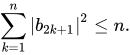
The Robertson conjecture states that if
is an odd schlicht function in the unit disk with then for all positive integers ,
Robertson observed that his conjecture is still strong enough to imply the Bieberbach conjecture and proved it for . This conjecture introduced the important idea of limiting different quadratic functions of the coefficients instead of just the coefficients themselves, which is the same as setting limits on the sizes of certain elements in specific Hilbert spaces of schlicht functions.
Hayman (1955) proved that the limit of exists, and has an absolute value less than unless is a Koebe function. In particular, this showed that for any there can be at most a finite number of exceptions to the Bieberbach conjecture.
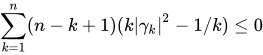
The Milin conjecture states that for each schlicht function on the unit disk, and for all positive integers ,
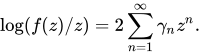
where the logarithmic coefficients of are given by
Milin (1977) showed using the Lebedev–Milin inequality that the Milin conjecture (later proved by de Branges) implies the Robertson conjecture and therefore the Bieberbach conjecture.
In 1983-84, De Branges was writing a book, one chapter of which was on the Bieberbach conjecture. He was surprised by the calculations, which were close to proving the conjecture. Letwhere is the Jacobi polynomial of degree with parameters . is a polynomial of degree k, and it is a hypergeometric series with rational coefficients (the precise coefficients can be derived using the hypergeometric series for Jacobi polynomials).
He showed that if for and , then . He verified this for by hand, finding it too laborious to continue. He asked Walter Gautschi for help, who verified more of these inequalities by Gauss–Jacobi quadrature on a CDC 6500, reaching up to . and then asked Richard Askey whether he knew of any similar inequalities. Askey pointed out that Askey & Gasper (1976) had proved the necessary inequalities eight years before, which allowed de Branges to complete his proof. The first version was very long and had some minor mistakes, which caused some skepticism about it, but these were corrected with the help of members of the Leningrad seminar on Geometric Function Theory (Leningrad Department of Steklov Mathematical Institute) when de Branges visited in 1984.
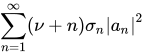
De Branges proved the following result, which for implies the Milin conjecture (and therefore the Bieberbach conjecture).
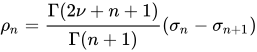
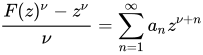
Suppose that and are real numbers for positive integers with limit and such that
is non-negative, non-increasing, and has limit . Then for all Riemann mapping functions univalent in the unit disk with
↑De Branges de Bourcia, Louis; Rovnyak, James (2014). Square Summable Power Series. Dover Books on Mathematics. Newburyport: Dover Publications. ISBN978-0-486-80136-0.
↑Walter Gautschi (1986). "17. Reminiscences of my involvement in de Branges's proof of the Bieberbach conjecture". In Baernstein, Albert; Drasin, David; Duren, David; Marden, Albert (eds.). The Bieberbach Conjecture: Proceedings of the Symposium on the Occasion of the Proof. Mathematical Surveys and Monographs. Vol.21. Providence: American Mathematical Soc. pp.205–211. ISBN978-0-8218-1521-2.
↑Louis de Branges (1986). "16. The story of the verification of the Bieberbach conjecture". In Baernstein, Albert; Drasin, David; Duren, David; Marden, Albert (eds.). The Bieberbach Conjecture: Proceedings of the Symposium on the Occasion of the Proof. Mathematical Surveys and Monographs. Vol.21. Providence: American Mathematical Soc. pp.199–204. ISBN978-0-8218-1521-2.
Baernstein, Albert; Drasin, David; Duren, Peter; etal., eds. (1986), The Bieberbach conjecture: Proceedings of the Symposium on the Occasion of the Proof, Mathematical Surveys and Monographs, vol.21, Providence, R.I.: American Mathematical Society, pp.xvi+218, doi:10.1090/surv/021, ISBN978-0-8218-1521-2, MR0875226
Bieberbach, L. (1916), "Über die Koeffizienten derjenigen Potenzreihen, welche eine schlichte Abbildung des Einheitskreises vermitteln", Sitzungsber. Preuss. Akad. Wiss. Phys-Math. Kl.: 940–955
de Branges, Louis (1987), "Underlying concepts in the proof of the Bieberbach conjecture", Proceedings of the International Congress of Mathematicians, Vol. 1, 2 (Berkeley, Calif., 1986), Providence, R.I.: American Mathematical Society, pp.25–42, MR0934213
Fekete, M.; Szegő, G. (1933), "Eine Bemerkung Über Ungerade Schlichte Funktionen", J. London Math. Soc., s1-8 (2): 85–89, doi:10.1112/jlms/s1-8.2.85
Garabedian, P. R.; Schiffer, M. (1955). "A Proof of the Bieberbach Conjecture for the Fourth Coefficient". Journal of Rational Mechanics and Analysis. 4: 427–465. ISSN1943-5282. JSTOR24900366.
Hayman, W. K. (1955), "The asymptotic behaviour of p-valent functions", Proceedings of the London Mathematical Society, Third Series, 5 (3): 257–284, doi:10.1112/plms/s3-5.3.257, MR0071536
Littlewood, J. E. (1925), "On Inequalities in the Theory of Functions", Proc. London Math. Soc., s2-23: 481–519, doi:10.1112/plms/s2-23.1.481
Littlewood, J.E.; Paley, E. A. C. (1932), "A Proof That An Odd Schlicht Function Has Bounded Coefficients", J. London Math. Soc., s1-7 (3): 167–169, doi:10.1112/jlms/s1-7.3.167
Löwner, C. (1917), "Untersuchungen über die Verzerrung bei konformen Abbildungen des Einheitskreises /z/ < 1, die durch Funktionen mit nicht verschwindender Ableitung geliefert werden", Ber. Verh. Sachs. Ges. Wiss. Leipzig, 69: 89–106
Milin, I. M. (1977), Univalent functions and orthonormal systems, Providence, R.I.: American Mathematical Society, MR0369684 (Translation of the 1971 Russian edition)
Nevanlinna, R. (1921), "Über die konforme Abbildung von Sterngebieten", Ofvers. Finska Vet. Soc. Forh., 53: 1–21
Pederson, Roger N. (December 1968). "A proof of the Bieberbach conjecture for the sixth coefficient". Archive for Rational Mechanics and Analysis. 31 (5): 331–351. Bibcode:1968ArRMA..31..331P. doi:10.1007/BF00251415.
Pederson, R.; Schiffer, M. (1972). "A proof of the Bieberbach conjecture for the fifth coefficient". Archive for Rational Mechanics and Analysis. 45 (3): 161–193. Bibcode:1972ArRMA..45..161P. doi:10.1007/BF00281531.