Mathematical constant
number theory , Niven's constant , named after Ivan Niven , is the largest exponent appearing in the prime factorization of a natural number "on average". More precisely, if we set
H
(
1
)
=
1
{\displaystyle H(1)=1}
H
(
n
)
{\displaystyle H(n)}
n
>
1
{\displaystyle n>1}
lim
n
→
∞
1
n
∑
j
=
1
n
H
(
j
)
=
1
+
∑
k
=
2
∞
(
1
−
1
ζ
(
k
)
)
=
1.7052111401
…
{\displaystyle \lim _{n\to \infty }{\frac {1}{n}}\sum _{j=1}^{n}H(j)=1+\sum _{k=2}^{\infty }{\bigg (}1-{\frac {1}{\zeta (k)}}{\bigg )}=1.7052111401\dots }
where
ζ
{\displaystyle \zeta }
Riemann zeta function . Niven also proved that
∑
j
=
1
n
h
(
j
)
=
n
+
c
n
+
o
(
n
)
,
{\displaystyle \sum _{j=1}^{n}h(j)=n+c{\sqrt {n}}+o({\sqrt {n}}),}
where
h
(
1
)
=
1
{\displaystyle h(1)=1}
h
(
n
)
{\displaystyle h(n)}
n
>
1
{\displaystyle n>1}
o
{\displaystyle o}
little-o notation , and
c
=
ζ
(
3
2
)
/
ζ
(
3
)
{\displaystyle c=\zeta (\textstyle {\frac {3}{2}})/\zeta (3)}
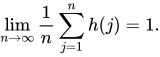
lim
n
→
∞
1
n
∑
j
=
1
n
h
(
j
)
=
1.
{\displaystyle \lim _{n\to \infty }{\frac {1}{n}}\sum _{j=1}^{n}h(j)=1.}