Unity Theatre was a left-wing amateur theatre club based in several venues in London between 1936 and 1994. It was linked to the Communist Party and allied with the Left Book Club Theatre Guild.:32 Over the years, Unity became affiliated with left-leaning theatres in other parts of London and in Aberdeen, Edinburgh, Glasgow, Cardiff, Liverpool, Leeds, Manchester, Birmingham, Bristol, Oxford, and elsewhere.:124
During its lifetime, Unity mounted over 250 productions, most of which were new plays, and toured extensively. Its stylistic repertoire was wide, spanning pantomimes, musicals, mass declamations, revues, music hall, sketches, Living Newspapers, agitprop, and conventional three-act plays.:17
Initially operating from a hall in Britannia Street in Somers Town, Unity moved in 1937 to a converted former chapel in Goldington Street in the same area. After the theatre was destroyed by fire in 1975, productions continued sporadically in other venues until 1994. The original site was sold for social housing, becoming Unity Mews: a plaque commemorates the former theatre.
History
Origin and aim
Aerial view of Unity Theatre in Goldington Street, Somers Town, London, in 1974, with alley entrance at bottom right
Unity Theatre emerged from the coming together in the 1930s of the Workers' Theatre Movement with Left Theatre, Group Theatre, and other London-based workers' theatre groups. It attempted to create "a single focus for socialist drama",:121 proclaiming that::99
Its aim is to help in the vitally urgent struggle for world peace, and a better social and economic order, by establishing a drama which deals with realities, and reflects contemporary life, instead of plays which merely provide a dream world of escape, and at best depict false ideas of life.
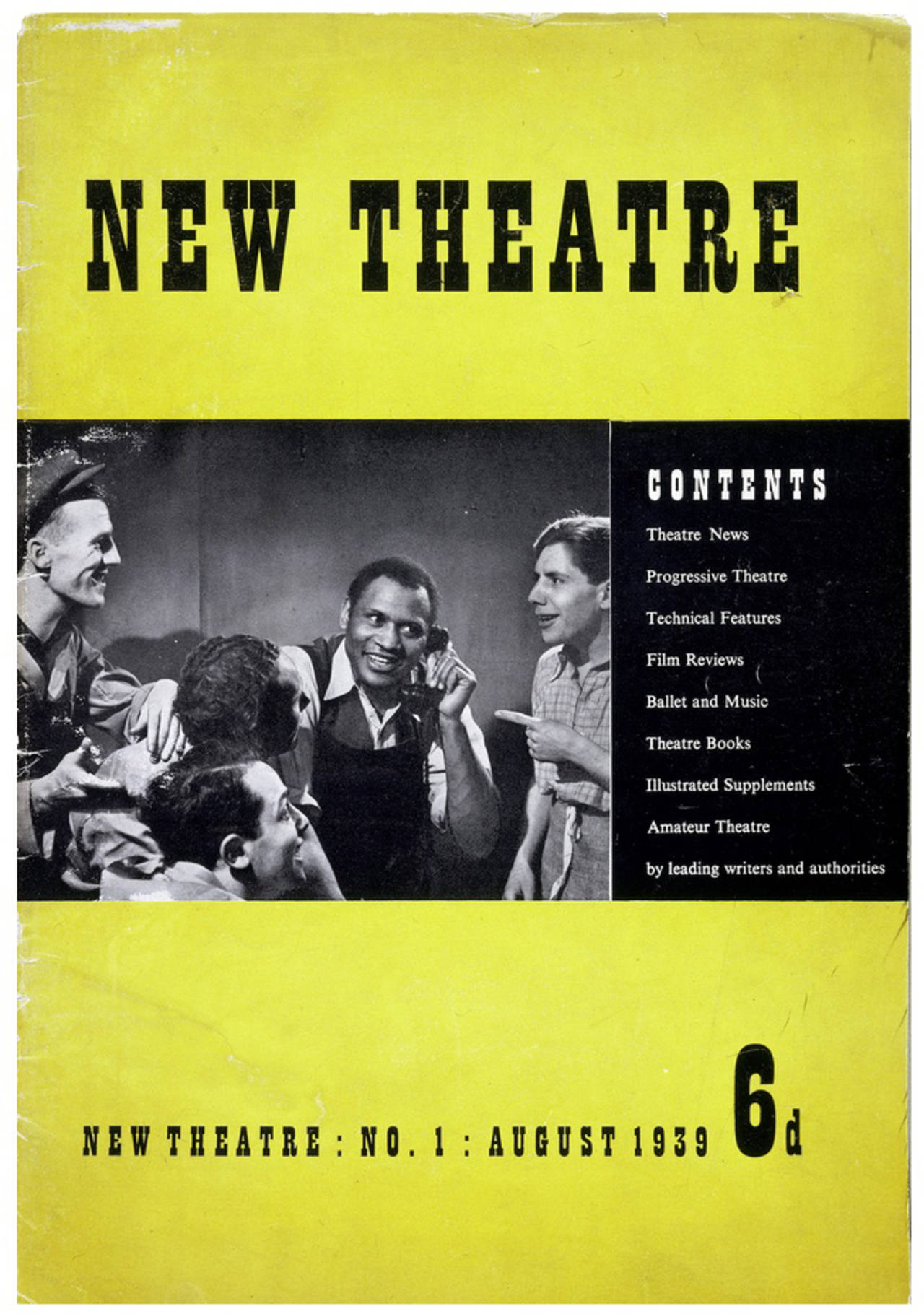
After moving to Goldington Street in 1937, Unity Theatre registered as a cooperative society, Unity Theatre Society Ltd.,:15 and set up the Unity Theatre Club. The club organised a multitude of cultural and social activities including folk, film, and poetry clubs, a choir, an orchestra, rambles, and parties and dances.:123 The society established a school of dramatic studies,:28:137 and in 1939 launched a glossy magazine, New Theatre.:182
First decade
In its early productions, Unity used several then-novel dramatic forms–satirical pantomime, Living Newspaper,:141 and mass declamation:80–and brought an international perspective to the London stage with plays by American, Irish, continental European and Russian dramatists.:126,132
When strife disturbs and wars corrupt our age
Keen satire is the business of the stage.
When the curtain falls upon our pantomime tonight
Join with the workers in the social fight.
The programme included lyrics for some of the production's songs.:9Babes in the Wood ran for seven months, and the critic Montagu Slater said the play "had more direct effect on current politics than any other single production in the history of the English stage".
Living Newspapers
Written and staged in early 1938, Living Newspaper No.1: Busmen, the first British Living Newspaper, dramatised the strike by London busmen in May 1937 for a shorter working day and less onerous schedules.:340
Busmen who had been strikers were involved in researching material for the play, which incorporated newspaper reports, meeting minutes, transcripts of speeches, statistics, and conversations overheard in bus queues and on buses. A series of short scenes interwove factual material with fictional reconstructions of events, switching between the formal discourse of politicians and trades union officials, extracts from op-eds and editorials, dialogues, statements of facts and figures, and the views of busmen. A "Voice of the Living Newspaper", offstage in the flys above, provided linking commentary. The non-naturalistic style of staging and production drew on the work of German Expressionist playwrights such as Erwin Piscator and Ernst Toller. Alan Bush composed the music, Herbert Hodge wrote scenes between a bus driver and his wife, and Montagu Slater composed the verse. Directed by John Allen, the play ran for three months and attracted generally favourable reviews.:7:341,345–346
Living Newspaper No.2: Crisis covered the appeasement crisis of September 1938. Put together by the company in 36 hours, it opened on 29 September, the day Chamberlain met Hitler and Mussolini in Munich. The production was updated as events unfolded.:7:162–165
Mass declamations
Who are the English? was the first of several mass declamations written by Jack Lindsay. Performed in 1936 initially by Unity and then by other left-wing theatre groups, it invoked and celebrated radicals and revolutionaries in British history in an alternative to the traditional imperialist narrative::127–128
I call on those who left the little farms
and left the common lands at Parliament's voice
to chase the grave and comely henpecked king.
I call on Cromwell's Ironsides and the men
who listened to the many voices blown, distracted,
birdcries out of the thicket of blood-darkness...
Come, you Anabaptists and you Levellers,
come, you Muggletonians, all you Bedlamites,
fall in behind us, you are not English, comrades.
—Jack Lindsay (1936), Who are the English? (extract from sixth verse)
Spain
Unity was active in the anti-fascist movement supporting the Spanish Republic during Spain's civil war.:82–88 In 1936, the troupe performed Spain, a poem by Randall Swingler adapted by Edgar Criddle for mass declamation as "A drama of modern history"::151–156
spain– People of England, while you ponder, The ring is closing, the iron ring that strangles us. Your government is ready now To sacrifice its boasted empire To uphold the privilege of its class. ... Time weighs heavily on us. The voice of the people crying to the people: "Today it is us Tomorrow it will be you". chorus & peasant– People of England, what are you going to do?
—Final lines of Spain: A drama of modern history (Unity acting script):288–289
A reworking of Jack Lindsay's poem On Guard for Spain! followed in 1937. Transformed by Unity into a declamatory piece for voices and chorus, there were several versions, with Lindsay writing extra stanzas at Unity's request. On Guard was performed by theatre groups across Britain::82–85
spanish man– Workers, drive off the fascist vultures gathering to pick the bones of Spanish cities, to leave the Spanish fields dunged with peasant dead that greed may reap the fattened crops. spanish woman– Fuse your unity in the furnace of our pain. spanish man– Enter this compact of steel. spanish man & spanish woman– And then we shall not complain. all women– On guard for the human future! all men– On guard for the people of Spain!
—Final stanza of On Guard for Spain! (Unity acting script):254
Wartime
In May 1939, the society recorded 7,000 members, with affiliated organisations (such as trades union branches and cooperative societies) accounting for another 250,000.:14
On 3 September that year, Britain declared war on Germany at the outbreak of World War II, and all theatres and other places of public entertainment were closed. Unity Theatre re-opened two weeks later (the first theatre to do so), staging a revue, Sandbag Follies, and then another, Turn Up the Lights. Both criticised government policy, with Unity declaring in a pamphlet that "We are the first theatre to attack the war policy of a government in wartime since Euripedes' Trojan Women was performed in Athens in 415BC.":128
Many of the troupe's actors and writers were conscripted, and the theatre was bombed several times. Unity remained active throughout the conflict: besides staging plays, pantomimes and revues, from September 1940, at the start of The Blitz, its Outside Show (later Mobile) Group presented plays and sketches in factories, hospitals, parks, and air-raid shelters, putting on over 1,000 performances. Ann Davies described performing in a shelter in Belsize Park tube station::129
Swanee River, John Brown's Body, Roll out the Barrel, etc., got them interested... prepared the way for a couple of sketches, solos, songs and jokes. Ten minutes at one end of the platform, and ten the other... and finally a show at each end of the liftshafts. Even when these items had to be done sideways-on... they went over big, and the crowd was almost as pleased as we were.
The chief theatre critic of The Sunday Times, writing in 1990, said:
The best work of the Unity Theater was done in the 1930s and during World War II. At a time of great poverty and ideological confusion, it provided a political and artistic outlet for people who were getting tired of being patronized and who were increasingly suspicious of their politicians.
Postwar
Professional company
Shortly after the end of the war, Unity declared its intention to set up a professional repertory company::10–11
We have left behind the rather narrow propaganda play... The people have developed a breadth of interest and confidence which demands a new expression... [and they] demand technical competence. Therefore the amateur theatre must raise its standards.... Therefore, Unity Theatre aims at creating a professional theatre alongside its amateur companies.
The professional company launched in early 1946 under the direction of Ted Willis with a production of Eugene O'Neill's All God's Chillun Got Wings. In May 1947, for economic reasons, the venture collapsed: several productions had been flops, no subsidy from the newly founded Arts Council was forthcoming, and with the advent of the Cold War, Unity's popularity suffered from its association with the Communist Party.:140–141
Role
During the war's aftermath, the satirical and documentary approaches taken in Unity Theatre productions became mainstream both in professional theatres in London and popular television programmes. According to Chambers (1989), "Unity turned inwards and failed either to find a new role or to renew with sufficient vigour its traditional one.":349–350 The London theatre closed after a fire in 1975.:395–397 In the view of Peter (1990), "[Unity Theatre] finally expired...because it represented a spirit of old-fashioned opposition and could not find its place in a more strident and increasingly prosperous age."
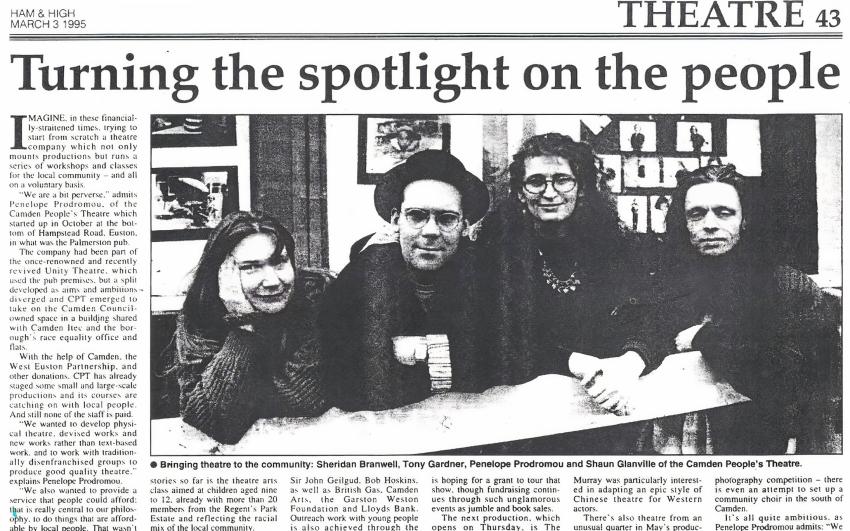
Attempts were made to revive the theatre in the late 1980s and early 1990s with a studio theatre in the space now occupied by Camden People's Theatre. The Merseyside Left Theatre, which became an affiliate of Unity Theatre in 1939, has, since 1944, operated first as Merseyside Unity Theatre and then as Unity Theatre Liverpool. Unity Theatre Cardiff, formed in 1942, left the Unity Theatre movement in 1948 and was renamed Everyman Theatre Cardiff.
The Unity Theatre Trust was established in 1962 as a registered charity with the aim of "[advancing] the education of the public by fostering, promoting and increasing the interest of the public in the art of drama and the co-related arts." It maintains an archive and awards grants.
The designers of Unity Theatre's sets, costumes, and programmes included James Friell and Lawrence Gowing (sets for Babes in the Wood); James Boswell, who designed the programme for Giant Ripper (1940); and John Heartfield, who contributed to the translation and design of the Soviet thriller Comrade Detective (1944).:104 Rivka Black and Ern Brooks created sets and costumes for various productions.:39 During the 1950s and 1960s, Ken Sprague designed several sets for productions of Shaw's The Apple Cart, Chekov's The Cherry Orchard, and Miller's The Crucible.:45Sean Kenny designed the sets and lighting for Bloomsday (1960), an adaptation of Joyce's novel Ulysses.:352
Managers
Managers, at various times, of the theatre or its sectional activities included Heinz Bernard (director), Alec Bernstein (chair),:265 Raymond Cross (business manager), Jack Firestein (who ran Unity's folk club and bookstall),:357Oscar Lewenstein (general manager, and secretary of the national society),:265 and André van Gyseghem (president).:28
Productions
Chambers (1989) chronicles productions in Unity's two principal theatres: Britannia Street, covering 1936 and 1937, and Goldington Street, from 1937 to 1975 (when the theatre burnt down). He also lists performances that took place in various venues from 1976 to 1983 and touring productions.:403–408 The Unity Theatre Trust lists productions from 1936 to 1994.
123In mass declamation, a group of actors (the mass) performs choral speech, chanting and song accompanied by choreographed movements. For a first-hand account of the impact of this technique on audiences of the time, highlighting Unity's production of On Guard for Spain!, see: Beste, R. Vernon (May 1943). "On Mass Declamations". Our Time. 2 (11): 5–6, 29–30. Retrieved 29 September 2026– via Internet Archive.
↑The Workers' Theatre Movement in Britain was established in 1926.:89–90
↑Breden (2020) reproduces an acting script based on the version used by Bristol Unity Players with amendments drawn from London Unity Theatre archives and versions of Lindsay's original poem.:239–240
↑During the war, Ann Davies became the theatre's first woman president.
↑Chambers stops in 1983 because, in his view, "arguments intensified over who could legitimately represent Unity to such an extent that further additions would have been meaningless".
↑Unity Mews, NW1 (zoomable map with choice of map years: selecting 1950 shows former location of Unity Theatre). Cartography by OpenStreetMap. London: The Underground Map. 2026 [2024]. Retrieved 11 October 2026.
↑
Paget, Derek (2002). "Mass declamation". In Chambers, Colin (ed.). The Continuum Companion to Twentieth Century Theatre (1sted.). London: Continuum. pp.483–484. ISBN978-0-826-44959-7. OCLC49506807.
↑
Unity Theatre (c. 1938). "Innocence Outraged" (programme for Babes in the Wood). Retrieved 28 August 2026– via Internet Archive.
1234
Breden, Simon (2020). El Unity Theatre y la Guerra Civil española[Unity Theatre and the Spanish Civil War] (in Spanish). Madrid: Guillermo Escolar Editor. ISBN978-8-418-09359-3. OCLC1203145608. This book contains, in English, full versions of Spain, On Guard for Spain!, Before Guernica, Insurgent's Aid Committee, Madrileñas, We Fight On, All One Battle, and This Trampled Earth.
↑
Brown, F. J. (January 1942). "Let the People Sing". Our Time. 1 (10): 27–29. Retrieved 29 September 2026– via Internet Archive. Brown lists some performance sites and describes how the Outside Show Group engaged with its audiences.
↑"Turning the spotlight on the people". Ham & High. Camden People's Theatre. 3 March 1995. p.43. Retrieved 29 August 2026. [The company] started up [in] Hampstead Road, Euston, in what was the Palmerston pub...[it] had been part of...[the] recently revived Unity Theatre, which used the pub premises.
12Lindey, Christine (2018). Art for All: British Socially Committed Art from the 1930s to the Cold War. London: Artery Publications. ISBN978-0-95582-288-9. OCLC1010955299.
↑"Jack the Giant-Killer" (extract of words and music of songs). London: Workers' Music Association. c. 1941. Retrieved 11 September 2026– via V&A.
↑Tank, Herb (1952). Longitude 49: A play by Herb Tank. New York: New Playwrights. Retrieved 20 September 2026– via Internet Archive. p.iii: On October 27, 1950, Longitude 49 was presented under the author's direction at Unity Theatre, London.
↑Williams, Jared (n.d.). "The Wages of Eve". Theatricalia. Retrieved 20 September 2026.
Unity Theatre Society (1945). People's Theatre: The Story of Unity Theatre (illustrated). London: Progress Publishing. OCLC639664044. Describes the history of the theatre, the influence of American, Russian and Spanish drama on its productions, the impact of World War II on its activities, links with other theatre groups under the Unity Theatre Society umbrella, and plans for the launch of a professional company.
Unity Theatre Society (1939). Unity Theatre Handbook (illustrated). London: Vail & Co. OCLC562512600. Describes the early history and productions of the theatre, and the management and activities of the Unity Theatre Society.