Virginia 10 Miler
| Virginia 10 Miler | |
|---|---|
 | |
| Date | September |
| Location | Lynchburg, Virginia, U.S. |
| Event type | Road |
| Distance | 10 miles (16 km) |
| Established | 1974 |
| Website | virginia10miler.com |
The Virginia 10 Miler is a historic 10 mile road race held annually in Lynchburg, Virginia. First run in 1974, it is one of the oldest 10 milers in the U.S. The race has hosted some of the best distance runners in the world, including Rod Dixon (course record holder with 46:50 in 1981), U.S. marathon champion Bill Rodgers, Olympic Gold medal winners Frank Shorter, Joan Benoit Samuelson, and Lasse Viren, and Olympic Silver medal winner Grete Waitz (course record holder with 53:05 in 1979). It continues to attract elite national and international runners.
The race event also includes a four mile race and walk, as well as "Amazing Mile" Kids Races the day before in downtown Lynchburg. The race is typically held at the end of September. Since 2021 the race has been called the Moore and Giles Virginia 10 Miler. The most recent race was held on Saturday, September 26, 2026.
History
The idea for the Virginia 10 Miler came in 1973 from a Lynchburg engineer and runner named Rudy Straub. Straub and some friends, who were part of the Lynchburg Area Track Club, wanted to create a long-distance road race that would encourage running in the community, and draw top athletes to Lynchburg. For that purpose they created a new club called the Lynchburg Road Runners, and with the support of First Colony Life Insurance Company, put on the first race in September, 1974. The total budget for the event was $550, with no prize money. The race, won by John Vitale in 49:14, had 225 starters, and included several national-level middle-distance runners, two of whom had been Olympic competitors, Marty Liquori and Jeff Galloway.
The following year, Straub, as race director, was able to entice two nationally-known runners, Bill Rodgers and Frank Shorter, to compete by offering them $500 each (unofficially, a common practice of the time). Rodgers, a top marathoner who would go on to win the Boston Marathon and the New York City Marathon four times each, drove down from Boston in his VW. Shorter had won the Gold medal in the marathon at the 1972 Summer Olympics three years before, and was one of America's most famous runners. The number of entrants in the race almost doubled, and Rodgers and Shorter crossed the finish line together, in a time of 48:17. Straub's unique marketing ideas, the nascent boom of road racing in the 1970s, and the presence of elite athletes flagged the race as a premier event that drew other top runners. The following year, 1976, Rodgers won again, with a time 0f 47:48, and Julie Shea of North Carolina broke the one-hour mark for the first time for women runners, with a time of 57:57.
Over the next decade the race continued to grow in number of participants and national recognition. In 1979, Norwegian Grete Waitz, who would go on to win a Gold medal in the marathon at the 1983 World Championships, and a Silver medal at the 1984 Olympics, took almost four minutes off the previous fastest women's time, with 53:05, a course record which still stands. Two years later New Zealander Rod Dixon, a Bronze medalist in the 1500 at the 1972 Olympics, ran the course in 46:50, also still the course record. In 1981, ESPN, then a new sports network, gave the race further publicity by having a reporter cover the race by running it with a helmet-mounted camera.
In 1986 the number of participants reached a high point, with more than 2,600 completing the race. Four-time Olympian Australian Rob de Castella won with a time of 47:49, after having missed Dixon's record by two seconds the previous year. New Zealander Anne Audain won the women's division with a time of 55:02, the fourth of her six wins.
In 1996, for the first and only time, the race winners were a married couple, Mark Coogan (50:55) and Gwyn Coogan (1:00:41), who had also been the first married couple to compete in the U.S. Olympic marathon trials earlier in the year.
Participation in the 10 Miler decreased from its peak in the 1980s and by the mid-2000s hit a "slump." By 2004-2006 the number of runners for the 10 Miler had dwindled to barely 500, and the winning time in 2005 was 10 minutes slower than it had been in the 1980s.
By 2009 however, participation and times began to improve, in part due to incentivizing elite runners to return, as well as returned stewardship of the race to the Lynchburg Road Runners Club. In 2007 the total prize money pool had been $650; by 2013 in had increased to $14,400. In 2013, the number of finishers in the 10 Miler had increased to 1,500, with winning times under 48 minutes again.
Other developments in the history of the race include:
- 1999: A separate four mile race was added to the event. In 2021 the four mile course was modified and extended, and is now referred to as the "4+ Miler."
- 2001: The initiation of children's races and other family-friendly activities, organized by the Amazement Square children's museum in downtown Lynchburg.. In 2026 the "Amazing Mile" Children's Run completed its 25th year.
- 2001: The initiation of a color guard run as part of the 10 mile race, originated by Marine Corps veteran Steve Bozeman after the September 11, 2001 attacks. A set of participants run the entire course carrying ceremonial flags in honor of veterans and the fallen. 2026 saw the 25th running of the color guard.
- 2010: Inception of the Virginia 4 Mile Walk.
- 2014: The Virginia 10 Miler was named the 2014 Road Race of the Year by the Road Runners Club of America. The award recognizes "events that are organized as nonprofit races that provide safe, well-designed, and enjoyable events that promote grassroots running and the mission of the RRCA.”
- 2020: Race was not held due to the COVID-19 pandemic.
In 2021 title sponsorship of the race was taken over by the Moore and Giles leather goods and furniture company. In 2026, there were more than 3,700 participants among all the events, including 1,427 finishers in the 10 Mile race.
Course
| External image | |
|---|---|
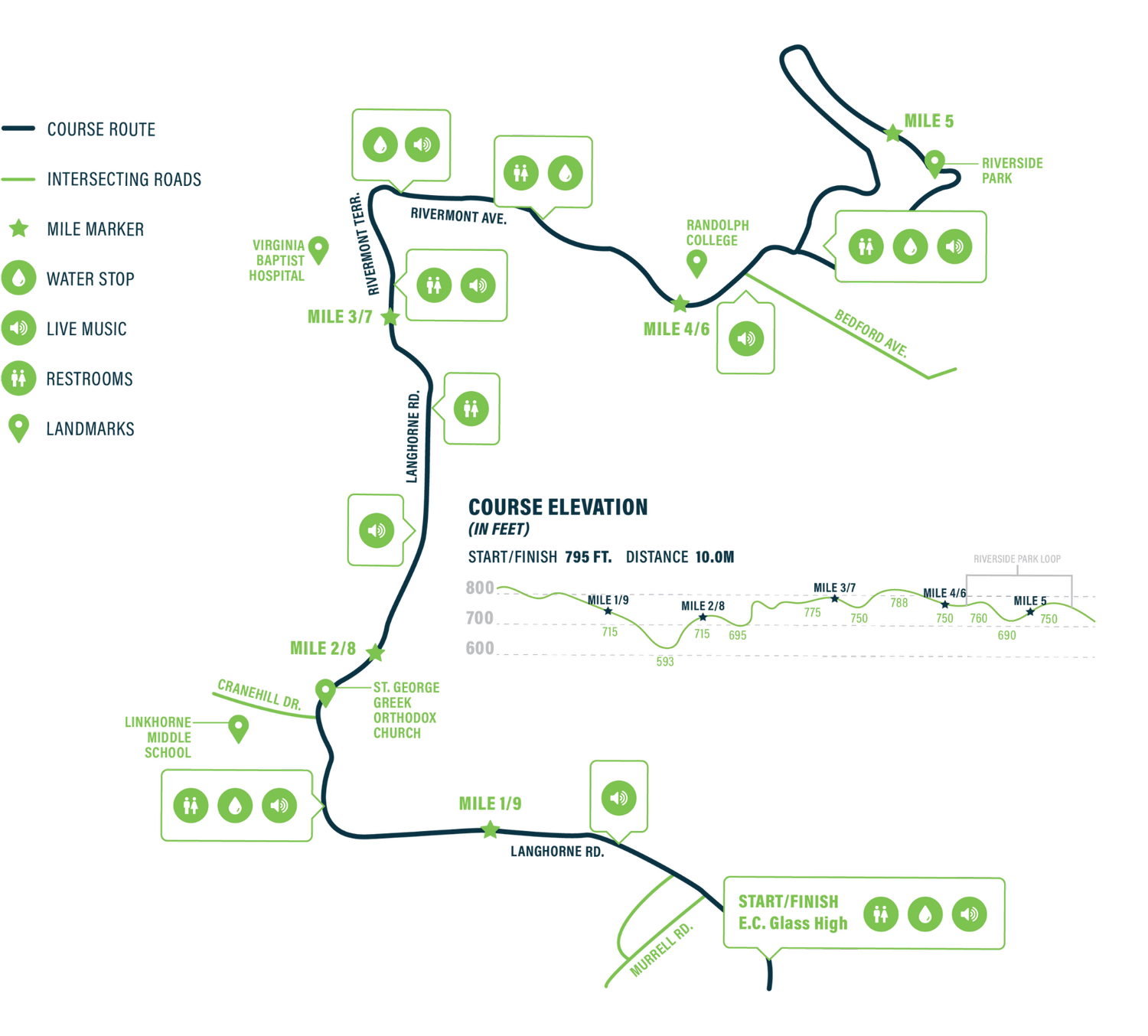
| Course map | |
 The Virginia 10 Miler Course Map |
The 10 Miler course is hilly and often described as challenging. The race is an out-and-back course, with a loop near the midpoint. The course starts at E.C. Glass High School and goes downhill for roughly the first mile and a half, dropping 200 ft (61 m) in elevation until reaching a low point at what is known as "The Farm Basket" (from a local farm produce store there). It then climbs a series of rolling hills along Langhorne Road until turning on Rivermont Avenue, passing Randolph College, then entering Riverside Park, where it makes a loop including a short, steep hill near the halfway point, then returns the same way. The last 1.5 miles from The Farm Basket are uphill. The course has not changed in its history.
Race entrants may compete as individuals or in corporate or open teams. The race organizers and top runners have noted that, because of its hilliness, the race is ideal training for marathons later in the fall, and the competitors who do well at Lynchburg typically do well in later races.
Past winners
Key:
Course record
Source: 1974-1981 and 1997-present. 1982-1996.
| Year | Men's winner | Time (m:s) | Women's winner | Time (m:s) |
|---|---|---|---|---|
| 1974 |  John Vitale (USA) |
49:14 | Gail Hafley (USA) |
1:07:45 |
| 1975* | Bill Rodgers, Frank Shorter (USA) |
48:17 | Deborah Snaggs (USA) |
1:04:48 |
| 1976 | Bill Rodgers (USA) |
47:48 | Julie Shea (USA) |
57:57 |
| 1977 | Bill Rodgers (USA) |
48:14 | Kim Merritt (USA) |
58:11 |
| 1978 | Bill Rodgers (USA) |
48:33 | Julie Shea (USA) |
57:01 |
| 1979 | Herb Lindsay (USA) |
47:01 |  Grete Waitz (NOR) |
53:05 |
| 1980 |  Rod Dixon (NZ) |
46:51 |  Jacqueline Gareau (CAN) |
55:41 |
| 1981 | Rod Dixon (NZ) |
46:50 | Anne Audain (NZ) |
53:54 |
| 1982 | Jon Sinclair (USA) |
47:34 | Maureen Roben (USA) |
56:19 |
| 1983 | Rod Dixon (NZ) |
47:12 | Jacqueline Gareau (CAN) |
54:41 |
| 1984 |  Gabriel Kamau (KEN) |
46:59 | Anne Audain (NZ) |
53:47 |
| 1985 |  Rob de Castella (AUS) |
46:52 | Anne Audain (NZ) |
54:05 |
| 1986 | Rob de Castella (AUS) |
47:49 | Anne Audain (NZ) |
55:02 |
| 1987 | Jon Sinclair (USA) |
47:19 | Anne Audain (NZ) |
54:56 |
| 1988 | Jon Sinclair (USA) |
48:09 | Anne Hannam (NZ) |
54:40 |
| 1989 | John Halvorsen (NOR) |
47:54 | Diane Brewer (USA) |
55:52 |
| 1990 | John Halvorsen (NOR) |
47:40 | Kellie Archuletta (USA) |
55:27 |
| 1991 | Jon Sinclair (USA) |
48:19 | Anne Audain (NZ) |
55:28 |
| 1992 | John Halvorsen (NOR) |
48:22 | Julie Burtner (USA) |
1:06:39 |
| 1993 | Jon Sinclair (USA) |
50:14 | Libbie Hickman (USA) |
1:00:17 |
| 1994 | Matt Richards (USA) |
54:25 | Leslie Minnix (USA) |
1:02:09 |
| 1995 |  Martín Mondragón (MEX) |
50:49 | Elizabeth Andrews (USA) |
1:03:28 |
| 1996 | Mark Coogan (USA) |
50:55 | Gwyn Coogan (USA) |
1:00:41 |
| 1997 | Peter Githuka (KEN) |
48:55 |  Valentina Yegorova (RUS) |
58:17 |
| 1998 | Daniel Kihara (KEN) |
49:48 | Joan Nesbit (USA) |
58:07 |
| 1999 | Peter Githuka (KEN) |
47:12 | Margaret Kagiri (KEN) |
57:42 |
| 2000 | Peter Githuka (KEN) |
47:33 | Catherine Ndereba (KEN) |
55:03 |
| 2001 | Patrick Nthiwa (KEN) |
49:36 | Tara P. Wojciechowski (USA) |
1:00:09 |
| 2002 | Ronald Mogaka (KEN) |
48:42 | Tara P. Wojciechowski (USA) |
58:58 |
| 2003 |  Michael Mislay (TAN) |
48:42 | Naomi Wangui (KEN) |
57:45 |
| 2004 | Henry Githuka (KEN) |
51:21 | Tara P. Wojciechowski (USA) |
59:04 |
| 2005 | Pete O'Brien (USA) |
57:51 | Tara P. Wojciechowski (USA) |
59:30 |
| 2006 | Aaron Saft (USA) |
56:54 | Katie Stuckey (USA) |
1:09:08 |
| 2007 | David Cheromei (KEN) |
52:26 | Tara P. Wojciechowski (USA) |
59:35 |
| 2008 | David Cheromei (KEN) |
50:16 | Joan Benoit Samuelson (USA) |
1:02:25 |
| 2009 | Julius Kogo (KEN) |
48:40 | Helen Chemutai (KEN) |
56:41 |
| 2010 | Benson Cheruiyot (KEN) |
49:24 | Renee High (USA) |
1:01:17 |
| 2011 | Elkanah Kibet (USA) |
49:47 |  Bekelech Bedada (ETH) |
56:38 |
| 2012 | Julius Kogo (KEN) |
47:48 | Helen Chemutai (KEN) |
55:51 |
| 2013 | Julius Kogo (KEN) |
47:34 | Jane Murage (KEN) |
55:38 |
| 2014 | Julius Kogo (KEN) |
48:20 | Lilian Mariita (KEN) |
54:45 |
| 2015 | Kimutai Cheruiyot (KEN) |
48:58 | Susan Jerotich (KEN) |
56:12 |
| 2016 | Paul Sugut (KEN) |
47:42 | Joan Aiyabei (KEN) |
56:47 |
| 2017 | Benard Ngeno (KEN) |
47:25 | Biruktayit Degefa (ETH) |
54:31 |
| 2018 | Julius Kogo (KEN) |
48:17 | Vicoty Chepngeno (KEN) |
54:53 |
| 2019 | Raymond Magut (KEN) |
47:28 | Vicoty Chepngeno (KEN) |
53:39 |
| 2021 | Elkanah Kibet (USA) |
48:24 | Sarah Naibei (KEN) |
55:56 |
| 2022 | Melkamu Wube (ETH) |
47:48 | Monicah Ngige (KEN) |
53:16 |
| 2023 | Panuel Mkungo (KEN) |
47:50 | Sarah Naibei (KEN) |
53:13 |
| 2024 | Josephat Too (KEN) |
48:47 | Sarah Naibei (KEN) |
54:58 |
| 2025 | Athanas Kioko (KEN) |
48:14 | Werkuha Getachew (ETH) |
54:53 |
| 2026 | Sosten Kipchirchir (KEN) |
48:13 | Werkuha Getachew (ETH) |
55:08 |
- 1975: Bill Rodgers and Frank Shorter crossed the finish line together
Most wins, men
Source: 1974-1981 and 1997-present. 1982-1996.
| Men | Number | Years |
|---|---|---|
| Jon Sinclair | 5 | 1982, 1987, 1988, 1991, 1993 |
| Bill Rodgers | 4 | 1975, 1976, 1977, 1978 |
| Julius Kogo | 4 | 2009, 2012, 2013, 2014 |
| Rod Dixon | 3 | 1980, 1981, 1983 |
| John Halvorsen | 3 | 1989, 1990, 1992 |
| Peter Githuka | 3 | 1997, 1999, 2000 |
Most wins, women
| Women | Number | Years |
|---|---|---|
| Anne Audain | 6 | 1981, 1984, 1985, 1986, 1987, 1991 |
| Tara P. Wojciechowski | 5 | 2001, 2002, 2004, 2005, 2007 |
| Sarah Naibei | 3 | 2021, 2023, 2024 |