This is a list of products made by Yamaha Corporation. This does not include products made by Bösendorfer, which has been a wholly owned subsidiary of Yamaha Corporation since February 1, 2008.
GC1G / GC1FP (Georgian Brown mahogany / French Provincial Brown Cherry)
GC1M* / DGC1 / DGC1ME3 (*In North America, GC1 was introduced without the sostenuto pedal, instead (it was bass sustain. In 2007, it finally launched in Europe, but never having received the non sostenuto version, there was no need to add the M designation; whereas in North America, the GC1M was also launched in 2007 to distinguish between the earlier version. Confusingly, GC1M's from NA are the same as GC1 from EU, while GC1 from NA is a completely different model. This confusion could have been avoided if they'd simply named the European ones the same, CG1M)
GC2
GH1 / GH1G
GT7
A series (branched from C series)
A1 (1993–)
A1[L][S][SG]
DA1IIXG / DA1E3 / DA1M4
EA1 (2000–08)
S series
S4 (1994–)
S4BB
DS4E3PRO PE
S6 (1994–)
S6BB
DS6E3PRO PE
S400B (1982–94)
S700E (1989–94)
Z series
Z1 (2003–07)
Z1B
Baby grand pianos
GB1
GB1K / DGB1CD — most compact models (depth: 151cm or 59in) on current product line
RE-1 / RE-3 / RE-10 / RE-30 (1999, for U1/U3/UX10/W100)
silent ensemble unit
RSE-1 / RSE-3 / RSE-10 (1999, for U1/U3/UX10)
Newer Silent Piano Systems
SG-1 -? -?
SG-2 -? -?
SC-1 (Aka. SC) -? -
SC-2 -? - 2023
SC-3 - 2022 onwards
SC series found in Upright B1, B2, B3 and Grand GB1K - "entry level" models.
SH-1 (Aka. SH)
SH-2 -? - 2023
SH-3 - 2022 onwards
SH series silent modules found in more up market models such as Uprights P116, P121, U1, U3, YUS1, YUS3, YUS5, SE122, SE132, SU7 and Grand S3X, S5X, S6X, S7X, C1X, C2X, C3X, C3X Chrome, C5X, C6X, GC1 and GC2. (at the time of writing according to Yamaha.com).
TransAcoustic (Silent with a transducer added to essentially make the piano one big speaker)
DGX-640 (18 March 2010), Restyled flat front round corners, front facing USB slot
DGX-650 (5 February 2013), 128 polyphony, 100 songs, 3 pedals, aux in, USB audio recorder
DGX-660 (2016) mic input
DGX-670 (2021) color display, Super Articulation voices, Virtual Resonance Modeling, enhanced style section, Bluetooth audio
Entertainment Series
PSR-K1 (February 6, 2003)
Others
N-100 (2006, with Graded Hammer Effect, weighted-action KB)
PDP400
PSR-GX76 (2000, export model, with Portable Grand)
Organs
Yamaha organ (1888–)
Nishikawa organ (left,1884–c.1936)
Pump organs
In 1888, Yamaha started to manufacture their pump organs in the form of reed organs.
In 1921, Yamaha acquired Nishikawa & Sons in Yokohama after the death of its founder, and continued to manufacture Nishikawa organs and pianos until 1936.
Magna organ (1934)
Yamaha Magna Organ & Tone Cabinet (1935)
Magna Organ introduced in 1935, was a multi-timbral keyboard instrument invented in 1934 by a Yamaha engineer, Sei-ichi Yamashita. It was a kind of electro-acoustic instrument, an acoustic instrument with additional electronic circuits for sound modification. The Magna Organ was an electric-fan driven free reed organ with the microphone sealed in a soundproof box, instead of the electrostatic pickups used on electrostatic reed organs. Early designs of the Magna Organ were a type of additive-synthesizer that summed-up the partials generated by the frequency-multipliers. However, it was difficult to achieve polyphony without intermodulation distortions with the technology of the 1930s. According to the additional patents and the reviews at that time, its later design as finally implemented, seems to have shifted to the sound-colorization system using the combinations of sets of free reeds, microphones and loudspeakers.
Similar types of instruments using the pairs of free reeds and microphones sealed in double-soundproof boxes, were later re-commercialized as Croda Organs in 1959 by Tōyō Denshi Gakki Kenkyūjo (In English: Tōyō Electronic Musical Instrument Laboratory) in Tokyo.
The most models and years of introductions are based on official chronicle. Also, the photograph of major models on each era is available on the 50th anniversary site.
Prototype Electone
E-T (1958, prototype concept model)
ET-5 (May 1959, Improved version of E-T Prototype)
EM-6 (May 1959, Single-stage keyboard prototype)
1st Electone
D-1 (1959–1962, electronic organ products)
Stage models
Yamaha Electone Stage models
Yamaha EX-42 (1970–1977)
Yamaha GX-1 (1975–1982)
Yamaha EX-1 (1977–1983)
EX-21 (1968, prototype of EX-42)
EX-42 (1970–1977, stage model, design origin of GX-1)
SY-1 (1971, solo part of GX-1, monophonic synth with initial/after touch)
SY-2 (1971)
GX-1 (1973 to 1982, polyphonic synth)
EX-1 / EX-2 (1977–1983)
FX-1 (1983–1988, FM synthesis)
HX System1 (1987–1992)
HX-1 / HX-1S (1987/1989, AWM(PCM)+FM)
ELX-1 / ELX-1m (1992/2000)
Number series
305 / 315 (1979, export model)
405 / 415 (1980, U.S. models of the D-65 / D-85)
6000 (1981, export model)
7000 (1982, export model)
A series
A-55 (1978)
A-2 (1960–1963)
A-3 (1966, red combo organ, forerunner of YC series)
The Yamaha WX5, WX7, and WX11 are models of monophonicMIDIwind controller musical instruments manufactured by the Yamaha Corporation that have since been discontinued. The fingering system is based on the saxophone basic fingering. Like a keyboard controller, wind controllers send MIDI note information electronically to an external sound module or tone generator which in turn synthesizes a tremendous variety of musical tones. Unlike a keyboard controller which is usually polyphonic, a wind controller is monophonic. The only limits to the kinds of sounds available are the limitations of the external module/tone generator, not the WX5 itself. A WX5 performer can sound like any melodic instrument: wind, string, percussion, keyboard, or purely electronic, including special sound effects. In addition most tone generators a mix of instruments can be programmed.
The WX5 wind controller simulates a wind instrument because of the way it is played, the key layout, and because it responds to breath (wind) pressure as well as lip pressure on a simulated reed mouthpiece similar to that of a saxophone or clarinet. The wind and lip pressure information is converted to MIDI data which is interpreted by the external sound module. Usually the wind pressure is interpreted as loudness and lip pressure is interpreted as pitch bend; thus, the instrument responds much like an acoustic wind instrument and extremely realistic musical phrasing is available to the player.
The WX5 has a 16-key layout similar to a standard saxophone. It also includes a built-in MIDI output connector, a dedicated connector and cable for direct connections to Yamaha WX-Series tone generators, a high-resolution wind sensor, and a thumb-controlled pitch bend wheel. Yamaha recommend that this device be used with the Yamaha VL70m Virtual Acoustic Tone Generator.
The WX7 was the first model that Yamaha produced, beginning in 1987. This was followed by the WX11 in 1988, and then the WX5 in 1998. The WX5 was discontinued in October 2017.[citation needed]
PSR-E453 / PSR-EW400(2015, Stadium Rock is first style, SurfRock, BeachRock, CanadianRock, ChartPianoPop, 70sRock added in 8Beat, New Style Collection is Movie & Show and 38 styles including WildWest, Showtune and TapDanceSwing, etc. in Movie & Show and Another Style collection is Entertainer and 34 styles in Entertainer)
PSR-E463 / PSR-EW410(2017, 758 high-quality voices with 1 sample voice for sampling, 235 styles, 30 built-in songs, 10 user songs, 8 banks with 4 registrations, and groove generator) The EW410 offers 76 keys and features phono jacks for connecting external powered speakers. The E463 has 61 keys.
PSR-E473 / PSR-EW425(2021, 820 high-quality voices with Super Articulation Lite and 1 sample voice for sampling, 290 styles,30 built-in songs, 10 user songs, 8 banks with 4 registrations, and groove generator) The EW425 offers 76 keys and features phono jacks for connecting external powered speakers. The E473 has 61 keys.
PSR-E483 / PSR-E583(2026, PSR-E483: 860 voices; PSR-E583: 890 voices with Super Articulation Lite and 1 sample voice for sampling, 345 styles, 2 built-in songs, 10 user songs, 8 banks with 4 registrations, auto chord play, Looper, and MegaBoost (2 steps: approx. +3 dB and +6 dB)) The E583 also has an added modulation wheel and a volume pedal connector. Both the E483 and E583 have 61 keys and feature a USB Type-C connector to host instead of the standard Type-B connector.
PSR others
PSR-I510 / PSR-I610 (21 January 2026, respectively based on PSR-E483 and E583 with added Indian voices and styles)
GC-5 (c.1967) Solid cedar top, laminate rosewood back and sides
GC-7 (c.1967) Solid cedar top, laminate rosewood back and sides
GC-10 (c.1967) Solid cedar top, Solid rosewood back and sides
gc 60 (c.1968)
Concert Classic 80 (c.1968)
Concert Classic 100 (c.1968)
Concert Classic 120 (c.1968)
Concert Classic 150 (c.1968)
Flamenco series
GC-5F (c.1968)
GC-7F (c.1968)
GC-10F (c.1968)
Custom Classical guitars
GC-30A (c. 1974)
GC-30B (c. 1974)
GC-30C (c. 1974)
C series
(S = small body model)
C-30S (c. 1984, small body)
C40
C-50S (c. 1984, small body)
C-170A (c. 1984)
C-200A (c. 1984)
C-250A (c. 1984)
C-300A (c. 1984)
C-400A (c. 1984)
C-530 (c. 1988)
Grand Concert Classic
CG-150 (c.1968)
CG-180SA (c.1966)
CG series
CG-100A
CG-101A
CG-120
CG-120A
CG-151
CG-171SF
GD series
GD-10[C] (1990)
GD-20[C] (1990)
GD-20[E][CE] (1992)
Grand Concert GD-10
G-245S
G series
Model Years MSR Description
G50A 1969-72 $69.50
G-60 1966- $59.00 Two-piece spruce top, maple back and sides, rosewood fingerboard and bridge, length 39+1⁄4 inches, width 14+1⁄2 inches
G60A 1969-73 $79.50
G65A 1972-74 $95.50
G70A 1969-$72 --.--
G-80 1966- (1970 price $69.00) Two-piece spruce top, maple back and sides, rosewood fingerboard and bridge, nineteen nickel silver frets, length 39+1⁄4 inches, width 14+1⁄2inches
G80A 1969-74 $75.00
G85A 1970-72 $89.50
G90A 1967-74 $125.50
G-100 1967-76 (1970 price $79.00) Two-piece spruce top, maple back and sides, rosewood fingerboard and bridge with nineteen nickel silver frets, length 39+1⁄4 inches, width 14+1⁄2 inches
G100A 1970-72 $99.50
G-120 1966- (1970 price $89.00) Two-piece spruce top, curly maple back and sides, mahogany neck, rosewood fingerboard and bridge, length 39+1⁄4 inches, width 14+1⁄2 inches
G120A 1970-76 $142.50
G130A 1969-76 $119.50
G-150 1966-
G150A 1970-76 $166.50
G-160 1970-1977-? (1970 price $109.00) Two-piece spruce top, rosewood back and sides, mahogany neck, nineteen nickel silver frets, six color wood marquetry around soundhole, length 39+1⁄4 inches, width 14+1⁄2 inches, 36-inch scale
G280A 1972-74 $300
G231S 1978-80 Spruce top, laminate mahogany back and sides, rosewood fretboard and bridge, nut width 2 inches - 51mm
G-245S 1977-81 $265.00 Solid spruce top, laminate rosewood back and sides, rosewood fretboard and bridge, Nato neck 658mm scale
G-245Sii 1981-$1985 --.--
G-250S 1977-1981 $290 Solid spruce top/quarter sawn, real wood marquetry rosette, triple laminated veneer head, Ebony fingerboard, rosewood back and sides, rosewood bridge, transverse fan type bracing, concert scale size of 260mm with a 52mm nut width
G255S 1977-81 $360.00 Solid spruce top/quarter sawn, real wood marquetry rosette, triple laminated veneer head, Ebony fingerboard, rosewood back and sides, Jacaranda bridge, transverse fan type bracing, concert scale size of 260mm with a 52mm nut width
FG-303 / FG-303E (1981, semi-jumbo, E = 2way piezo electric)
FG-310
FG-325
Yamaha FG-331 acoustic guitarFG-331
FG-332
FG-335
FG-335 II
FG-340 (1972G, folk)
FG-340 II (1981–85, western)
FG-345 II (1981–1985)
FG-350 (c. 1969R, '68jumbo)
FG-350F (1974B, folk)
FG-350J (1974B, jumbo)
FG-350E (1972G2, western style jumbo, E = magnetic electric (Gibson J-160E style))
FG-350D (1981, yamaha western)
FG12-350 (1981, 12strings yamaha western)
FG-351 / FG-351B (1976/1978, western)
FG-360 (1972G, jumbo)
FG-365SII
FG-400
FG-400J (1974B, jumbo)
FG-400W (1974B, western style jumbo)
FG-400D / FG-400S / FG-400M (1981/1981/1984, yamaha western, S = sunburst, M = mahogany side & back)
FG-401
FG-401B (1978, western)
FG-401W / FG-401WB (1976/1980, western, western style)
FG-402 /FG-402B / FG-402C (1976/1978/1984, folk)
FG-403 (1981, semi-jumbo)
FG-410A
FG-411S
FG-412 BL
FG-420
FG-420A
FG-420-12A (12 String)
FG-430
FG-440 (1972G, folk)
FG-441
FG-450 (1972G, jumbo)
FG-450E (1974B, western style jumbo, E = magnetic electric (J-160E style))
FG-455
FG-460-12 (12 string)
FG-461
FG-500 (c. 1969R, '68jumbo)
FG-500F (1974B, folk)
FG-500J (1974B, jumbo)
FG-500S (1981, yamaha western, S = sunburst)
FG-550 (c. 1969R, 12strings '68jumbo)
FG-580 (1972G2, new jumbo)
FG-600S (1972G2, folk, western style, S = sunburst)
FG-600J (1974B, HQ jumbo)
FG-612S (1981–1985, 12strings)
FG-630 (1972G2, 12strings new jumbo)
FG-700 (1972G2, new jumbo)
FG-700S (1974B, western style jumbo, S = sunburst)
FG720S-12
FG730S
FG-720S
FG-720S-12 (12strings)
FG-730S
FG-750S
FG-800J (1974B, HQ jumbo)
FG-12-800 (1974B, 12strings HQ jumbo)
FG-850 (1972G2, new jumbo)
FG-1000 (1972G2, new jumbo)
FG-1000J (1974B, HQ jumbo)
FG-1200J (1974B, HQ jumbo)
FG-1200S / FG-1200SN (1974, western style jumbo (Gibson Dove style), S = sunburst, SN = natural)
FG-1500 (1972G2, folk)
FG-2000 (1972G2, new jumbo)
FG-2500 (1972G2, 12strings new jumbo)
FX series
FX-170A (1984, yamaha jumbo, limited entry model)
L series
(finishes: S,S* = sunburst, T = satin wood color?)
E = electric acoustic model with piezo pickup systems:
E in 1980: piezo pickup (bar type under saddle) + 3 controls (bass, treble, volume)
E in 1981: 2way piezo pickups (bar type under saddle & dot type under lower end-pin) + 3 or 4 controls (bass, treble, volume, and mix (PMSII on L-10E))
SG-175B (1996, Yamaha Electric Guitars 30th Anniversary, with Buddha inlay replicated from Carlos Santana model)
SG-25S / SG-25T (1991 by Yamaha custom shop, Yamaha Electric Guitars 25th Anniversary, based on SG-3000, S = pearl inlay on the body (hummingbird and floral), T = Takanaka model (tremolo and HSH pickups))
DG100-212 / DG100-212A (2×12-inch, A = with built-in effects (chorus, tremolo, tape echo))
DG-1000 (preamp, flagship of DG amp series & DG-STOMP series)
DS60-112 (12-inch, combo / powered cabinet; similar power circuitry and same Celestion speaker as the DG60-112, but not digital; three band High Mid base EQ, no effects)
F series (Introduced 1980)
F-20
F-20 (20W 8-inch introduced 2001)
F-20FX (FX = stereo effects)
F-20B (20W 10-inch bass amp introduced 2001)
F30R (30W 10-inch, R = reverb.)
F50-112 (50W 12-inch, color:black, gray 1980)
F50-115B (50W bass amp, 50W 15-inch 1980)
F100-112 (100W 12-inch, color:black, gray 1980)
F100-115 (100W 15-inch 1980)
F100-115B (100W bass amp 15-inch 1980)
F100-212 (100W 2×12-inch 1980)
G series (1980s)
Series I
Series II 1982
Series III 1985
G-5 (7W 6-inch introduced 1982)
G-10L (7W 6-inch introduced 1979)
G-10W (7W 6-inch introduced 1979)
G50-112 (50W, 12-inch)
G50-410 (50W, 4×10-inch)
G100 (100W head, successor to the J-100)
G100-112 (100W, 12-inch)
G100-115 (100W, 15-inch)
G100-210 (100W, 2×10-inch)
G100-212 (100W, 2×12-inch)
S412 (4×12-inch cabinet to match G100)
J series (1970s, the combos were replaced by the JX and F series in 1980, the separate heads and cabinets continued into the 1980s)
J-15 (15W 12-inch introduced 1979)
J-25 (30W 12-inch)
J-35 (40W 12-inch)
J-35B (30W bass amp 15-inch introduced 1979)
J-45II (50W 12-inch)
J-45B (50W bass amp 15-inch)
J-55 (50W 12-inch)
J-55B (50W bass amp 15-inch)
J-65 (50W 2×12-inch)
J-75 (50W 4×10-inch)
J-85 (100W 2×12-inch)
J-95 (twin)
J-100 (100W head)
J-100B (100W bass head)
J-100S (2×12-inch cabinet)
J-105 (100W 2 Channel amp 2×12-inch)
J-110S (15-inch cabinet)
J-110L (15-inch bass cabinet
J-115 (100W 15-inch)
J-115B (100W bass amp 15-inch)
S-115 (bass cabinet for J-115B, 120W 15-inch)
J-120L (2×15-inch bass cabinet)
J-125 (100W 2 Channel 15-inch)
J-135 (100W 4×10-inch)
J-140S (4×12-inch cabinet)
J-145 (100W 4×12-inch)
J-160S (6×10-inch cabinet)
JX series (1980s)
JX55 (input)
JX15
JX20 (20W 10-inch 1980)
JX25 / JX25B
JX30 (30W 12-inch 1980)
JX30B (30W bass amp 15-inch 1980)
JX35B (JX30B with comp)
JX40 (30W 12-inch 1980)
JX50 (50W 1980)
JX50B (50W bass amp 1980)
JX55 / JX55B
JX65D (c. 1982, 2×12-inch)
RA rotary speakers (1970s)
rotary sound amplifiers which produce Leslie speaker effects by rotating a series of speaker units instead of horns. also featuring Yamaha Natural Sound Speaker units
CSY-2 (1975)
R-60 (a combination of dual 3way normal speakers and dual 2way rotary speakers)
RA-50 (1970s, single rotary + woofer)
RA-70R
RA-100 (1970s, dual rotary + woofer)
RA-200R (1970s, triple rotary + woofer) — David Gilmour (Pink Floyd) used it along with Hiwatt amp between 1976 and 1983.
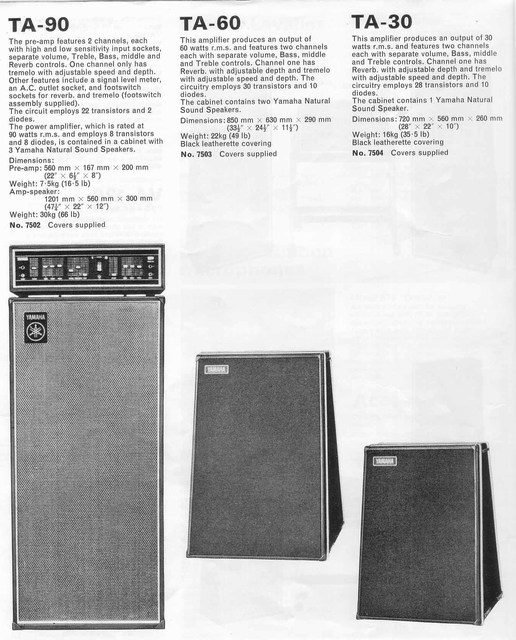
TA series (late 1960s)
wedge-shaped flat amplifiers, featuring Yamaha Natural Sound Speaker units
YSL denotes any Alto, Tenor, Compact or Valve trombone
YBL denotes any Bass trombone
Dis. = Discontinued Models
Student Range
YSL-154
YSL-352 (Dis.)
YBL-322 (Dis.)
YSL-354
YSL-354G
Compact Trombones
YSL-350C
Valve Trombones
YSL-354V
Intermediate Trombones
YSL-445G
YSL-446G
YSL-447G
YSL-448G
YBL-421G
Professional Trombones
YSL-610
YSL-620
YSL-630
YSL-640
YBL-620G
Custom Jazz Trombones
YSL-691Z (Dis.)
YSL-697Z (Dis.)
YSL-891Z
YSL-897Z
Xeno Trombones
YSL-881
YSL-881G
YSL-882
YSL-882G
YSL-882O
YSL-882GO
YSL-882OR
YSL-882GOR
YBL-822G
YBL-830
Custom Alto Trombones
YSL-871
YSL-872
French horns
Vienna Horn YHR-601
YHR-567
YHR-601
YHR-667
YHR-667V
YHR-668
YHR-668II
YHR-671D (detachable)
Mellophones
YMP-201 (circular, more concert-focused mellophone)
YMP-202M[S]
YMP-203M[S]
YMP-204M[S]
Note: Model 204 is mainly an improved revision of the model 203.
Euphoniums
YEP-201[S]
YEP-321[S]
YEP-621[S]
YEP-642[S]
YEP-842[S]
YEP-202M[S] (Marching Euphonium)
Baritone horns
YBH-301S
YBH-621S
YBH-301M[S] (Marching Baritone)
Tenor horns
YAH-201
YAH-202
YAH-203
YAH-602
Flugelhorns
YFH-231
YFH-2310
YFH-631
YFH-731
YFH-631G
YFH-6310Z
YFH-731 ( Dis.)
YFH-8310Z
YFH-8310G
Tubas
in BBb
YBB-103 ( Dis. )
YBB-321
YBB-621
YBB-631S
YBB-641
YBB-841
YBB-105MSWC (3/4 Convertible Tuba)
YBB-201MSWC (Convertible Tuba)
YBB-202MWC (Marching Tuba)
in CC
YCB-621
YCB-661
YCB-822
YCB-826S
in Eb
YEB-321S
YEB-632S
in F
YFB-621
YFB-821
YFB-822
Sousaphones
in BBb
YSH-301
YSH-411
Woodwind instruments
Clarinets
B♭ Clarinets
Advantage
YCL-20
YCL-250
YCL-250S (Silver Plated)
YCL-251 (Japan import)
YCL-255
YCL-26
YCL-26ii (precursor to YCL-250)
YCL-34
YCL-34ii (precursor to YCL-450)
YCL-34iiS (Silver Plated)
YCL-450 (Silver Plated)
YCL-450N (Nickel Plated)
YCL-550AL
YCL-62
YCL-64 (precursor to YCL-650)
YCL-650
YCL-SE (custom clarinets starting from this point)
YCL-CS
YCL-CX
YCL-SEV
YCL-CSV
YCL-CSG
YCL-CSG-H
YCL-CSGII
A Clarinets
YCL-CS-A
YCL-SE-A
YCL-CSG-A
YCL-CSG-AH
YCL-CSV-A
YCL-SEV-A
YCL-CSG-AII
E♭ Clarinets
YCL-881
YCL-681II
Bass Clarinets
YCL-221II
YCL-621II
YCL-622II
Alto Clarinets
YCL-631II
Bassoons
YFG-811
YFG-812
YFG-821
Flutes
YFL-261 flute
YFL-A421/B
YFL-B441
Student Models (Series 200)
Current models
YFL212
YFL222
YFL262
YFL272
YFL282
Discontinued models
YFL-211
YFL-221
YFL-261
YFL-271
YFL-281
Intermediate Models (Series 300 and 400)
Current models
YFL312
YFL322
YFL362
YFL372
YFL382
YFL412
YFL422
YFL462
YFL472
YFL482
Discontinued models
YFL311
YFL321
YFL361
YFL371
YFL381
YFL411
YFL421
YFL461
YFL471
YFL481
Student and intermediate models are numbered in one system. The first number shows the material/series; the second shows if there is an offset G and/or a split E, and the type of keys; and the third shows if the flute is the latest or not. Currently, latest models will end with the number 2, but older models may end with the number 1, or 5. Different suffixes mean different things - 'H' means the flute has a B footjoint; 'AL' means the instrument is part of Yamaha's 'Allegro' lineup of instruments; 'U' means the instrument has a curved headjoint; 'GL' and 'SL' signal the material of the lip-plate (being gold and silver respectively); 'HD' means that the instrument is a high durability instrument.
Professional Models (Series 500, 600 and 700)
Current models
YFL517
YFL577
YFL587
YFL597
YFL617
YFL677
YFL687
YFL697
YFL717
YFL777
YFL787
YFL797
Discontinued models
YFL514
YFL574
YFL584
YFL594
YFL614
YFL674
YFL684
YFL694
YFL714
YFL774
YFL784
YFL794
Handmade Models (Series 800W, 800, 900A, 900B and 900C)
Series 800W models
YFL817W
YFL874W
YFL894W
Series 800 and 900 Models
Current models:
YFL817
YFL877
YFL887
YFL897
YFL917
YFL977
YFL987
YFL997
Discontinued models:
YFL-874
YFL-881
YFL-884
YFL-892
YFL-894
Additionally, for Series 600 - 900 flutes, the last number will be seven if it is the latest model. Older models may have a 4, or other numbers. Additional suffixes include (but are not limited to): 'W' meaning the flute is wooden; 'CT' for a C# trill.
For series 900 flutes, the suffixes A, B, and C show how much of the flute is gold.
Piccolos
YPC-32 piccolo
YPC-30
YPC-31
YPC-32
YPC-61
YPC-62
YPC-81
YPC-82
YPC-87R
YPC-91
YPC-92
Venova
YVS-100
Saxophones
Yamaha Custom Z Saxophones
Soprano saxophones
YSS-475II (intermediate grade instrument. Sold mainly in Europe)
YSS-61 (Yamaha's first professional-grade soprano saxophone)
YSS-62 (significantly updated version of YSS-61. Professional-grade instrument)
YAS 22 (same as 21 body and key work, more copper look lacquer)
YAS-23 (student-grade instrument which replaced the YAS-21)
YAS-25 (identical to YAS-23, but has a high F♯ key and improved octave-key mechanism)
AS-100 (identical to YAS-23. Sold outside Europe & N.America)
YAS-275 (successor to the YAS-25. Made in Indonesia. Sold mainly in Europe)
YAS-280 (successor to the YAS-275)
YAS-31
YAS-32 (intermediate grade instrument, similar to YAS-52. Superseded by the YAS-475)
YAS-475 (intermediate grade instrument. Sold mainly in Europe)
YAS-480 (intermediate grade instrument)
YAS-52 (intermediate grade instrument. Sold mainly in the USA)
YAS-61 (Yamaha's first professional-grade alto with purple logo. Has non-ribbed construction and real mother of pearl key-touches)
YAS-62 (Mk 1 version of YAS-62 with purple logo, ribbed construction and real MOP key-touches)
YAS-62ll (Mk 2 version with different neck design, slightly different key-work and key-touches are made from plastic)
YAS-62IlI (Mk 3 version with new style neck design, integrated key posts and other changes)
YAS-82Z (Custom model)
YAS-82ZII (Custom model)
YAS-855 (Custom model)
YAS-875 (Custom model)
YAS-875EX (Custom model)
YAS-875EXW (Custom model)
Tenor saxophones
YTS-23 tenor saxophone made in 1986
YTS-21 (Yamaha's first student-grade tenor sax) (Gold and silver color lacquer)
YTS 22 (almost exact replica of YTS 21 but with pinkish color lacquer)
YTS-23 (student-grade instrument which replaced the YTS-21)
YTS-25 (identical to YTS-23, but has a high F♯ key and improved octave-key mechanism)
TS-100 (identical to YTS-23. Sold outside Europe & N.America)
YTS-31 (YTS 61 body and keys but no engraving or pearls on F♯s)
YTS-32 (intermediate grade instrument, similar to YTS-52. Superseded by the YTS-475)
YTS-52 (intermediate grade instrument. Sold mainly in the USA)
YTS-275 (successor to the YTS-25. Made in Indonesia)
YTS-280 (successor to the YTS-275)
YTS-475 (intermediate grade instrument. Sold mainly in Europe)
YTS-480
YTS-61 (Yamaha's first professional-grade tenor sax)
YTS-62 (Mk 1 version of YTS-62 with purple logo and real mother of pearl key-touches)
YTS-62II (Mk 2 version with different neck design and key-touches are made from plastic)
YTS-62III (Mk 3 version with different neck design)
YTS-82Z (Custom model)
YTS-855 (Custom model)
YTS-875 (Custom model)
YTS-875EX (Custom model)
Yamaha baritone saxophone
Baritone saxophones
YBS-32 (intermediate grade instrument)
YBS-52
YBS-61 (Yamaha's first professional-grade baritone sax)
YBS-62
YBS-62II
YBS-82
Musical Sirens
Between 1950 and 1998, the Yamaha Corporation produced a form of outdoor warning siren which was designed to play music, rather than alert the public of danger. Using several mechanical sirens tuned to a specific octave, the siren would use either electromagnetic or solenoid-driven sliding dampers which would open to allow air to enter each siren to play a musical note, or close to silence each siren. The musical sirens could be played directly with a keyboard located in a control station, or played automatically through a music box-like mechanism. There were two distinct generations produced, with the first being a 5-meter long siren with 10 siren units on a common driveshaft, and the second being a vertical unit inside of a box, which contained the siren units and had two shafts connected through belts to make it more compact. These could be controlled through a MIDI controller, instead of the music box system. These were created by the president of Yamaha at the time to harness the sheer sound output of a siren to play music, and to ease the fears and memory of war and air raids for the public. These sirens became "symbols of peace" and were widely installed on department stores and city halls. Production ended on these sirens in 1998, with Yamaha ceasing support for them in 2011. Most of these musical sirens have been decommissioned as parts became scarce or unavailable, although some units remain in service today.
Audio
Music production
Recorders
Digital mixing studio
n12 / n8 (2007)
MW8CX / MW10C / MW12C / MW12CX (2007)
MW10 / MW12 (2006)
01X (2003)
DSP Factory DS2416 (digital mixing card (PCI) for PC/Mac, based on 02R)
DSP-E492 Natural Sound AV Processor Amplifier (1997–99)
Natural Sound
Hi-Fi audio speakers
NS series
1982, the company presented the NS-2000 loudspeaker box as their new top model incorporating new technologies like a subwoofer with a membrane from carbon fiber.
YMF7x0 series — for on-board or embedded solutions
YMF7x4 series — for PCI bus standalone adapter
it supported Yamaha XG level 1, some of MU50 additions, DB50XG compatibilities, Roland GS in TG300B mode, OPL3 FM synthesizer, some emulation of Sound Blaster Pro (stereo 8-bit at 22kHz) and MPU-401 (MIDI interface).
↑Colbeck, Julian (1996). Keyfax Omnibus Edition. MixBooks. p.129. ISBN0-918371-08-2.
↑The Reface YC includes an American tonewheel organ, a British transistor organ, an Italian transistor organ, a Japanese transistor organ, and Yamaha YC-45D
↑"一時代を畫する新樂器完成 濱松の靑年技師山下氏"[An epoch new musical instrument was developed by a young engineer, Mr.Yamashita, in Hamamatsu]. Hochi Shimbun (in Japanese). 8 June 1935. Archived from the original on 12 March 2012. Retrieved 28 March 2011.
↑新電氣樂器 マグナオルガンの御紹介[New Electric Musical Instrument – Introduction of Magna Organ] (in Japanese). Hamamatsu: 日本樂器製造株式會社 (Yamaha). October 1935. 特許第一〇八六六四号, 同 第一一〇〇六八号, 同 第一一一二一六号{{cite book}}: |work= ignored (help)
12
Junya, FUJINO (12 February 2020). "日本楽器製造の電気楽器「マグナオルガン」の理想と現実 ─楽音合成のメカニズム─]"[The Development of "Magna Organ" and Its Mechanism for Sound Synthesis: The Earliest Electric Musical Instrument of YAMAHA](PDF). Geijutsu Bunka Kenkyū (in Japanese). 24. Osaka University of Arts Graduate School: 69–89. ISSN1342-9086. 4.1 特許第 108664 号(1934 年 3 月 15 日出願 ... 当該明細書には「特許請求の範囲」として次の三点が列記されている。/ 1. 「適当なる機械的振動体例えば発音「リード」と「マイクロフォン」とを原音の演奏室への漏洩を阻止すべく構成せる音響的絶縁密閉室内に配置」 / 2. 「『ペダル』又は鍵盤に加うる圧力に依る音量制御及び前期『リード』群の制御を全て演奏室に設置せる『コンソール』により行う」 / 3. 「『マイクロフォン』電流の増幅回路の一部に適当の周波数変換機を接続して原動電流及之と適当倍率関係に変換せる振動電流に依る楽音を前記密閉室外に於て同時に発音」 See also bellow patents: JP108664C, JP110068C, and JP111216C.
↑JP 108664C,山下 靜一 [Yamashita, Seiichi],"電氣樂器 [Electric instrument]",published 1 August 1934,issued 28 November 1934, assigned to 日本樂器製造株式會社 [Yamaha]
↑道志郎 [Shiro Michi] (1958). クリスマスメロディーズ・イン・ヤマハエレクトーン[Christmas Melodies in Yamaha Electone](Vinyl record, LP, Single, Stereo) (in Japanese). Tokyo, Japan: Nippon Grammophon. YE-2 / JP-107. Christmas Melodies in Yamaha Electone / The first Electone prototype concept, named Type E-T, developed by Yamaha (Nippon Gakki) in the year 1958. / ...
↑エレクトーン誕生ストーリー[The story of Electone] (in Japanese). Japan. Brief history of Yamaha Electone
↑沖 浩一 [Koichi Oki], 酒井 潮 [Ushio Sakai], 斎藤 英美 [Hidemi Saito], 関藤 繁生 [Shigeo Sekito] (1968). エレクトーン・ファンタスティック!! EX-21のすべて[Electone Fantastic [All about EX-21]](Vinyl record, LP) (in Japanese). Tokyo, Japan: CBS/Sony. SOND66006. (Note: several tracks are available on YouTube; B6:L'amour Est Bleu (played by Koichi Oki), A7:Chitty Chitty Bang Bang (played by Hidemi Saito), B7:The Last Waltz (played by Hidemi Saito))
↑一時代を画する新楽器完成 浜松の青年技師山下氏[An epoch new musical instrument was developed by a young engineer Mr.Yamashita in Hamamatsu]. Hochi Shimbun (in Japanese). 8 June 1935. Archived from the original on 12 March 2012.
↑goo blog 新電氣樂器 マグナオルガンの御紹介[New Electric Musical Instrument — Introduction of Magna Organ] (in Japanese). Hamamatsu: 日本樂器製造株式會社 (Yamaha). October 1935. Archived from the original on 11 May 2013. 特許第一〇八六六四号, 同 第一一〇〇六八号, 同 第一一一二一六号
↑"Cool machines - Yamaha YIS PU-I-20" (in Japanese). Archived from the original on 25 September 2013. — a home automation system in 1982. Also system integration diagram is at the bottom of page.
↑"Yamaha CX5M" (in Spanish). El Museo de los 8 bits. Archived from the original on 22 August 2011.
ピアノ/キーボード:製品アーカイブ検索[Piano/Keyboard: archived products (searched result)] (in Japanese). Yamaha Corporation. Archived from the original on 21 July 2011. Retrieved 8 April 2011.