Amphipappus
| Amphipappus | |
|---|---|
 | |
Scientific classification  | |
| Kingdom: | Plantae |
| Clade: | Tracheophytes |
| Clade: | Angiosperms |
| Clade: | Eudicots |
| Clade: | Asterids |
| Order: | Asterales |
| Family: | Asteraceae |
| Subfamily: | Asteroideae |
| Tribe: | Astereae |
| Subtribe: | Solidagininae |
| Genus: | Amphipappus Torr. & A.Gray |
| Species: | A. fremontii |
| Binomial name | |
| Amphipappus fremontii Torr. & A.Gray | |
| Synonyms | |
| |

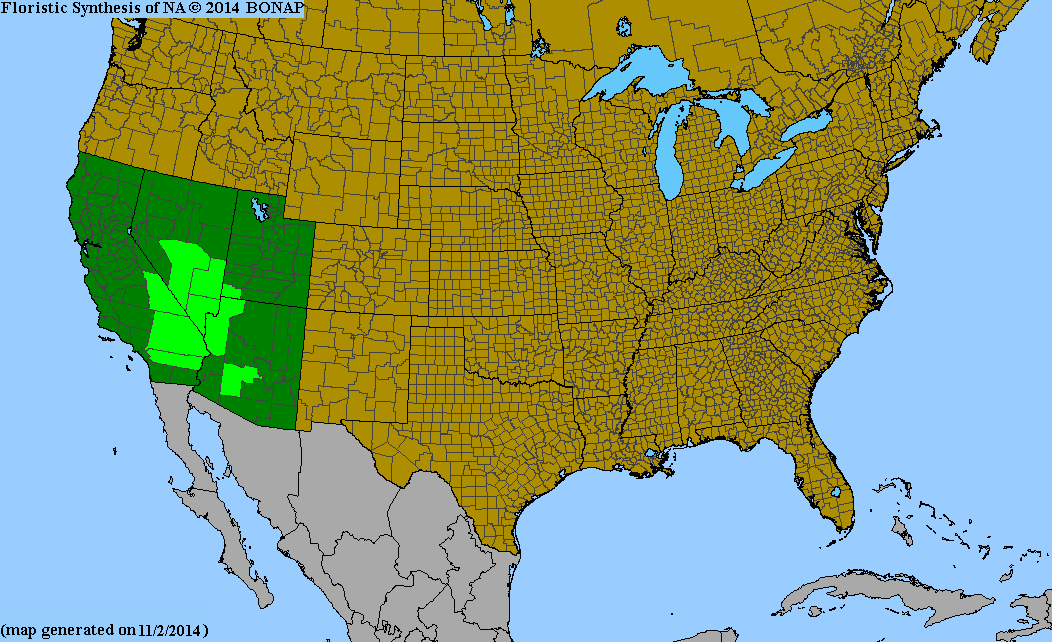
Amphipappus is a North American genus in the family Asteraceae. It is native to desert regions of the southwestern United States, in southern California, southern Nevada, Arizona, and southeastern Utah.
There is only one known species Amphipappus fremontii. It is a shrub up to 60 cm (23.5 in) tall. The flower heads are yellow and have both ray florets and disc florets. Its rounded clumps are scattered about dry, rocky areas.
The species takes its scientific epithet, fremontii from John C. Frémont, and is known commonly by the names chaffbush or eytelia (in honor of artist Carl Eytel).
References
- ↑ NatureServe. "Amphipappus fremontii". NatureServe Explorer. Arlington, Virginia.
- ↑ "Amphipappus fremontii Torr. & A.Gray ex A.Gray". The Global Compositae Checklist (GCC) – via The Plant List. Note that this website has been superseded by World Flora Online
- ↑ "Biota of North America Program 2014 county distribution map". Retrieved 2015-05-17.
- ↑ "Amphipappus". Amphipappus fremontii. Berkeley, California: The Calflora Database. Retrieved 2021-07-26.
- ↑ Flora of North America Editorial Committee (ed.). "Amphipappus". Flora of North America North of Mexico (FNA). New York and Oxford: Oxford University Press. 101471. Retrieved 2015-05-17 – via eFloras.org, Missouri Botanical Garden, St. Louis, Missouri and Harvard University Herbaria, Cambridge, Massachusetts.
- ↑ Charters, Michael L. "Botanical Names: F". California Plant Names: Latin and Greek Meanings and Derivations. Sierra Madre, CA. Retrieved 24 September 2009.
- ↑ Morhardt, Sia; Morhardt, J. Emil (2004). California Desert Flowers: an Introduction to Families, Genera, and Species. University of California Press. p. 44. ISBN 978-0520240032.
- ↑ Jaeger, Edmund C. (1978). Desert Wild Flowers. Stanford, California: Stanford University Press. p. 322. ISBN 978-0804703659. LCCN 41022485. OCLC 631689191. Retrieved 2020-10-04. LCC QK938.D4 J23
External links
- berkeley.edu – Jepson Manual Treatment
- United States Department of Agriculture Plants Profile
- Calphotos Photo gallery, University of California
 Media related to Amphipappus at Wikimedia Commons