In 1760, the French zoologist Mathurin Jacques Brisson included a description of the blue dacnis in his Ornithologie based on a specimen collected in "Cayenne" (French Guiana). He used the French name Le Pepit bleu de Cayenne and the Latin name Sylvia cayanensis caerulea. Although Brisson coined Latin names, these do not conform to the binomial system and are not recognized by the International Commission on Zoological Nomenclature. When in 1766 the Swedish naturalist Carl Linnaeus updated his Systema Naturae for the twelfth edition he added 240 species that had been previously described by Brisson. One of these was the blue dacnis. Linnaeus included a terse description, coined the binomialMotacilla cayana and cited Brisson's work. The specific epithetcayana is from Cayenne. This species is now placed in the genusDacnis that was introduced in 1816 by the French naturalist Georges Cuvier with the blue dacnis as the type species.
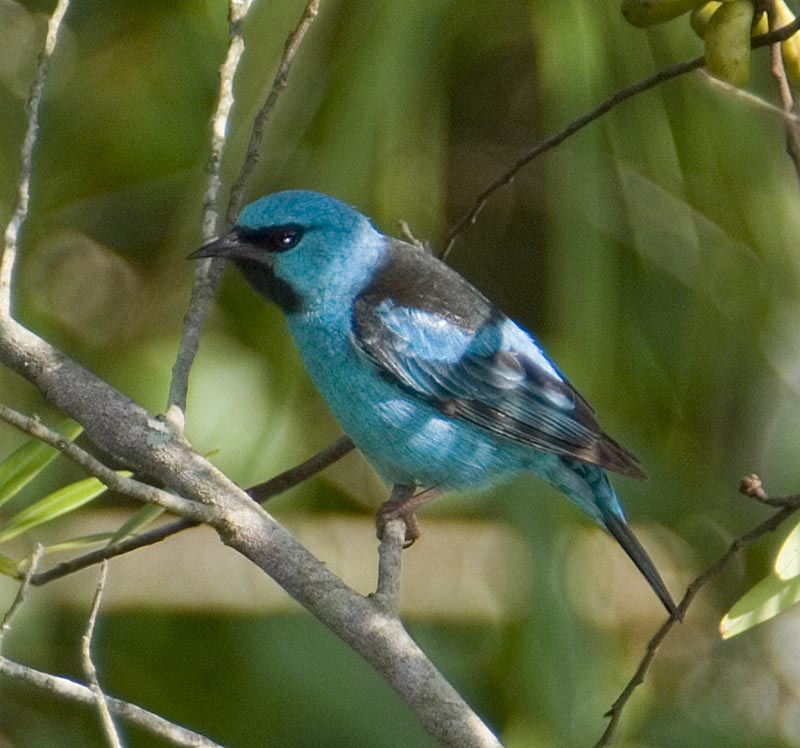
The blue dacnis is 11 to 12cm (4.3 to 4.7in) long and weighs 10 to 15.5g (0.35 to 0.55oz). It has a thin pointed bill. The species is sexually dimorphic. Adult males of the nominate subspeciesD. c. cayana have a mostly turquoise-blue head and nape with a thin black mask from the lores to just past the eye. Their mantle and back are black; the color narrows to a point just above the rump. Their scapulars, the sides of their back, and their rump and uppertail coverts are turquoise-blue. Their tail is black with very thin blue edges on the outer two or three pairs of feathers. Their upperwing coverts are mostly black with blue edges. Their flight feathers are black with wide blue edges. The center of their throat is black and the rest of their underparts are turquoise. Adult females are mostly green with paler underparts than upperparts. Their head is mostly bluish and their throat gray. Both sexes of all subspecies have a dark red to reddish brown iris, a dusky bill with a pale gray inner half of the mandible, and pinkish legs and feet.
The other subspecies of the blue dacnis differ from the nominate and each other thus:
D. c. callaina: male is a brighter cerulean blue
D. c. ultramarina: male is medium blue, not turquoise
D. c. napaea: male is rich cobalt blue; female has bluish violet head
D. c. baudoana: male is dark violaceous blue; female has more and brighter blue on head
D. c. caerebicolor: male is darkest, a bluish violet to purplish; female has bluish violet head
D. c. glaucogularis: male is lighter turquoise blue with less deep black throat; female has deep blue crown and face
D. c. paraguayensis male is similar to glaucogularis but paler
D. c. ultramarina: from extreme eastern Honduras south on the Caribbean slope through Nicaragua, Costa Rica, and Panama into northwestern Colombia on the west side of the Gulf of Urabá
D. c. napaea: Colombia from the Santa Marta region west to the Gulf of Urabá and the lower Magdalena River valley
D. c. glaucogularis: from Caquetá and Putumayo departments in southeastern Colombia south through eastern Ecuador and eastern Peru into northern and eastern Bolivia
The blue dacnis inhabits a variety of moist to wet landscapes including terra firme and várzea forests, secondary forest, gallery forest, and somewhat open areas with trees and shrubs. In Honduras it is found below 750m (2,500ft). In Costa Rica it ranges in elevation from sea level to 900m (3,000ft) on the Caribbean slope and 1,200m (3,900ft) on the Pacific slope. In Venezuela it occurs below 1,200m (3,900ft) north of the Orinoco River and 1,400m (4,600ft) south of it. It reaches 1,100m (3,600ft) in Colombia, 1,000m (3,300ft) in Ecuador, 1,500m (4,900ft) in Peru, and 1,400m (4,600ft) in Brazil.
Behavior
Movement
The blue dacnis is almost entirely a year-round resident though some seasonal elevational movements have been noted in Colombia.
Feeding
The blue dacnis feeds on arthropods, fruit, seeds, and possibly nectar. In a study in Panama, out of 26 species of plants the species fed on, more than a third of its take was Miconia berries and a quarter was from the family Euphorbiaceae. Other fruits are from Cecropia and Clusia, and it will feed on bananas at bird feeders. It primarily forages singly or in pairs, but groups of about 12 have been noted. It almost always is seen as a member of a mixed-species feeding flock. It feeds acrobatically, leaning, reaching, and hanging upside down to reach fruit and insects. It also takes insects in mid-air with a sally from a perch.
Breeding
The blue dacnis breeds between May and October in Costa Rica but its breeding seasons elsewhere are not known. Its nest is a deep cup, almost a pouch, built from soft plant fibers and seed down. It typically is suspended between twigs at the outer part of a tree. The clutch is two eggs. The incubation period, time to fledging, and details of parental care are not known.
The song of the blue dacnis in Peru is "a wheezy series of thin, high notes, somewhat variable in pattern, for example: wee-tee tsee-tew wee-tee tsee-tew wee-tee, interspersed with call notes". Its calls are weak and include "high, thin tsit notes and a high chit or chit-it or tseep".
Status
The IUCN has assessed the blue dacnis as being of Least Concern. It has an extremely large range; its estimated population of at least 50 million mature individuals is believed to be decreasing. No immediate threats have been identified. It is uncommon in Honduras, "fairly uncommon" in Costa Rica, common in Colombia, Ecuador, and Venezuela, "fairly common" in Peru, and "common to frequent" in Brazil. It is found "in many protected areas, and vast areas of its range in the Guianas and Amazonia contain extensive intact habitat that is unprotected but at little immediate risk".
12Allen, J.A. (1910). "Collation of Brisson's genera of birds with those of Linnaeus". Bulletin of the American Museum of Natural History. 28: 317–335. hdl:2246/678.
123456789Hilty, S. L. (2020). Blue Dacnis (Dacnis cayana), version 1.0. In Birds of the World (J. del Hoyo, A. Elliott, J. Sargatal, D. A. Christie, and E. de Juana, Editors). Cornell Lab of Ornithology, Ithaca, NY, USA. https://doi.org/10.2173/bow.bludac1.01 retrieved August 21, 2026
123Garrigues, Richard; Dean, Robert (2007). The Birds of Costa Rica. Ithaca: Zona Tropical/Comstock/Cornell University Press. pp.290–291. ISBN978-0-8014-7373-9.
123Fagan, Jesse; Komar, Oliver (2016). Field Guide to Birds of Northern Central America. Peterson Field Guides. Boston: Houghton Mifflin Harcourt. pp.366–367. ISBN978-0-544-37326-6.
12345McMullan, Miles; Donegan, Thomas M.; Quevedo, Alonso (2010). Field Guide to the Birds of Colombia. Bogotá: Fundación ProAves. p.199. ISBN978-0-9827615-0-2.
123Ridgely, Robert S.; Greenfield, Paul J. (2001). The Birds of Ecuador: Field Guide. Vol.II. Ithaca: Cornell University Press. p.615. ISBN978-0-8014-8721-7.
123Hilty, Steven L. (2003). Birds of Venezuela (seconded.). Princeton NJ: Princeton University Press. p.777.
123van Perlo, Ber (2009). A Field Guide to the Birds of Brazil. New York: Oxford University Press. pp.380–381. ISBN978-0-19-530155-7.
123Schulenberg, T.S.; Stotz, D.F.; Lane, D.F.; O'Neill, J.P.; Parker, T.A. III (2010). Birds of Peru. Princeton Field Guides (revised and updateded.). Princeton, NJ: Princeton University Press. p.572. ISBN978-0691130231.