Calculating Space
| Author | Konrad Zuse |
|---|---|
| Original title | Rechnender Raum |
| Language | German |
| Subject | Automata theory |
| Genre | Non-fiction |
| Publication date | 1969 |
| Publication place | Germany |

Calculating Space (German: Rechnender Raum) is Konrad Zuse's 1969 book on automata theory. He proposed that all processes in the universe are computational. This view is known today as the simulation hypothesis, digital philosophy, digital physics or pancomputationalism. Zuse proposed that the universe is being computed by some sort of cellular automaton or other discrete computing machinery, challenging the long-held view that some physical laws are continuous by nature. He focused on cellular automata as a possible substrate of the computation and pointed out that the classical notions of entropy and its growth do not make sense in deterministically computed universes.
See also
References
- ↑ Zuse, Konrad (1967). "Rechnender Raum" (PDF). Elektronische Datenverarbeitung (in German). 8. Bad Hersfeld, Germany: 336–344. Archived from the original (PDF) on 2017-07-06. Retrieved 2022-08-02. (9 pages)
- 1 2 Mainzer, Klaus; Chua, Leon Ong (September 2011). The Universe as Automaton: From Simplicity and Symmetry to Complexity. Springer-Verlag. p. 6.
- ↑ Müller, Vincent C. (January 2014). "Pancomputationalism: Theory or Metaphor?". In Hagengruber, Ruth; Riss, Uwe (eds.). Philosophy, Computing and Information Science. Pickering & Chattoo. pp. 213–221. Archived (PDF) from the original on 2021-10-21. Retrieved 2022-08-02.
Further reading
- Zuse, Konrad (1969). Rechnender Raum [Calculating Space]. Schriften zur Datenverarbeitung (in German). Vol. 1. Braunschweig, Germany: Friedrich Vieweg & Sohn. ISBN 3-528-09609-8. (70+4 pages)
- Zuse, Konrad (February 1970). "Calculating Space - Translation of: Rechnender Raum" (PDF). MIT Technical Translation. Translated by Aztec School of Languages, Inc. Cambridge, Massachusetts, USA: Massachusetts Institute of Technology. AZT-70-164-GEMIT (Project MAC). Archived from the original (PDF) on 2017-07-06. Retrieved 2020-03-25. (98 pages); Zuse, Konrad (2012). "Konrad Zuse's Rechnender Raum (Calculating Space)" (PDF). In German, Adrian; Zenil, Hector (eds.). A Computable Universe: Understanding & Exploring Nature as Computation (re-edition in LaTeX with permission of MIT and Zuse's family ed.). World Scientific. Archived (PDF) from the original on 2022-05-21. Retrieved 2025-09-13. (69 pages)
- Alex, Jürgen (2007). "Rechnender Raum". Zur Entstehung des Computers - Von Alfred Tarski zu Konrad Zuse [...] - Tertium non datur. Düsseldorf, Germany: VDI-Verlag. pp. 251–279. ISBN 978-3-18-150051-4. ISSN 0082-2361.
External links
- Jürgen Schmidhuber's site Zuse's book and 1967 paper.
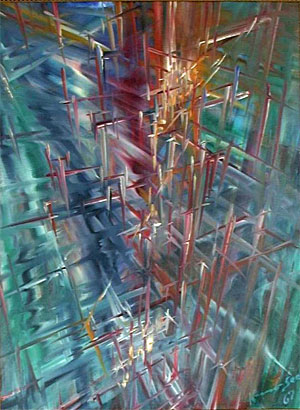
- Calculating Space - a painting by Zuse - Konrad Zuse's visualization of the idea
- Web article and simulation of such a calculating space in C and LIBPNG
- SecondSpace Simulation of waves within a 2D space (time and space are discrete), similar to FDTD. An OpenCL graphic card is needed.
 | This article about a physics-related book is a stub. You can help Wikipedia by adding missing information. |