Comparison of commercial battery types battery types summarizing some of their characteristics for ready comparison.
Common characteristics
This table lists characteristics common to both single use (primary) and rechargeable (secondary) batteries.
^† 2025 USD.
^‡ Lithium-ion battery § Negative electrode for alternative electrode materials.
Rechargeable characteristics
This is a table of characteristics common to rechargeable batteries.
Cycle life can be significantly affected by factors such as the ambient temperature and charge/discharge rate. For the purposes of this table, typical conditions are assumed.
Cell chemistry
Round-trip efficiency Cycle durability at varying depth of discharge (DoD) cycles
%
100% DoD
70-90% DoD
40-60% DoD
<40% DoD
Lead–acid 50–92
50–100
150–250 @ 70% DoD
300–500 @ 50% DoD
>800 @ 30% DoD
Rechargeable alkaline 5–100
Nickel–zinc 100 to 50% capacity
Nickel–iron 65–80
5,000
Nickel–cadmium 70–90
500
Nickel–hydrogen 85
20,000
Nickel–metal hydride 66
300–800
Low self-discharge nickel–metal hydride battery 500–1,500
Lithium cobalt oxide 90
500–1,000
Lithium–titanate 85–90
>13,000
≫20,000 @ 80% DoD
>60,000 @ 60% DoD
Lithium iron phosphate 90
≥2,000 @ 80% DoD
3,500–>9,000 @ 50% DoD
>10,000 @ 20% DoD
Lithium manganese oxide 90
300–700
Thermal runaway
Under certain conditions, some battery chemistries are at risk of thermal runaway , leading to cell rupture or combustion. As thermal runaway is determined not only by cell chemistry but also cell size, cell design and charge, only the worst-case values are reflected here.
References
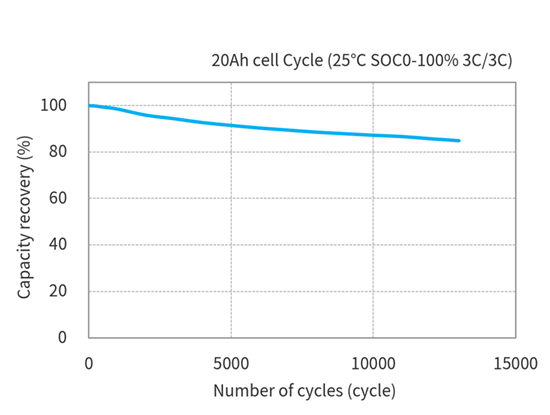
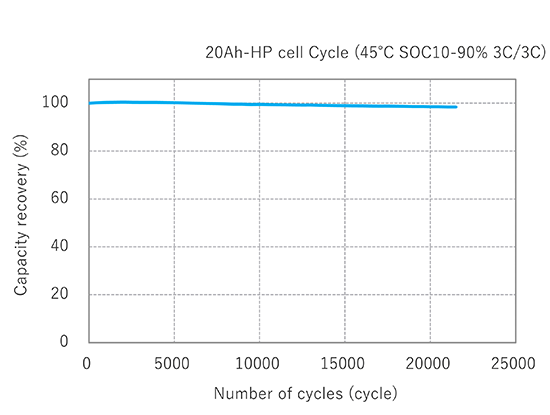
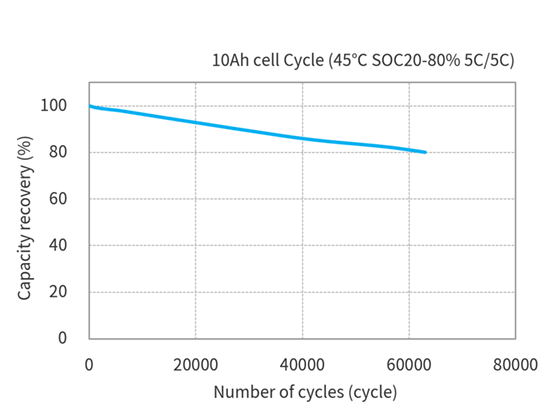
1 2 3 4 5 6 7 8 "mpoweruk.com: Accumulator and battery comparisons (pdf)" (PDF) . Archived from the original (PDF) on 2018-03-29. Retrieved 2016-02-28 .1 2 3 4 5 6 7 8 9 "All About Batteries, Part 3: Lead-Acid Batteries" . Retrieved 2016-02-26 .1 2 3 Liu, Wei; Placke, Tobias; Chau, K. T. (2022-11-01). "Overview of batteries and battery management for electric vehicles" . Energy Reports . 8 : 4058– 4084. doi :10.1016/j.egyr.2022.03.016 . hdl :10397/107849 ISSN 2352-4847 . 1 2 Sutikno, Tole; Arsadiando, Watra; Purnama, Hendril Satrian (2025-11-17). "Battery types and recent developments for energy storage in electric vehicles: technical criteria and battery management system" . Clean Energy . 9 (6): 293– 322. doi :10.1093/ce/zkaf048 ISSN 2515-4230 . 1 2 3 4 5 6 7 8 9 "All About Batteries, Part 5: Carbon Zinc Batteries" . Retrieved 2016-02-26 .1 2 3 "Energizer Non-Rechargeable Batteries: Frequently Asked Questions" (PDF) . Archived from the original (PDF) on 2016-04-04. Retrieved 2016-02-26 .1 2 3 4 5 6 7 8 9 10 "All About Batteries, Part 6: Zinc-Air" . Retrieved 2016-03-01 .1 2 3 Narayan, R.; Viswanathan, B. (1998). Chemical And Electrochemical Energy Systems 92. ISBN 9788173710698 1 2 "Mercury Use in Batteries" . Archived from the original on 2012-11-29. Retrieved 2016-03-01 .1 2 3 4 5 Crompton, Thomas Roy (2000). Batteries Reference Book ISBN 9780750646253 . Retrieved 2016-03-01 . 1 2 Herbert, W. S. (1952). "The Alkaline Manganese Dioxide Dry Cell" . Journal of the Electrochemical Society . 99 (August 1952): 190C. doi :10.1149/1.2779731 1 2 3 "Alkaline Manganese Dioxide Handbook and Application Manual" (PDF) . Archived from the original (PDF) on 2010-12-16. Retrieved 2016-03-01 .1 2 3 4 5 "Primary and Rechargeable Battery Chemistries with Energy Density" . Retrieved 2016-02-26 .1 2 3 4 5 "All About Batteries, Part 4: Alkaline Batteries" . Retrieved 2016-02-26 .1 2 "Improving Cycle Life and Active Materials Utilization for Rechargeable Alkaline Zn-Mn02 Batteries" .1 2 3 4 5 6 7 8 9 10 11 12 13 14 "Rechargeable Batteries — compared and explained in detail" . Retrieved 2016-02-28 .1 2 3 4 "Data Sheet of Pure Energy XL Rechargeable Alkaline Cells" (PDF) . Retrieved 2016-03-01 .1 2 "The history of the battery: 2) Primary batteries" . Archived from the original on 2018-05-26. Retrieved 2016-03-01 .1 2 3 "Silver Primary Cells & Batteries" (PDF) . Archived from the original (PDF) on December 15, 2009. Retrieved 2016-03-01 .1 2 3 4 "ProCell Silver Oxide battery chemistry" . Duracell . Archived from the original on 2009-12-20. Retrieved 2009-04-21 .1 2 "Edison's non-toxic nickel-iron battery revived in ultrafast form" . Wired UK . Retrieved 2016-02-28 .1 2 3 4 "The Future For Total Electric Vehicles... Nickel-Iron Power" (PDF) . Archived (PDF) from the original on 2012-03-15. Retrieved 2026-10-17 .1 2 "Energy Density from NREL Testing by Iron Edison" . Archived from the original (PDF) on 2016-10-20. Retrieved 2016-02-26 .1 2 Jha, A.R. (2012-06-05). Next-Generation Batteries and Fuel Cells for Commercial, Military, and Space Applications 28. ISBN 978-1439850664 1 2 "Nickel Iron Batteries" . www.mpoweruk.com .1 2 "A description of the Chinese nickel–iron battery from BeUtilityFree" (PDF) . Archived from the original (PDF) on July 25, 2021.1 2 "NiFe FAQ's" . www.beutilityfree.com . Archived from the original on 2016-02-21. Retrieved 2016-02-27 .1 2 3 4 "Nickel Cadmium Batteries" . Electropaedia . Woodbank Communications. Archived from the original on 2019-01-04. Retrieved 2016-02-29 .1 2 3 4 5 6 7 "Testing NiCd and NiMH Batteries" . Retrieved 2016-03-01 .1 2 3 4 Arther, Miller (26 February 2016). "Ons werk" . Diensten (in Dutch). Retrieved 2016-02-26 . 1 2 3 4 5 "Optimization of spacecraft electrical power subsystems" (PDF) . Retrieved 2016-02-29 .1 2 "Nickel-Hydrogen Battery Technology—Development and Status" (PDF) . Archived from the original (PDF) on 2009-03-18. Retrieved 2012-08-29 .1 2 Thaller, Lawrence H.; Zimmerman, Albert H. (2003). Nickel-hydrogen Life Cycle Testing ISBN 9781884989131 1 2 3 4 5 Arther, Miller (23 May 2014). "Ons werk" . DoubleSmart (in Dutch). Retrieved 12 January 2019 . 1 2 "Ansmann AA – NiMH 2700mAh datasheet" (PDF) . Retrieved 2016-03-02 .1 2 3 "AA Battery Considerations" . Retrieved 2016-03-01 .1 2 "General Description" . Eneloop.info . Sanyo . Archived from the original on 2012-09-02. Retrieved 2015-08-06 .1 2 "Metero Webinar 2" . Archived from the original on 2016-03-11. Retrieved 2016-03-02 .1 2 "SANYO new Eneloop Batteries Remains Energy Longer" (PDF) . Archived from the original (PDF) on 2016-03-04. Retrieved 2016-03-02 .1 2 3 Dyer, Chris K; Moseley, Patrick T; Ogumi, Zempachi; Rand, David A. J.; Scrosati, Bruno (2013). Encyclopedia of Electrochemical Power Sources 561. ISBN 978-0444527455 . Retrieved 2016-03-03 . 1 2 "Lithium Manganese Dioxide Batteries CR2430" (PDF) . Retrieved 2016-03-01 .1 2 3 4 5 6 7 8 9 "Li/CFx Batteries: The Renaissance" (PDF) . Retrieved 2019-02-24 .1 2 3 "Chapter 1 Overview - Industrial Devices and Solutions" (PDF) . Archived from the original (PDF) on 2016-03-06. Retrieved 2016-03-03 .1 2 "Lithium Carbon-monofluoride (BR) Coin Cells and FB Encapsulated Lithium Coin Cells" . Archived from the original on 2015-03-30. Retrieved 2016-03-03 .1 2 3 4 5 6 "Lithium Iron Disulfide Handbook and Application Manual" (PDF) . Archived from the original (PDF) on 2006-03-17. Retrieved 2016-03-03 .1 2 3 "Energizer's Lithium Iron Disulfide – The best of all worlds for the most demanding applications" (PDF) . Archived from the original (PDF) on 2016-03-06. Retrieved 2016-03-03 .1 2 "LTO Anode Material for Lithium-ion Battery Manufacturing" . Retrieved 2018-12-16 .1 2 3 4 Gotcher, Alan J. (29 November 2006). "Altair EDTA Presentation" (PDF) . Altairnano.com. Archived from the original (PDF) on 16 June 2007. 1 2 3 4 5 "All About Batteries, Part 12: Lithium Titanate (LTO)" . Retrieved 2018-12-16 .1 2 3 4 5 6 "Battery chemistry FINALLY explained" . Archived from the original on 2016-02-12. Retrieved 2016-02-26 .1 2 "Hooked on lithium" . The Economist . Retrieved 2016-02-26 .1 2 3 4 5 6 7 "Comparison Common Lithium Technologies" (PDF) . Archived from the original (PDF) on 2016-12-22. Retrieved 2016-12-21 .1 2 3 4 5 6 7 8 9 10 11 12 13 14 15 16 17 "Lithium Battery Technologies" . Retrieved 2016-02-26 .1 2 "LiFePO4 : A Novel Cathode Material for Rechargeable Batteries", A.K. Padhi, K.S. Nanjundaswamy, J.B. Goodenough, Electrochemical Society Meeting Abstracts, 96-1 , May, 1996, pp 73 1 2 "Lithium Battery Mystery: This 100Ah LiFePO4 Energy Density is Off the Charts" . YouTube . Retrieved 2019-12-31 .1 2 3 "Lithium-Ion 32140 Energy Cells" . Lithium Werks . Retrieved 2025-07-23 .1 2 "12,8 Volt Lithium-Iron-Phosphate Batteries" (PDF) . Archived from the original (PDF) on 2016-09-21. Retrieved 2016-04-20 .1 2 "Datasheet HeadWay LiFePO4 38120" (PDF) . Retrieved 2020-04-08 .1 2 "Lithium-Ion Battery Pack Prices Hit Record Low of $139/kWh" . BloombergNEF . 2023-11-26. Retrieved 2024-10-22 .1 2 "Which battery type is right for you?" . Retrieved 2021-08-11 .[ permanent dead link ] 1 2 3 "Lithium-ion Battery Overview" (PDF) . Lighting Global (May 2012, Issue 10). Archived from the original (PDF) on 2014-06-17. Retrieved 2016-03-01 .1 2 3 "Lithium nickel cobalt aluminium oxide" . Retrieved 2016-03-01 .1 2 "Battery Technology" . Retrieved 2016-02-26 .1 2 Wang, John; Liu, Ping; Hicks-Garner, Jocelyn; Sherman, Elena; Soukiazian, Souren; Verbrugge, Mark; Tataria, Harshad; Musser, James; Finamore, Peter (2011-04-15). "Cycle-life model for graphite-LiFePO4 cells" Journal of Power Sources . 196 (8): 3942– 3948. doi :10.1016/j.jpowsour.2010.11.134 . ISSN 0378-7753 . 1 2 3 4 5 electricrider.com: Lithium Batteries Citat: Citat: "...The cycle life of sealed lead-acid is directly related to the depth of discharge. The typical number of discharge/charge cycles at 25 °C (77 °F) with respect to the depth of discharge is: * 50–100 cycles with 100% depth of discharge (full discharge) * 150–250 cycles with 70% depth of discharge (deep discharge) * 300–500 cycles with 50% depth of discharge (partial discharge) * 800 and more cycles with 30% depth of discharge (shallow discharge)..."1 2 "20Ah cell Cycle (25°C SOC0-100% 3C/3C)" .1 2 "20Ah-HP cell Cycle (45°C SOC10-90% 3C/3C)" .1 2 "10Ah cell Cycle (45°C SOC20-80% 5C/5C)" .1 2 3 4 "Figure 1 - from "Cycle-life model for graphite-LiFePO4 cells" . Retrieved 2026-05-18 .1 2 Doughty, Dan; Roth, E. Peter (2012). "A General Discussion of Li Ion Battery Safety" (PDF) . The Electrochemical Society Interface . 21 (Summer 2012): 37. Bibcode :2012ECSIn..21b..37D . doi :10.1149/2.F03122if . Retrieved 2016-02-27 .
Types Other cell
Cell parts