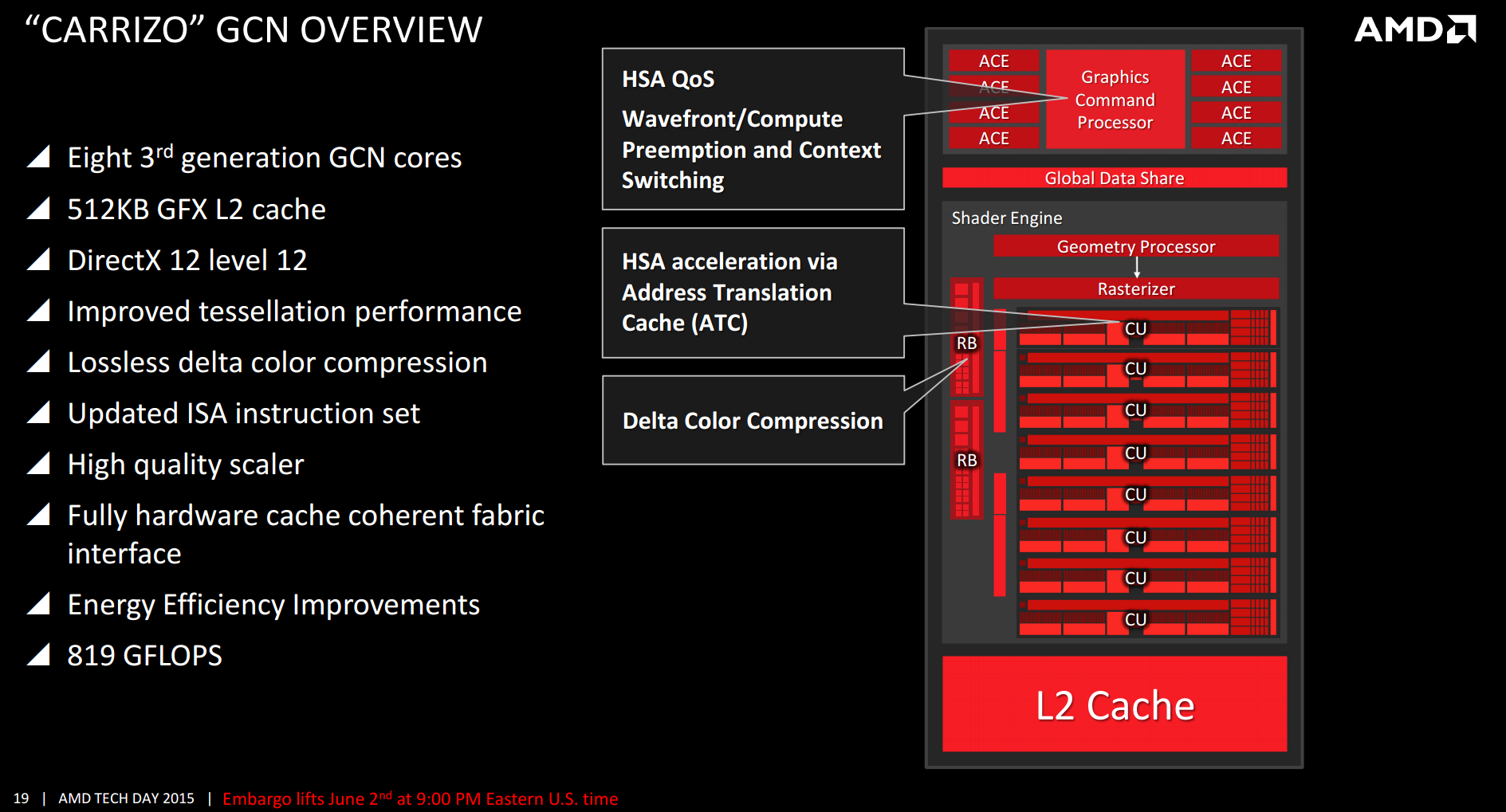
Compute units
One compute unit (CU) combines 64 shader processors with 4 texture mapping units (TMUs). The compute units are separate from, but feed into, the render output units (ROPs). Each compute unit consists of the following:
- a CU scheduler
- a Branch & Message Unit
- 4 16-lane-wide SIMD Vector Units (SIMD-VUs)
- 4 64 KiB vector general-purpose register (VGPR) files
- 1 scalar unit (SU)
- a 8 KiB scalar GPR file
- a local data share of 64 KiB
- 4 Texture Filter Units
- 16 Texture Fetch Load/Store Units
- a 16 KiB level 1 (L1) cache
Four Compute units are wired to share a 16KiB L1 instruction cache and a 32KiB L1 data cache, both of which are read-only. A SIMD-VU operates on 16 elements at a time (per cycle), while a SU can operate on one a time (one/cycle). In addition, the SU handles some other operations, such as branching.
Every SIMD-VU has some private memory where it stores its registers. There are two types of registers: scalar registers (S0, S1, etc.), which hold 4 bytes number each, and vector registers (V0, V1, etc.), which each represent a set of 64 4-byte numbers. On the vector registers, every operation is done in parallel on the 64 numbers. which correspond to 64 inputs. For example, it may work on 64 different pixels at a time (for each of them the inputs are slightly different, and thus you get slightly different color at the end).
Every SIMD-VU has room for 512 scalar registers and 256 vector registers.
AMD has claimed that each GCN compute unit (CU) has 64 KiB Local Data Share (LDS).
CU scheduler
The CU scheduler is the hardware functional block, choosing which wavefronts the SIMD-VU executes. It picks one SIMD-VU per cycle for scheduling. This is not to be confused with other hardware or software schedulers.
Wavefront
A shader is a small program written in GLSL that performs graphics processing, and a kernel is a small program written in OpenCL that performs GPGPU processing. These processes don't need that many registers, but they do need to load data from system or graphics memory. This operation comes with significant latency. AMD and Nvidia chose similar approaches to hide this unavoidable latency: the grouping of multiple threads. AMD calls such a group a "wavefront", whereas Nvidia calls it a "warp". A group of threads is the most basic unit of scheduling of GPUs that implement this approach to hide latency. It is the minimum size of the data processed in SIMD fashion, the smallest executable unit of code, and the way to processes a single instruction over all of the threads in it at the same time.
In all GCN GPUs, a "wavefront" consists of 64 threads, and in all Nvidia GPUs, a "warp" consists of 32 threads.
AMD's solution is to attribute multiple wavefronts to each SIMD-VU. The hardware distributes the registers to the different wavefronts, and when one wavefront is waiting on some result, which lies in memory, the CU Scheduler assigns the SIMD-VU another wavefront. Wavefronts are attributed per SIMD-VU. SIMD-VUs do not exchange wavefronts. A maximum of 10 wavefronts can be attributed per SIMD-VU (thus 40 per CU).
AMD CodeXL shows tables with the relationship between number of SGPRs and VGPRs to the number of wavefronts, but essentially, for SGPRS it is between 104 and 512 per number of wavefronts, and for VGPRS it is 256 per number of wavefronts.
Note that in conjunction with the SSE instructions, this concept of the most basic level of parallelism is often called a "vector width". The vector width is characterized by the total number of bits in it.
SIMD Vector Unit
Each SIMD Vector Unit has:
- a 16-lane integer and floating point vector Arithmetic Logic Unit (ALU)
- 64 KiB Vector General Purpose Register (VGPR) file
- 10× 48-bit Program Counters
- Instruction buffer for 10 wavefronts (each wavefront is a group of 64 threads, or the size of one logical VGPR)
- A 64-thread wavefront issues to a 16-lane SIMD Unit over four cycles
Each SIMD-VU has 10 wavefront instruction buffers, and it takes 4 cycles to execute one wavefront.
Audio and video acceleration blocks
Many implementations of GCN are typically accompanied by several of AMD's other ASIC blocks. Including but not limited to the Unified Video Decoder, Video Coding Engine, and AMD TrueAudio.
Video Coding Engine
The Video Coding Engine is a video encoding ASIC, first introduced with the Radeon HD 7000 series.
The initial version of the VCE added support for encoding I and P frames H.264 in the YUV420 pixel format, along with SVE temporal encode and Display Encode Mode, while the second version added B-frame support for YUV420 and YUV444 I-frames.
VCE 3.0 formed a part of the third generation of GCN, adding high-quality video scaling and the HEVC (H.265) codec.
VCE 4.0 was part of the Vega architecture, and was subsequently succeeded by Video Core Next.
Hardware schedulers
Hardware schedulers are used to perform scheduling and offload the assignment of compute queues to the ACEs from the driver to hardware, by buffering these queues until there is at least one empty queue in at least one ACE. This causes the HWS to immediately assign buffered queues to the ACEs until all queues are full or there are no more queues to safely assign.
Part of the scheduling work performed includes prioritized queues which allow critical tasks to run at a higher priority than other tasks without requiring the lower priority tasks to be preempted to run the high priority task, therefore allowing the tasks to run concurrently with the high priority tasks scheduled to hog the GPU as much as possible while letting other tasks use the resources that the high priority tasks are not using. These are essentially Asynchronous Compute Engines that lack dispatch controllers. They were first introduced in the fourth generation GCN microarchitecture, but were present in the third generation GCN microarchitecture for internal testing purposes. A driver update has enabled the hardware schedulers in third generation GCN parts for production use.


 Classical desktop computer architecture with a distinct graphics card over PCI Express. CPU and GPU have their distinct physical memory, with different address spaces. The entire data needs to be copied over the PCIe bus. Note: the diagram shows bandwidths, but not the memory latency.

 Integrated graphics-solutions (and AMD APUs with TeraScale graphics) suffer under partitioned main memory: a part of the system memory is allocated to the GPU exclusively. Zero-copy is not possible, data has to be copied (over the system memory bus) from one partition to the other.
 AMD APUs with GCN graphics gain from unified main memory conserving scarce bandwidth