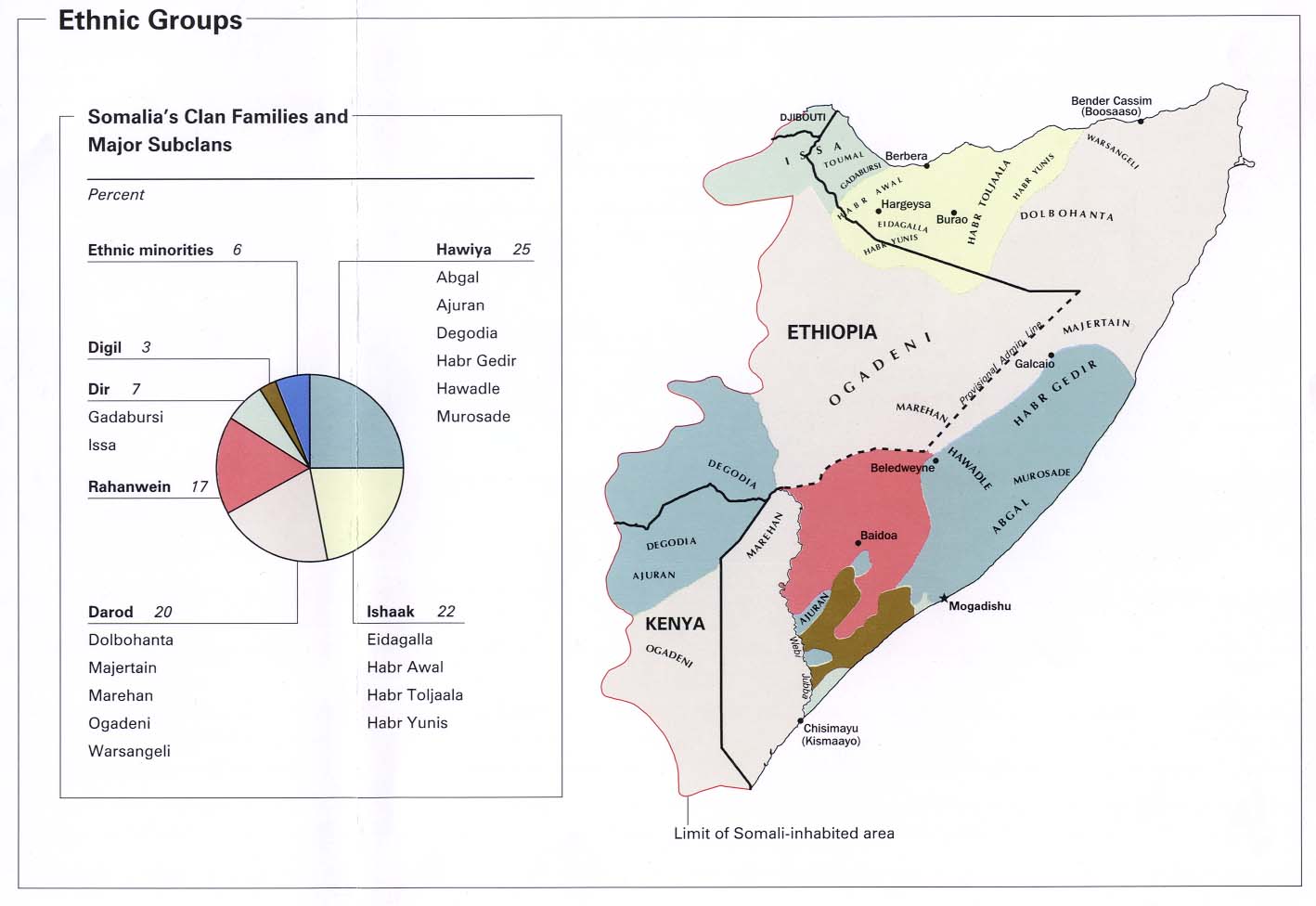
The Majeerteen, (Somali: Majeerteen, Arabic: ماجرتين; also spelled Majerteen, Macherten, Majertain, or Mijurtin) alternately known as Mohammed Harti, is a Somali sub-clan part of the Harti branch of the Darod clan. Traditionally, they inhabit extensive territories in the Bari, Nugaal, and Mudug regions of Somalia, spanning from Bosaso to Garacad, mainly in Puntland state. Additionally, Majeerteen populations are present in southern towns such as Kismayo.
Overview
The Majeerteen Sultanates played an important role in the pre-independence era of Somalia. The Majeerteen also held many other significant government posts in the 1960s and 1970s, and continue to play a key role in Puntland state and Somalia as a whole.
Etymology
The name Majeertayn means much beloved or much admired in Somali and comes from the root word, Majeero, which means a strong attraction.
Distribution
The Majeerteen are traditionally settled in Somalia's northern regions of Bari, Nugal and Mudug. They can also be found in Kismayo in southern Somalia due to migrations starting in the 19th century along with their fellow members of the larger Harti subclan, the Dhulbahante, Dishiishe and Warsangeli.
The Majeerteen are traditionally settled in the land in-between Murcanyo, Bandar Siyad an ancient port town facing the Gulf of Aden, and Garacad a coastal port town, facing the Indian Ocean and all the land in between which corresponds to the area encompassing the Horn of Africa. Therefore, the Majerteen are settled in what is literally considered to be 'the Horn of Africa'.
Some Majeerteen people are also found in the Somali Region in Ethiopia, specifically in the Dollo Zone near the Somalia border. The Majeerteen are part of Darod subclans within Somalia. The Majeerteen are more commonly found in the cities of Bosaso, Garowe and Galkacyo which are all regional capitals of Bari, Somalia, Nugal, Somalia and Mudug respectively.
The Osman Mahmud (Cismaan Maxamuud), Omar Mohamoud (Cumar Maxamuud), and Isse Mahmoud (Ciise Maxamuud) comprise the Maxamuud Saleebaan; which, along with Ali Saleebaan and Ugaar Saleebaan,[citation needed] forms the major subclan of Saleebaan Maxamed (Majeerteen). A 2010 study identifies as both the main division of Majeerteen and a central and unifying entity in Puntland. During the 1960s, the Osman Mahamud, Ali Saleebaan (or Cali Saleebaan), Wadalmoge and Ciise.
Maxamuud formed a powerful business class in Kismayo, while Siad Barre exploited a rivalry between the Cali Saleebaan and Cumar Maxamuud in an effort to weaken the Majeerteen in general. Historically, the Majeerteen formed part of a coastal trading network around the Red Sea and the Indian Ocean, along with other subclans.
The first recorded mention of the Majeerteen (Mijertayne Somauli) clan in English appears in a passage by Henry Salt, who described them as inhabiting the coast of Hafun under the leadership of a certain Sultan Hassan. Salt recounts that the Imam of Muscat had, sometime earlier, sent gifts to the Majeerteen and requested permission to construct a small fort on the coast of Hafun. This request, however, was declined, and the gifts were rejected, maintaining the tribe's independence.
A 1727 English account of a Somali pirate raid on an Indian ship seeking water near Ras Filuk, in current day Murcanyo, appears to be the earliest written record of possible Majeerteen pirate activity. The pirates slaughtered the entire crew except for two young boys and brought the Indian vessel to shore. They then sailed to Aden, where they sold the two boys into slavery.
Early Majeerteen maritime history
In the early 1700s, a Majeerteen religious sheikh named Omar left Somalia after fleeing incessant family quarrels over power and property. Feeling called to teach Islam in foreign lands, he arrived in Tadjoura, where the Ayrolasso Afar tribe welcomed him, gave him a wife, and integrated him into their tribal group. From this marriage, a son named Roble was born. Roble later had two sons, Ibrahim and Omar. Omar married Nagousse Fattou, the daughter of the Sultan of Tadjoura from the ruling Dini-Sarra clan. Their descendants became known as the Roble-Omarto subclan of the Ayrolasso. Ahmed-Dini, the great-great-grandson of the immigrant Majeerteen sheikh, became the Qadi of Tadjoura during the mid-1800s.
Majeerteen merchants played an important role in Red Sea and Indian Ocean trade networks during the 19th century. One notable figure was Yunus Buraale, a Majeerteen merchant and Nakhuda from the Abdirahim Ibrahim subclan. In 1808, Salt noted that Yunus, along with his brother and other Somali traders, had established a trading factory at Harena, an outpost on the Eritrean Red Sea coast, writing:
I also found a party of Somauli traders, who, under the direction of Yunus's brother, had established a small factory at this place for the purpose of carrying on an intercourse with the natives, an instance of enterprise strongly marking the superiority of the Somauli over all other African tribes on the coast. The chief exports consist of slaves, horses, cattle, goats, and ghee, of which latter very considerable quantities are always to be procured in the neighbourhood.
Harena, the location of the Majeerteen trading factor1809 depiction of Yunus Buraale by Henry Salt
In 1809, Yunus also briefly acted as an envoy between Pearce and the then Ras of Tigray, Wolde Selassie.
In 1809, Yunus was secretly poisoned by the Damoheita Afar after they received letters with orders from Omar Aga, the Ottoman governor of Massawa. In traditional Somali custom, Yunus's dhow was inherited by his son, Warsame, who, together with his uncle and his father's Damoheita Afar widow, buried and mourned the great merchant.
In 1841, Antoine d'Abbadie met a Majeerteen sailor named Muhammad Araale, who recounted that he had travelled with Salt in his youth alongside his uncle, Yunus Buraale. d'Abbadie wrote of Araale:
His name is Arrali, and he traveled with Salt, who received from his uncle the information this author gives on the Somali country. Salt writes his uncle's name Yunis (Younis).
Majeerteen lineage of Muhammad Araale, the nephew of Yunus Buraale
In January 1841, d'Abbadie recorded the complete lineage of Yunus's nephew Araale, confirming Yunus's Majeerteen lineage as follows:
Muhamad Araale Ilmi Siyad Ali Odowaa Ismail Yusuf Muhamad Ahmed Abdirahim Ibrahim Jibraahiil....Majeerteen.
Yunus's ties to the Abdirahim Ibrahim branch of Majeerteen were further confirmed by Theodor von Heuglin upon his visit to Harena and Baka Island on the Bay of Howakil, where he listed the descendants of Yunus in Baka and Harena as "Somalis from Eial Abd Ur Rahim (Abdurahim Ibrahim)."
The Eritrean Majeerteen Sultanate of Baka Island
Majeerteen merchants from the Warwaaqsame subclan migrated to Harena from the Bari region, including Muhammad Abubakar (Warwaaqsame subclan), who arrived in Harena during the late 1700s with Yunus (Abdirahim Ibrahim subclan) and Yunus's brother. His son, Ahmed Muhammad, later rose to prominence as a merchant known throughout the Red Sea. His mercantile activities extended from Suakin, where he met Theodor von Heuglin in 1857, to Massawa and the Howakil region.
The Damoheita Afar of the Howakil, with whom Ahmed Muhammad traded, were so impressed by his wealth that they granted him control of the island of Baka and gave him three wives from the daughters of prominent Damoheita Afar chiefs with whom he had twenty sons. Major Teobaldo Folchi confirmed this in his report, writing:
Seventy or eighty years ago a Somali chief, a certain Mohammed Ahmed, arrived in Harena, coming from Mogadishu, to take up residence there. Welcomed by the Damhoeita as an honored guest, he became part of their community and was related by marriage to three of their leaders, who, having given their daughters in marriage to the new arrival, spontaneously offered him the island of Baca as a gift for him to inhabit.
In 1857, Heuglin also confirmed the ownership of Baka Island by the Massawa merchant Ahmed Muhammad.
In 1869, Ahmed Muhammad was, in effect, because of his great riches, the undisputed ruler of the entire Howakil coast as far as Meder, with even local Afar chiefs deferring to Ahmed when the French consul Werner Munzinger attempted to travel through Afar country, sending boats to him to ask for permission to allow Munzinger to travel.
Map of Baka
By 1872, during Hildebrandt's visit to Baka, Ahmed Muhammad had died, and the island was inhabited by his twenty sons and their families.
The lineage of the Baka Sultans Ahmed, Musa, and Warsame
After Ahmed's death, his brother, Musa Muhammad, was appointed the new Sultan of Baka. Later, his cousin's son, Warsame Muhammud, also settled on the island and became the new head of the island, which he, in turn, passed on to Saleh, the son of Ahmed Muhammad, during the time of Italian occupation. Saleh Ahmed passed away in 1897 and was succeeded by his son, Ahmed Saleh.
The tribes of Baka were subdivided into three fractions, each descended from the island's former rulers:
Bayt Ahmed Muhammad - descendants of the first Sultan of Baka, Ahmed Muhammad
Bayt Musa Muhammad - descendants of the second Sultan of Baka, Musa Muhammad
Bayt Warsame Muhammud - descendants of the third Sultan of Baka, Warsame Muhammud
The Lineage of the Eritrean Sultan of the Warwaqsame Majeerteen, 1913
During the Italian occupation of Eritrea, the tribe came to be collectively known as "Ad Saleh", named after their most prominent Sultan, Saleh Ahmed. The Italian authorities also recorded the lineage of the then Sultan of Baka as:
Sheikh Ahmed Saleh Ahmed Muhammad Abubakar Yusuf Guled Yahya Ibrahim Daud Hassan Habib Ardul-Nabi Warwaaqsame Majeerteen.
In 1891, conflict broke out between rival factions within the Baka Majeerteen and the Damoheita Afar. Taher Ahmed Muhammad, angered by Sultan Ahmed Saleh's decision to make peace with the Damoheita, declared himself the rightful Sultan and rebelled against his nephew, Ahmed Saleh Ahmed Muhammad, demanding to be named the leader of Baka. Taher fled to the court of Sultan Osman Mahmud of Majeerteeniya. Sultan Osman then attempted to mediate and resolve the dispute between Taher and Ahmed, as reflected in the letters between him and Governor Gandolfi of Italian Eritrea.
Sheikh Ahmed Saleh's claim to the Sultanate of Baka was supported by Sheikh Mohamed Zebibi, chief of the Beit Khalifa subsection of the Asawurta Saho, and Naib Idris Hassan of the Balaw of Massawa. In a report concerning the dispute, Gandolfi wrote:
The aforementioned Sheikh Saleh inherited the Sheikhate of the island of Baka from his ancestors, as you will see from the documents sent to his family by both the Turkish and Egyptian governments, and as Naib Idris of Moncullo and Sheikh Zibibi of Zula could also attest.
In 1895, Sheikh Ahmed Saleh inherited the nearby island of Abbagubba and imposed tribute on the local Damoheita Afar.
In 1997, Sheikh Jamal al-Din al-Shami published Al Manhal fi Tarikh wa Akhbar al-Afar al-Danakil, which included an interview with an elderly Sheikh Ahmed Saleh. In the interview, Ahmed Saleh again recited his lineage to Majeerteen and recounted how his ancestors settled on the Eritrean coast.
The journey from Somalia to Eritrea, taken by the Majeerteen merchants in the late 1700s
The Majeerteen Sultanate was founded in the 15-16th century and came to prominence in the 19th century, under the reign of the resourceful King (Boqor) Osman Mahamuud. His Sultanate controlled Bari Karkaar, Nugaal and also central Somalia in the 19th and early 20th centuries. The polity maintained a robust trading network, entered into treaties with foreign powers, and exerted strong centralized authority on the domestic front.
Osman Mahamuud's Sultanate was nearly destroyed in the late-1800s by a power struggle between himself and his ambitious cousin, Yusuf Ali Kenadid who founded the Sultanate of Hobyo in 1878. Initially he wanted to seize control of the neighbouring Majeerteen Sultanate, ruled by his cousin Boqor Osman Mahamud. However, Yusuf Ali Kenadid was unsuccessful in his endeavour, and was eventually forced into exile in Yemen. A decade later, in the 1870s, Yusuf Ali Kenadid returned from the Arabian Peninsula with a band of Hadhramimusketeers and a group of devoted lieutenants. With their assistance, he managed to overpower the local Hawiye clans and establish the Kingdom of Hobyo in 1878.
As with the Majeerteen Sultanate, the Sultanate of Hobyo exerted a strong centralized authority during its existence, and possessed all of the organs and trappings of an integrated modern state: a functioning bureaucracy, a hereditary nobility, titled aristocrats, a state flag, as well as a professional army. Both sultanates also maintained written records of their activities, which still exist.
Colonial era
In the late 19th century, all extant northern Somali monarchs entered into treaties with one of the colonial powers, Abyssinia, Britain or Italy, except for the Dhulbahante. Likewise, in late 1889, Boqor Osman entered into a treaty with the Italians, making his realm an Italian protectorate. His rival Sultan Kenadid had signed a similar agreement vis-a-vis his own Sultanate the year before. Both rulers had signed the protectorate treaties to advance their own expansionist objectives, with Boqor Osman looking to use Italy's support in his ongoing power struggle with Kenadid over the Majeerteen Sultanate. Boqor Osman and Sultan Kenadid also hoped to exploit the conflicting interests among the European imperial powers that were then looking to control the Somali peninsula, so as to avoid direct occupation of their territories by force.
The relationship between the Sultanate of Hobyo and Italy soured when Sultan Kenadid refused the Italians' proposal to allow a British contingent of troops to disembark in his Sultanate so that they might then pursue their battle against Mohammed Abdullah Hassan's Dervish forces. Viewed as too much of a threat by the Italians, Sultan Kenadid was eventually exiled to Aden in Yemen and then to Eritrea, as was his son Ali Yusuf, the heir apparent to his throne.
Osman Yusuf Kenadid, the son of the first Sultan Yusuf Ali Kenadid, was a famous poet and scholar. Osman Yusuf Kenadid was the inventor of the first phonetically standard script for the Somali language in the 1920s, the Osmanya Script.
Following a two-year resistance by Boqor Osman and Majeerteen rebels, Italian Somaliland came under the full authority of Rome by late 1927. Long-lasting Italian coastal bombardments on urban settlements and naval blockades were utilized by colonial forces to suppress the rebels.
Groups
Taargooye, an exclusively Majeerteen Darawiish administrative division and disbanded in 1910 when its constituents became mutinous
12Helen Chapin Metz, ed., Somalia: a country study, (The Division: 1993), p.10.
12Horn of Africa, Volume 15, Issues 1-4, (Horn of Africa Journal: 1997), p.130.
↑Transformation towards a regulated economy, (WSP Transition Programme, Somali Programme: 2000) p.62.
↑Lee V. Cassanelli, The shaping of Somali society: reconstructing the history of a pastoral people, 1600-1900, (University of Pennsylvania Press: 1982), p.75.
↑Jardine, Douglas (1923). Mad Mullah of Somaliland. Early in 1885 Great Britain concluded separate protective treaties with all the Somali tribes now living under her protection, except the Warsangeli, who concluded a treaty in 1886, and the Dolbahanta, with whom no treaty has been made.
↑Samatar, Said (1982). Oral Poetry and Somali Nationalism. p.214. ISBN9780511735370. 'Abdalla Qoriyow, the prestigious Islamic magistrate of the Dervish capital, who took part in the conspiracy. 108 Ahmad Fiqi, also a conspirator, was the Dervish expert on Qur'anic exegesis. 109 Reference to the Sayyid's brother-in-law, Faarah Mahamuud Sugulle, whose involvement in the conspiracy was particularly bad news for the Sayyid ... After a week of intense fighting, the Sayyid emerged victorious, but not before several Dervish clans, like the Reer Samatar Khalaf Majeerteen, were decimated

 Somali
 Ethiopia
 Kenya
 Yemen
 Oman
 Eritrea
 Arabic