In probability theory, a random variable is said to be mean independent of random variable if and only if its conditional mean equals its (unconditional) mean for all such that the probability density/mass of at , , is not zero. Otherwise, is said to be mean dependent on .


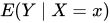


Stochastic independence implies mean independence, but the converse is not true.; moreover, mean independence implies uncorrelatedness while the converse is not true. Unlike stochastic independence and uncorrelatedness, mean independence is not symmetric: it is possible for to be mean-independent of even though is mean-dependent on .
The concept of mean independence is often used in econometrics to have a middle ground between the strong assumption of independent random variables () and the weak assumption of uncorrelated random variables


