The Skoll Foundation's total assets (including its affiliated funds) exceed $2 billion as of 2025. The combined entities made grant disbursements totaling about $106 million in 2025, based on unaudited numbers reported by the foundation. According to Skoll's most recent audited financial statements (2024), the non-grant expenses for the foundation totaled around $32 million in 2025.
History
Skoll set up the foundation in 1999 to fund social entrepreneurship through awards, grants and educational programs at Oxford and Harvard Universities. Skoll, the first president of eBay, created the Skoll Foundation after setting up the eBay Foundation.
In 2001, Skoll hired Sally Osberg, formerly the founding executive director of the Children's Discovery Museum of San Jose. Osberg was the foundation's first employee, president and CEO. Osberg claims that she led the organization through its startup, implementation and renewal phases. Osberg and her colleagues set up platforms to connect civil society members with private and public sector leaders. These platforms included partnerships with Sundance Festival and Oxford's Saïd Business School.
In 2003, Skoll established the private Skoll Foundation. The two entities, which have distinct governing bodies but share staff and offices, together operate the foundation's grantmaking and other programs.
In 2017, Osberg announced plans to step down from the role of CEO. In 2018, Richard Fahey assumed the role of interim president after 14 years of executive leadership at the foundation. In February 2019, Donald Gips was appointed as the foundation's CEO. Formerly, Gips served as the U.S. Ambassador to the Republic of South Africa. In March 2021, the foundation hired Marla Blow as its president and chief operating officer. She had formerly served as the senior vice president for social impact in North America for the Mastercard Center for Inclusive Growth. She was promoted to CEO as of June 1, 2025.
The foundation, which moved to its Palo Alto headquarters in 2004, also collaborated closely with the Skoll Global Threats Fund, established in 2009, to address climate change, pandemics, water security, nuclear proliferation, and conflict in the Middle East. Some of the fund's initiatives supported by the foundation have included an app, developed in partnership with the Brazilian Ministry of Health, that allowed monitoring of health conditions and potential infection by the Zika virus during the 2016 Olympics; supporting surveillance technologies that identify epidemics at their earliest outbreak; and development of an online tool that will help policymakers identify global water risk and food security hot spots.
The foundation began funding research into pandemic preparedness and prevention in 2009. Simultaneously, the organization funded research into climate change water scarcity, nuclear weapons and conflict in the Middle East; it called this its Global Threats Fund. Previously, the foundation partnered with Google's philanthropic arm, Google.org to fund Nathan Wolfe's 2008 research into cross-species transmission amongst Cameroonian bushmeat hunters. In 2018 the fund created Ending Pandemics, a non-profit spun out from its research into pandemic detection and rapid response.
Skoll increased the foundation's 2020 grant to $200 million to respond to the pandemic's economic, health and social impact. The African Field Epidemiology Network, a group that works with Africa Centres for Disease Control and Prevention were the foundation's first COVID-related grantees. The foundation also gave sixty-four past and current Skoll grantees $50,000 in emergency funding during this period.
Skoll Centre for Social Entrepreneurship at the University of Oxford
In 2003, the foundation donated $7.5M to the Saïd Business School at Oxford University to establish the Skoll Centre for Social Entrepreneurship. The center studies and promotes socially purposed businesses and hosts a one-year MBA programme in social entrepreneurship. The grant also funded an endowed lectureship, program director, visiting fellows, five MBA student fellowships, visiting fellows, and the annual Skoll World Forum on Social Entrepreneurship. The Skoll Centre's activities concentrate on educating social change leaders, practical research and convening leaders in the social change field.
Skoll World Forum
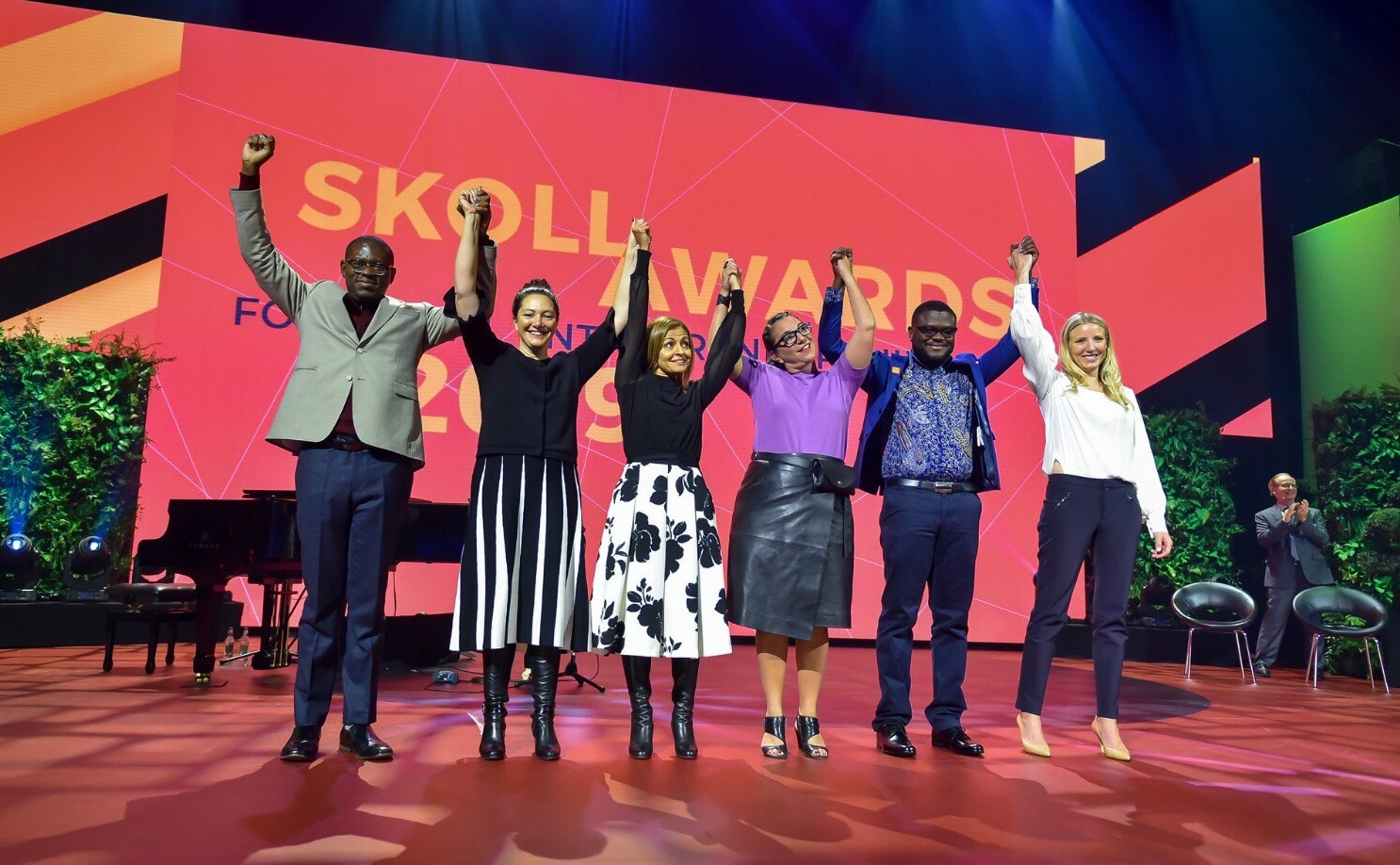
The annual Skoll World Forum assembles social entrepreneurship leaders at the Said Business School to discuss solutions to social challenges. The foundation held its first forum in 2004. Attendance was roughly 1,200 as of the 2019 Forum, and the delegates represented around 80 countries. The event facilitates impact investing.
In 2026, the event attracted thousands of philanthropists and social entrepreneurs, and artificial intelligence was a prominent topic of discussion. Comedian Trevor Noah discussed AI with Noubar Afeyan, co-founder and chairman of Moderna.