Mathematical description
Source:
The sprays are assumed to be spherical with radius  , even though the assumption is valid for solid particles(liquid droplets) when their shape has no consequence on the combustion. For liquid droplets to be nearly spherical, the spray has to be dilute(total volume occupied by the sprays is much less than the volume of the gas) and the Weber number
 , where
 is the gas density,
 is the spray droplet velocity,
 is the gas velocity and
 is the surface tension of the liquid spray, should be
 .
The equation is described by a number density function  , which represents the probable number of spray particles (droplets) of chemical species
 (of
 total species), that one can find with radii between and
 , located in the spatial range between
 and
 , traveling with a velocity in between and
 , having the temperature in between
 and
 at time
 . Then the spray equation for the evolution of this density function is given by

where
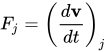 is the force per unit mass acting on the
 species spray (acceleration applied to the sprays),
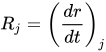 is the rate of change of the size of the species spray,
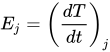 is the rate of change of the temperature of the species spray due to heat transfer,
 is the rate of change of number density function of species spray due to nucleation, liquid breakup etc.,
 is the rate of change of number density function of species spray due to collision with other spray particles.
A simplified model for liquid propellant rocket
This model for the rocket motor was developed by Probert, Williams and Tanasawa. It is reasonable to neglect  , for distances not very close to the spray atomizer, where major portion of combustion occurs. Consider a one-dimensional liquid-propellent rocket motor situated at
 , where fuel is sprayed. Neglecting
 (density function is defined without the temperature so accordingly dimensions of
 changes) and due to the fact that the mean flow is parallel to
 axis, the steady spray equation reduces to

where  is the velocity in direction. Integrating with respect to the velocity results

The contribution from the last term (spray acceleration term) becomes zero (using Divergence theorem) since  when
 is very large, which is typically the case in rocket motors. The drop size rate
 is well modeled using vaporization mechanisms as

where  is independent of , but can depend on the surrounding gas. Defining the number of droplets per unit volume per unit radius and average quantities averaged over velocities,

the equation becomes

If further assumed that  is independent of , and with a transformed coordinate

If the combustion chamber has varying cross-section area  , a known function for
 and with area
 at the spraying location, then the solution is given by
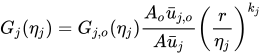 .
where  are the number distribution and mean velocity at respectively.
