NGC 3310
| NGC 3310 | |
|---|---|
 NGC 3310 imaged by the Hubble Space Telescope | |
| Observation data (J2000 epoch) | |
| Constellation | Ursa Major |
| Right ascension | 10h 38m 45.857s |
| Declination | +53° 30′ 11.89″ |
| Redshift | 0.003309 |
| Heliocentric radial velocity | 989±1 km/s |
| Distance | 42.73 ± 3.72 Mly (13.100 ± 1.142 Mpc) |
| Apparent magnitude (V) | 10.6 |
| Characteristics | |
| Type | SAB(r)bc pec or SAcd |
| Size | ~47,200 ly (14.48 kpc) (estimated) |
| Apparent size (V) | 3.1′ × 2.4′ |
| Other designations | |
| IRAS 10356+5345, 2MASX J10384585+5330118, Arp 217, UGC 5786, MCG +09-18-008, PGC 31650, CGCG 267-004, VV 356 and 406 | |
NGC 3310, also known as the Bow and Arrow Galaxy, is a grand design spiral galaxy in the constellation Ursa Major. Its velocity with respect to the cosmic microwave background is 1,169±13 km/s, which corresponds to a Hubble distance of 56.3 ± 4.0 Mly (17.25 ± 1.22 Mpc). However, eight non-redshift measurements give a closer mean distance of 42.73 ± 3.72 Mly (13.100 ± 1.142 Mpc). It was discovered by German-British astronomer William Herschel on 12 April 1789.
NGC 3310 is a starburst galaxy and it is likely that it collided with one of its satellite galaxies about 100 million years ago, triggering widespread star formation. The ring clusters of NGC 3310 have been undergoing starburst activity for at least the last 40 million years.
Supernovae

Four supernovae have been discovered in NGC 3310:
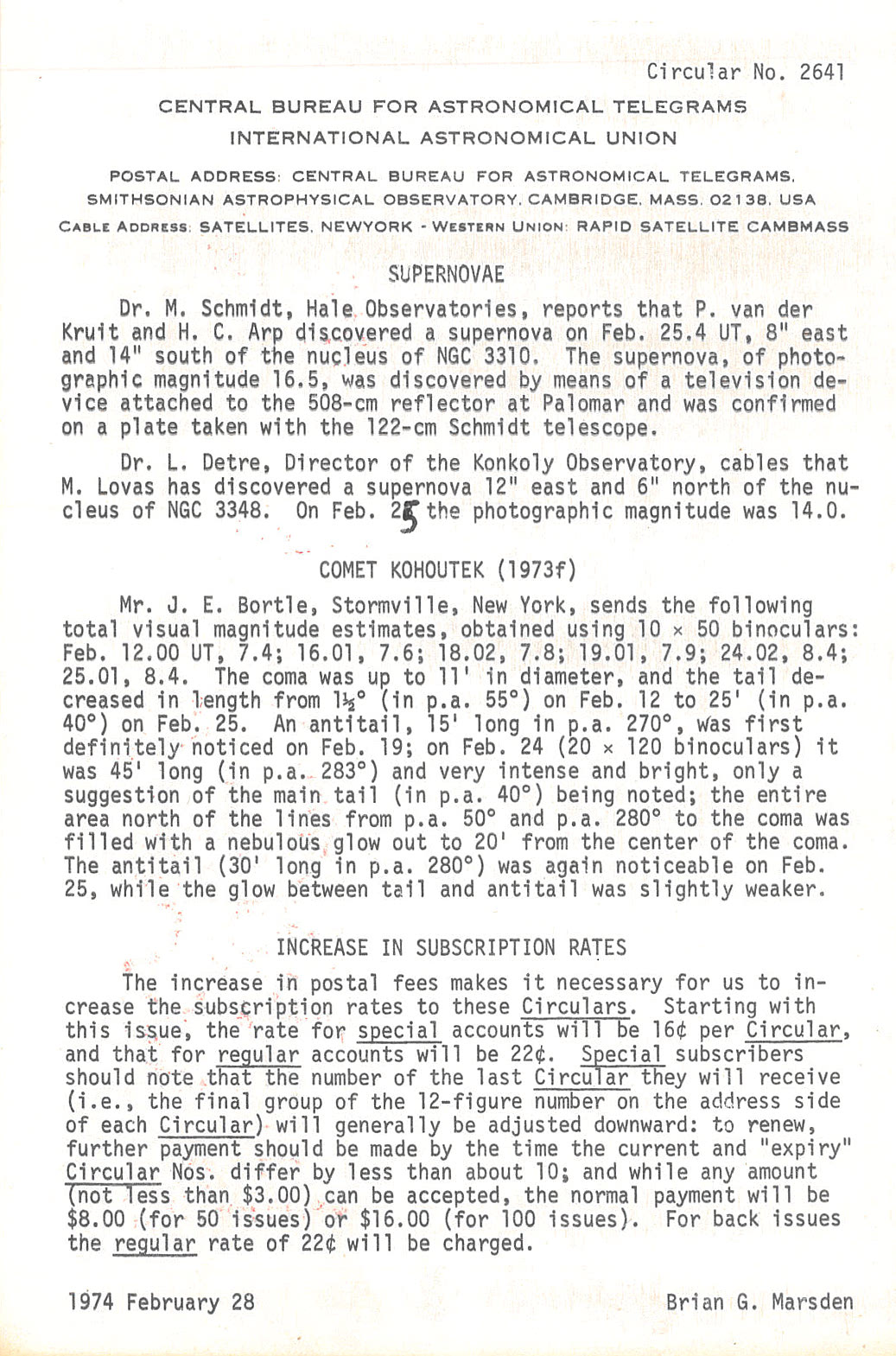
- SN 1974C (type unknown, mag. 16.5) was discovered by Pieter van der Kruit and Halton Arp on 25 February 1974.
- SN 1991N (Type Ib/c, mag. 15) was discovered by the Berkeley Automated Supernova Search on 29 March 1991 at an offset of 5″ east and 7″ south of the galactic nucleus.
- SN 2021gmj (Type II-P, mag. 15.1) was discovered by the Distance Less Than 40 Mpc Survey (DLT40) on 20 March 2021.
- SN 2026sqf (Type Ia-CSM, mag. 12.9) was discovered by American amateur astronomer Patrick Wiggins on 8 July 2026. It had originally been classified as Type II, but later analysis concluded it to be type Type Ia-CSM, the closest yet known of this kind. SN 2026sqf is part of the Unistellar "cosmic cataclysms" smart telescope tracking project.
Notes
- ↑ Some sources incorrectly list the discovery date as 26 February 1974.
References
- 1 2 3 4 Finlay, Warren H. (2014). Concise Catalogue of Deep-Sky Objects. The Patrick Moore Practical Astronomy Series (2nd ed.). Springer Cham. p. 245. doi:10.1007/978-3-319-03170-5. ISBN 978-3-319-03169-9.
- 1 2 Skrutskie, Michael F.; et al. (February 1, 2006). "The Two Micron All Sky Survey (2MASS)". The Astronomical Journal. 131 (2): 1163–1183. Bibcode:2006AJ....131.1163S. doi:10.1086/498708. ISSN 0004-6256. S2CID 18913331.
- 1 2 Ann, H. B.; et al. (2015), "A Catalog of Visually Classified Galaxies in the Local (z ~ 0.01) Universe", The Astrophysical Journal Supplement Series, 217 (2): 27–49, arXiv:1502.03545, Bibcode:2015ApJS..217...27A, doi:10.1088/0067-0049/217/2/27, S2CID 119253507.
- 1 2 3 4 5 "Results for object NGC 3310". NASA/IPAC Extragalactic Database. Retrieved 9 July 2026.
- 1 2 "Distance Results for NGC 3310". NASA/IPAC Extragalactic Database. NASA. Retrieved 9 July 2026.
- ↑ Stoyan, Ronald; Schurig, Stephan (2014). interstellarum Deep Sky Atlas. Erlangen: Cambridge University Press; Oculum-Verlag GmbH. ISBN 978-1-107-50338-0. OCLC 920437579.
- ↑ Seligman, Courtney. "New General Catalogue Objects: NGC 3310". Celestial Atlas. Retrieved 9 July 2026.
- ↑ de Grijs, R.; Anders, P.; Bastian, N.; Lynds, R.; et al. (2003). "Star cluster formation and evolution in nearby starburst galaxies - II. Initial conditions". Monthly Notices of the Royal Astronomical Society. 343 (4): 1285–1300. arXiv:astro-ph/0305184. Bibcode:2003MNRAS.343.1285D. doi:10.1046/j.1365-8711.2003.06777.x. S2CID 16174497.
- ↑ Schmidt, M.; van der Kruit, P. (28 February 1974). Marsden, Brian G. (ed.). "SUPERNOVAE". Central Bureau Electronic Telegrams (2641). Smithsonian Astrophysical Observatory, IAU: 1. Retrieved 4 August 2025.
- ↑ "SN 1974C". Transient Name Server. IAU. Retrieved 3 December 2024.
- ↑ Perlmutter, S.; et al. (March 1991). Green, D. W. E. (ed.). "Supernova 1991N in NGC 3310". IAU Circular (5227): 1. Bibcode:1991IAUC.5227....1P.
- ↑ "SN 1991N". Transient Name Server. IAU. Retrieved 3 December 2024.
- ↑ "SN 2021gmj". Transient Name Server. Retrieved 2021-12-20.
- ↑ "SN 2026sqf". Transient Name Server. IAU. Retrieved 8 July 2026.
- ↑ Rehemtulla, Nabeel; Jacobson-Galán, Wynn; Kwok, Lindsey; Miller, Adam A.; Gangopadhyay, Anjasha; Singh, Avinash; Sollerman, Jesper (7 August 2026). "Reclassification of SN 2026sqf, the nearest Type Ia-CSM to-date". Transient Name Server AstroNote. 240. IAU: 1. Bibcode:2026TNSAN.240....1R.
- ↑ "SN2026sqf". Unistellar. Archived from the original on 2026-07-10. Retrieved 2026-07-10.
External links
 Media related to NGC 3310 at Wikimedia Commons
- NASA Astronomy Picture of the Day: Spiral Galaxy NGC 3310 Across the Visible (11 September 2001)
- Hubble's Ultraviolet Views of Nearby Galaxies Yield Clues to Early Universe
- The Scale of the Universe (Astronomy Picture of the Day 2012 March 12)


| Morphology | |
|---|---|
| Structure | |
| Active nuclei | |
| Energetic galaxies | |
| Low activity | |
| Interaction | |
| Lists | |
| Related |
|