| Messier 85 | |
|---|---|
Galaxy Messier 85 by Hubble Space Telescope | |
| Observation data (J2000 epoch) | |
| Constellation | Coma Berenices |
| Right ascension | 12h 25m 24.0528s |
| Declination | +18° 11′ 27.888″ |
| Redshift | 729 ± 2 km/s |
| Distance | 60 ± 4 Mly (18.5 ± 1.2 Mpc) |
| Apparent magnitude (V) | 9.1 |
| Characteristics | |
| Type | SA(s)0+ pec/E2 |
| Size | 36.99 kiloparsecs (120,600 light-years) (diameter; 2MASS total aperture) |
| Apparent size (V) | 7′.1 × 5′.5 |
| Other designations | |
| NGC 4382, UGC 7508, PGC 40515 | |
Messier 85 (also known as M85 or NGC 4382 or PGC 40515 or ISD 0135852) is a lenticular galaxy, or elliptical galaxy for other authors, in the Coma Berenices constellation. It is 60 million light-years away, and has a diameter of about 36.99 kiloparsecs (120,600 light-years) across.
Pierre Méchain discovered M85 in 1781. It is within the outskirts of the Virgo Cluster, and is relatively isolated.
M85 is extremely poor in neutral hydrogen and has a very complex outer structure with shells and ripples that are thought to have been caused by a merger with another galaxy that took place between 4 and 7 billion years ago, as well as a relatively young (<3 billion years old) stellar population on its centermost region, some of it in a ring, that may have been created by a late starburst. Like other massive, early-type galaxies, it has different populations of globular clusters. Aside from the typical "red" and "blue" populations, there is also a population with intermediate colors and an even redder population. It is likely transitioning from being a lenticular galaxy into an elliptical galaxy.
While indirect methods imply that Messier 85 should contain a central supermassive black hole of around 100 million solar masses, velocity dispersion observations imply that the galaxy may entirely lack a central massive black hole.
M85 is interacting with the nearby spiral galaxy NGC 4394, and a small elliptical galaxy called MCG 3-32-38.
Compared to other early-type galaxies, M85 emits a relatively smaller proportion of X-rays.
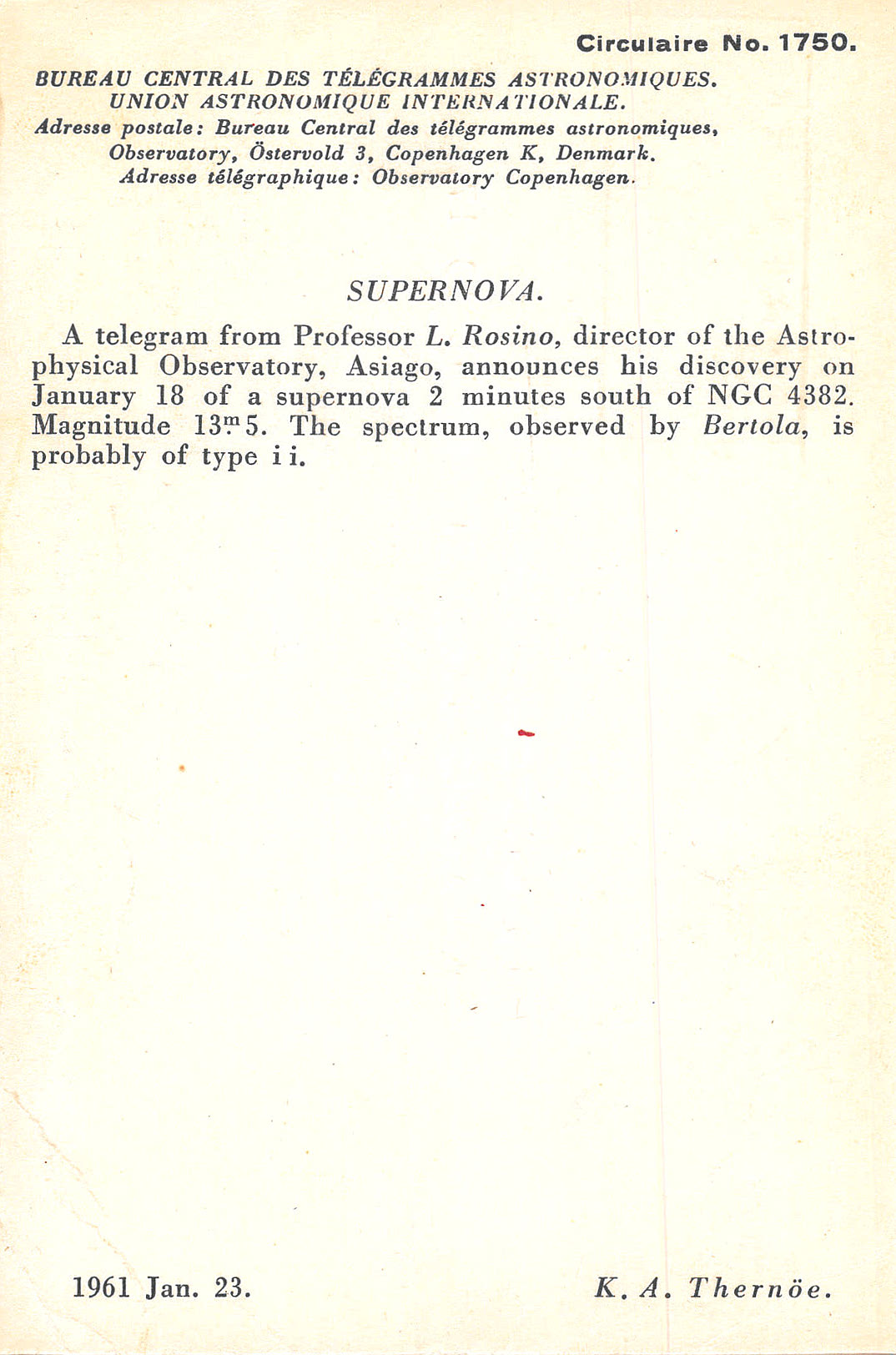
Two supernovae and one luminous red nova have been observed in M85: