NGC 4874

NGC 4874
NGC 4874 dominates this picture created from optical and near-infrared exposures taken with the Wide Field Channel of Hubble's Advanced Camera for Surveys.
(Credit: ESA/Hubble, NASA)
Observation data (J2000 epoch)
ConstellationComa Berenices
Right ascension12h 59m 35.709s
Declination+27° 57′ 33.80″
Redshift0.023907±0.00000667
Heliocentric radial velocity7,167±2 km/s
Distance315.73 ± 6.41 Mly (96.804 ± 1.966 Mpc)
Group or clusterComa Cluster
Apparent magnitude (V)11.4
Apparent magnitude (B)13.7
Characteristics
TypecD; Di
Size79.792 to 82.79 kpc (260,250 to 270,020 ly)
(diameter; D25.0 B-band and 2MASS K-band total isophotes
Apparent size (V)1.9′ × 1.9′
Other designations
2MASX J12593570+2757338, UGC 8103, LEDA 44628, MCG +05-31-070, PGC 44628, CGCG 160-231, SDSS J125935.70+275733.3

NGC 4874 is a supergiant elliptical galaxy in the constellation of Coma Berenices. It was discovered on 11 April 1785 by German-British astronomer William Herschel, who catalogued it as a bright patch of nebulous feature. The second-brightest galaxy within the northern Coma Cluster, it is located at a distance of about 97 megaparsecs (316,000,000 light-years) from Earth.

Characteristics

The galaxy is surrounded by an immense stellar halo that extends up to around ten times the size of the Milky Way Galaxy, somewhere roughly one million light-years in diameter. It is also enveloped by a huge cloud of interstellar medium that is currently being heated by the action of infalling material from its central supermassive black hole.[citation needed] A jet of highly energetic plasma extends out to 1,700 light-years from its center.[citation needed] The galaxy has more than 30,000 globular clusters.

Supernovae

Three supernovae have been observed in NGC 4874:

See also

References

  1. 1 2 "SIMBAD basic query result". SIMBAD Astronomical Database. Retrieved 20 September 2011.
  2. 1 2 3 4 5 6 "NASA/IPAC Extragalactic Database". Results for NGC 4889. Retrieved 2015-01-04.
  3. ↑ Michard, R.; Andreon, S. (2008). "Morphology of galaxies in the Coma cluster region down to M_B = −14.25. I. A catalog of 473 members". Astronomy and Astrophysics. 490 (3): 923. arXiv:0809.2487. Bibcode:2008A&A...490..923M. doi:10.1051/0004-6361:200810283. S2CID 16930860.
  4. ↑ Falco, Emilio E.; Kurtz, Michael J.; Geller, Margaret J.; Huchra, John P.; Peters, James; Berlind, Perry; Mink, Douglas J.; Tokarz, Susan P.; Elwell, Barbara (1999). "The Updated Zwicky Catalog (UZC)". Publications of the Astronomical Society of the Pacific. 111 (758): 438. arXiv:astro-ph/9904265. Bibcode:1999PASP..111..438F. doi:10.1086/316343. S2CID 14298026.
  5. ↑ Seligman, Courtney. "New General Catalogue Objects: NGC 4874". Celestial Atlas. Retrieved 19 January 2026.
  6. ↑ "Distance Results for NGC 4874". NASA/IPAC Extragalactic Database. NASA. Retrieved 19 January 2026.
  7. 1 2 "Hubble Catches Galaxies Swarmed by Star Clusters - NASA Science". 2017-09-29. Retrieved 2025-08-20.
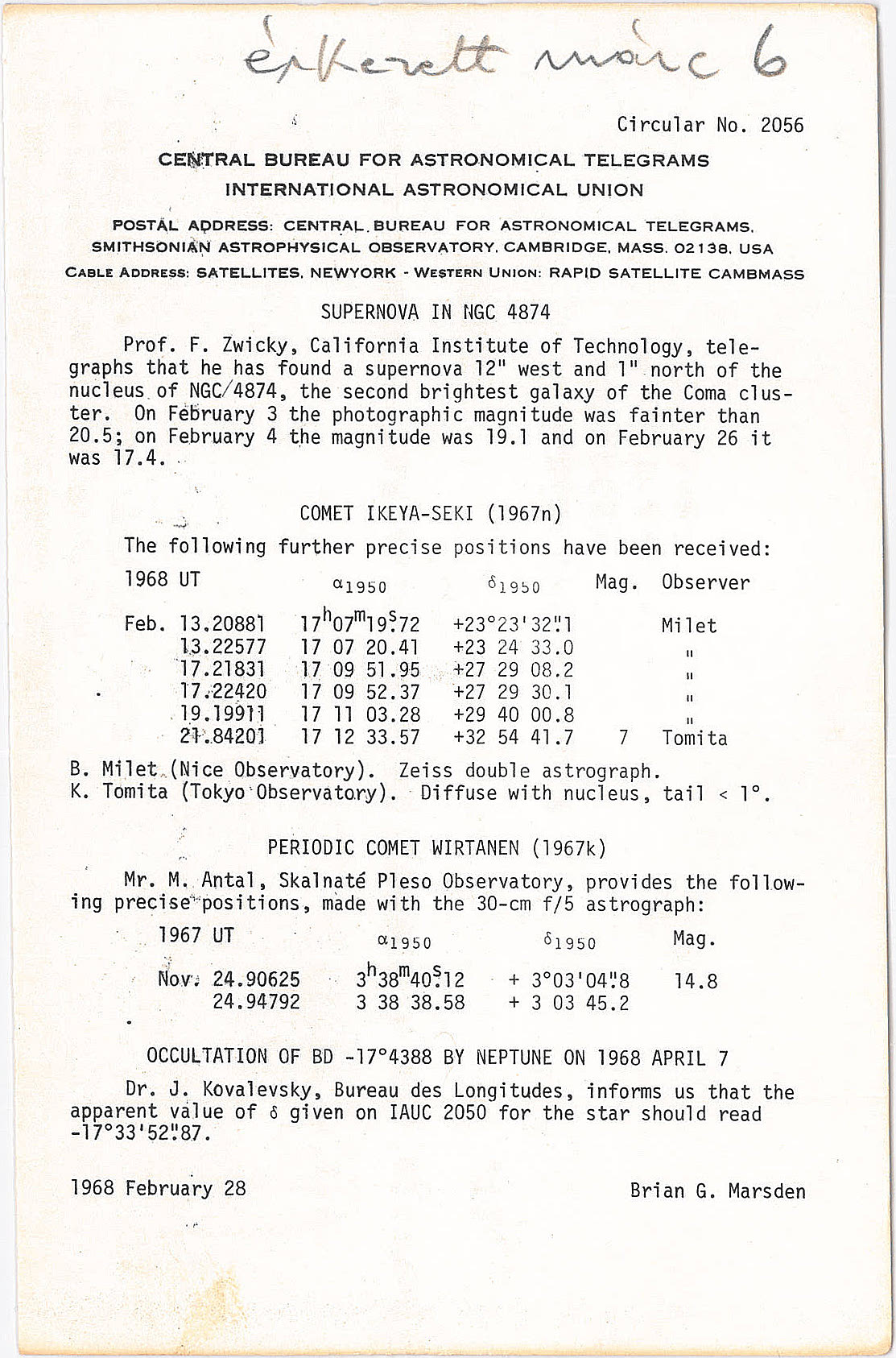
  8. ↑ Zwicky, F. (28 February 1968). Marsden, Brian G. (ed.). "SUPERNOVA IN NGC 4874". Central Bureau Electronic Telegrams (2056). IAU: 1. Retrieved 2 December 2024.
  9. ↑ "SN 1968B". Transient Name Server. IAU. Retrieved 2 December 2024.
  10. ↑ Szeidl, B.; Lovas, M.; Torres, C.; Gonzalez, E. (1981). "Supernovae". International Astronomical Union Circular (3610): 1. Bibcode:1981IAUC.3610....1S.
  11. ↑ "SN 1981G". Transient Name Server. IAU. Retrieved 2 December 2024.
  12. ↑ "SN 2025ilo". Transient Name Server. IAU. Retrieved 3 May 2025.