NGC 7292
| NGC 7292 | |
|---|---|
 NGC 7292 imaged by the Hubble Space Telescope | |
| Observation data (J2000 epoch) | |
| Constellation | Pegasus |
| Right ascension | 22h 28m 26.2896s |
| Declination | +30° 17′ 29.904″ |
| Redshift | 0.003292±0.0000130 |
| Heliocentric radial velocity | 987±4 km/s |
| Distance | 38.55 ± 4.13 Mly (11.820 ± 1.266 Mpc) |
| Apparent magnitude (V) | 13.03 |
| Characteristics | |
| Type | IBm |
| Size | ~25,800 ly (7.91 kpc) (estimated) |
| Apparent size (V) | 2.1′ × 1.7′ |
| Other designations | |
| IRAS 22261+3002, UGC 12048, MCG +05-53-003, PGC 68941, CGCG 495-003 | |
NGC 7292 is a barred irregular galaxy in the constellation of Pegasus. Its velocity with respect to the cosmic microwave background is 652±24 km/s, which corresponds to a Hubble distance of 31.4 ± 2.5 Mly (9.62 ± 0.76 Mpc). However, six non-redshift measurements give a larger mean distance of 38.55 ± 4.13 Mly (11.820 ± 1.266 Mpc). It was discovered by French astronomer Édouard Stephan on 29 August 1872.
NGC 7292 has a possible active galactic nucleus, i.e. it has a compact region at the center of a galaxy that emits a significant amount of energy across the electromagnetic spectrum, with characteristics indicating that this luminosity is not produced by the stars.
Supernovae
Two supernovae have been observed in NGC 7292.
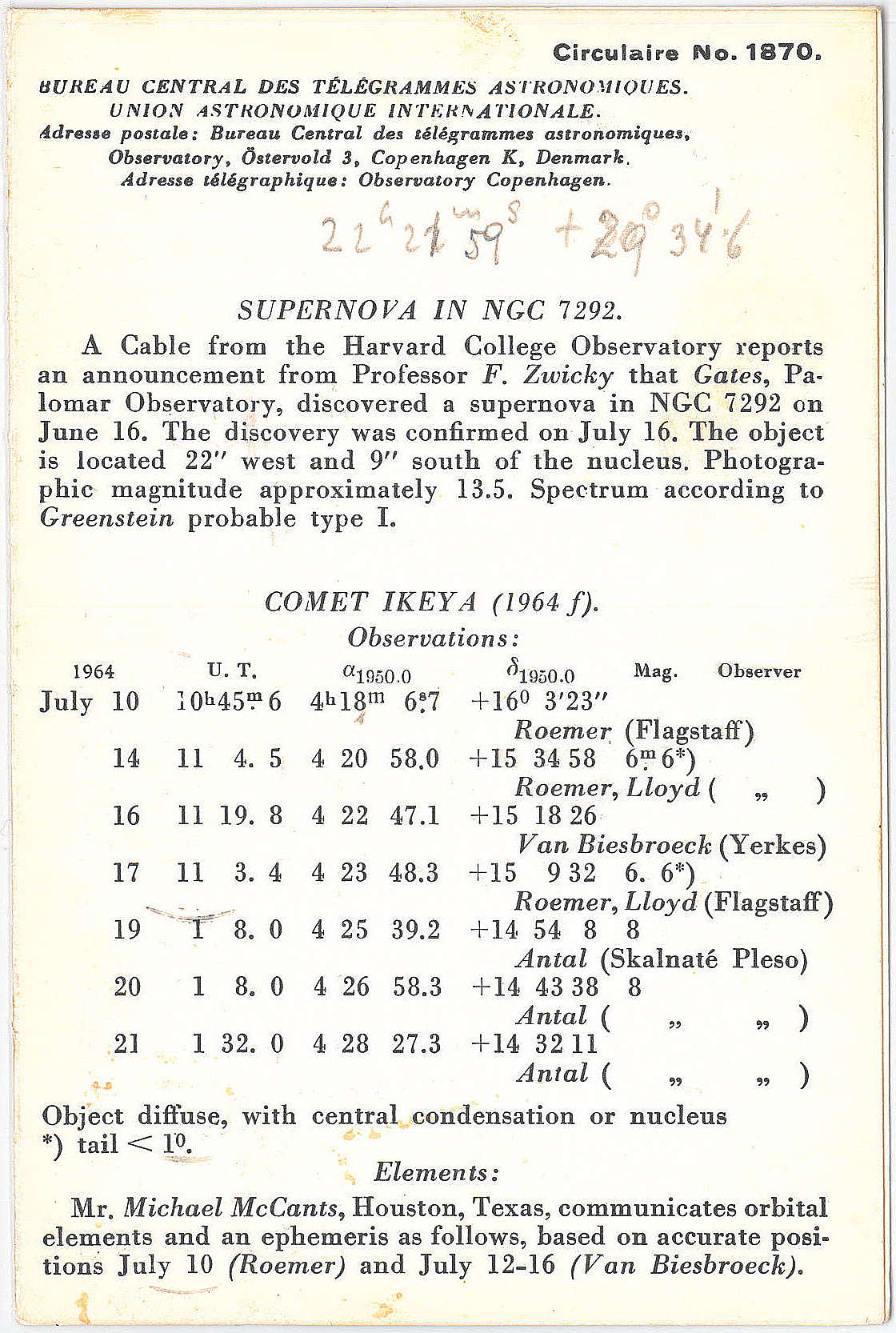
- SN 1964H (Type II, mag. 13.5) was discovered by Howard Stiles Gates on 16 June 1964.
- SN 2026fov (Type II, mag. 13.5) was discovered by Kōichi Itagaki on 14 March 2026. It was located 11".6 east and 24".5 north of the center of NGC 7292.
See also
References
- 1 2 3 4 5 6 7 8 9 10 11 "Results for object NGC 7292". NASA/IPAC Extragalactic Database. NASA and Caltech. Retrieved 7 December 2025.
- ↑ "Distance Results for NGC 7292". NASA/IPAC Extragalactic Database. NASA. Retrieved 7 December 2025.
- ↑ Seligman, Courtney. "New General Catalogue Objects: NGC 7292". Celestial Atlas. Retrieved 7 December 2025.
- ↑ Asmus, D.; Greenwell, C. L.; Gandhi, P.; Boorman, P. G.; Aird, J.; Alexander, D. M.; Assef, R. J.; Baldi, R. D.; Davies, R. I.; Hönig, S. F.; Ricci, C.; Rosario, D. J.; Salvato, M.; Shankar, F.; Stern, D. (2020). "Local AGN survey (LASr): I. Galaxy sample, infrared colour selection, and predictions for AGN within 100 MPC". Monthly Notices of the Royal Astronomical Society. 494 (2): 1784. arXiv:2003.05959. Bibcode:2020MNRAS.494.1784A. doi:10.1093/mnras/staa766.
- ↑ "NGC 7292". SIMBAD. Centre de données astronomiques de Strasbourg. Retrieved 7 December 2025.
- ↑ Zwicky, F. (1965). "The 1964 Palomar Supernova Search". Publications of the Astronomical Society of the Pacific. 77 (459): 456. Bibcode:1965PASP...77..456Z. doi:10.1086/128257.
- ↑ Zwicky, F.; Gates, H. S. (24 July 1964). Thernöe, K. A. (ed.). "SUPERNOVA IN NGC 7292". Central Bureau Electronic Telegrams (1870). Copenhagen Observatory, IAU: 1. Retrieved 7 December 2025.
- ↑ "SN 1964H". Transient Name Server. IAU. Retrieved 7 December 2025.
- ↑ Bishop, David. "Latest Supernovae, entry for AT 2026fov". rochesterastronomy.org. Retrieved 15 March 2026.
- ↑ "SN 2026fov". Transient Name Server. IAU. Retrieved 15 March 2026.
External links
 Media related to NGC 7292 at Wikimedia Commons
- NGC 7292 on WikiSky: DSS2, SDSS, GALEX, IRAS, Hydrogen α, X-Ray, Astrophoto, Sky Map, Articles and images