Unique positive real number which when multiplied by itself gives 3
Square root of 3
The height of an equilateral triangle with sides of length 2 equals the square root of 3.
Representations
Decimal
1.7320508075688772935...
Continued fraction
The square root of 3 is the positive real number that, when multiplied by itself, gives the number 3. It is denoted mathematically as or . It is more precisely called the principal square root of 3 to distinguish it from the negative number with the same property. The square root of 3 is an irrational number. It is also known as Theodorus's constant, after Theodorus of Cyrene, who proved its irrationality.
In 2013, its numerical value in decimal notation was computed to ten billion digits. Its decimal expansion, written here to 60 decimal places, is given by OEIS:A002194:
The upper limit is an accurate approximation for to (six decimal places, relative error ) and the lower limit to (four decimal places, relative error ).
The square root of 3 is an irrational number, meaning it can not be exactly represented as a fraction where and are integers. However, it can be approximated arbitrarily closely by such rational numbers.
Particularly good approximations are the integer solutions of Pell's equations,
which can be algebraically rearranged into the form
The square root of 3 can be found as the leg length of an equilateral triangle that encompasses a circle with a diameter of 1.
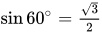
If an equilateral triangle with sides of length 1 is cut into two equal halves, by bisecting an internal angle across to make a right angle with one side, the right angle triangle's hypotenuse is length one, and the sides are of length and . From this, , , and .
The square root of 3 also appears in algebraic expressions for various other trigonometric constants, including the sines of other angles. For example, and .
It is the distance between parallel sides of a regular hexagon with sides of length 1. It is also the length of the longest side of a triangle formed from two adjacent sides of a regular hexagon; following from the law of cosines:
Since each angle of a regular hexagon is 120°, we can substitute 120° for in the equation above.