Die Samenanlagen sind tenuinucellat; das Endokarp besteht aus einer Zellschicht und ist nicht lignifiziert.
Sie besitzen Ölgänge.
Die meisten Arten sind krautige Pflanzen mit mehrfach geteilten Laubblättern. Einige wenige Arten der Unterfamilie verholzen, beispielsweise in den Gattungen Bupleurum (wenige Arten), Myrrhidendron und Steganotaenia.
Nur die Taxa der Apioideae im früheren Umfang, aber nicht die Taxa der ehemaligen Unterfamilie der Saniculoideae besitzen folgende Eigenschaften:
Die Frucht ist eine trockene, zweiteilige Spaltfrucht, auch Doppelachäne genannt. Die zwei Teilfrüchte (Mericarpien oder Carpiden) bleiben zunächst meist noch mit der Oberseite an einem Fruchthalter (Karpophor) hängen, der sich dazwischen befindet.
Die Vertreter der Apioideae besitzen in der Regel doppeldoldigeBlütenstände mit Dolden sowie Döldchen und Hüllen sowie Hüllchen. Der Aufbau der Blüte kann in folgender Blütenformel zusammengefasst werden:
Die Unterfamilie Apioideae wurde 1866 durch Berthold Carl Seemann (1865–1873) in Flora Vitiensis: a description of the plants of the Viti or Fiji islands, with an account of their history, uses, and properties. Volume 1, S. 112 aufgestellt. Typusgattung ist ApiumL. Eine wichtige Bearbeitung dieser Unterfamilie erfolgte 1983 durch R. F. Thorne in P. Royen: Alpine Flora of New Guinea. Band 4, S. 2994.
Tribus Aciphylleae: Habitus, Laubblätter und Blütenstand von Aciphylla subflabellataAcronema-Klade: Habitus, Laubblätter und doppeldoldiger Blütenstand von Spuriopimpinella calycinaAcronema-Klade: Habitus, Laubblätter und doppeldoldige Blütenstände von Tilingia tachiroeiTribus Annesorhizeae: Nymphendolde (Astydamia latifolia)Tribus Annesorhizeae: Habitus und Blütenstände der Peloponnesischen Schirmdolde (Molopospermum peloponnesiacum)Tribus Apieae: Habitus und Blütenstände vom Bischofskraut (Ammi visnaga)Tribus Apieae: Habitus, Laubblätter und doppeldoldige Blütenstände des Fenchel (Foeniculum vulgare)Tribus Arracacieae: Ausschnitt eines Blütenstandes von Mathiasella bupleuroidesTribus Arracacieae: Baumförmiger Habitus, Laubblätter und doppeldoldige Blütenstände von Myrrhidendron donnellsmithiiTribus Bupleureae: Habitus, Laubblätter und Blütenstand von Bupleurum angulosumCachrys-Klade: Habitus, Laubblätter und Blütenstand von Cachrys siculaTribus Careae: Habitus, Laubblätter und doppeldoldige Blütenstände von Chamaele decumbensTribus Careae: Habitus von Falcaria vulgaris
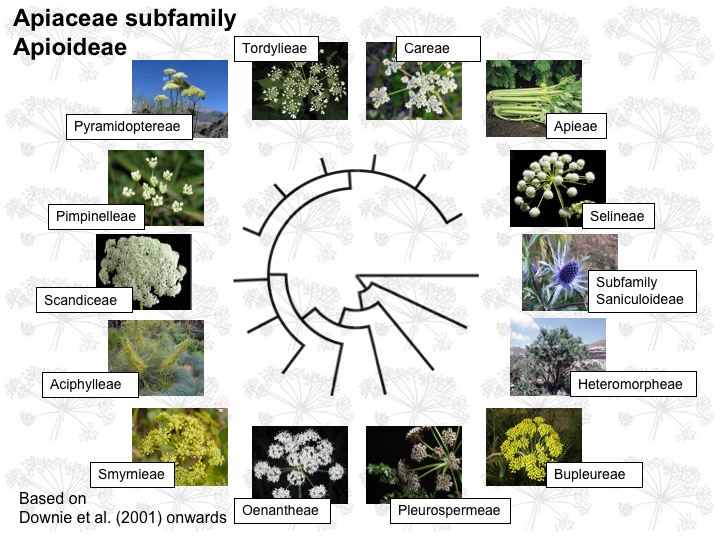
In der Unterfamilie der Apioideae gibt es über 400 Gattungen mit etwa 3500 Arten (404 Gattungen mit 2827 bis 2935 Arten oder etwa 3000 Arten). Moderne Untersuchungen mit gentechnischen Methoden zeigen, dass die hergebrachte auf der Morphologie der Früchte basierende Klassifikation innerhalb der Unterfamilie in weiten Teilen unzutreffend sein muss und zu vielen nicht-monophyletischen (vgl. Kladistik) Gruppierungen geführt hat. Die Einteilung der Unterfamilie in Triben und Gattungen ist deshalb im Fluss und aktuell Gegenstand intensiver botanischer Forschung. Seit Anthony R. Magee et al. 2010 gehören auch die Gattungen der ehemaligen Saniculoideae als die zwei Triben Steganotaenieae und Saniculeae hierhin. Nach Steven R. Downie etal. 2001, F.-J. Sun et al. 2004, und A. R. Magee et al. 2009 wurde die Unterfamilie der Apioideae 2009 in 21 Triben gegliedert. Die innere Systematik der Apioideae wird weiterhin kontrovers diskutiert. Je nach Autor wird nur in Tribus (mit Untertribus) oder Tribus und Kladen gegliedert. Nach dem Stand der Wissenschaft von 2013 enthalten die Apioideae 28 monophyletische Triben und mehrere Hauptkladen, die noch keine Namen erhalten haben.
Hier die Triben, Untertriben und Kladen mit ihren Gattungen; einige Gattungen sind noch in keiner Tribus eingeordnet (weitgehend auf dem Stand von 2010):
AnisotomeHook. f.: Die Heimat der etwa 16 Arten ist hauptsächlich Neuseeland.
GingidiaJ.W.Dawson (Syn.: GingidiumJ.R.Forst. & G.Forst.): Von den etwa sieben Arten kommen fünf Arten in Neuseeland und zwei Arten in Australien vor.
LignocarpaJ.W.Dawson: Die etwa zwei Arten kommen in Neuseeland vor.
ScandiaJ.W.Dawson: Die etwa zwei Arten kommen in Neuseeland vor.
Acronema-Klade: Sie enthält etwa 14 Gattungen in Eurasien:
AcronemaFalc. ex Edgew.: Die 25 bis 30 Arten gedeihen in größeren Höhenlagen der Sino-Himalaja-Region vom östlichen Nepal bis in die südwestliche Volksrepublik China. In China gibt es etwa 20 Arten, 14 davon nur dort.
HalosciastrumKoidz.: Sie enthält nur eine Art:
Halosciastrum melanotilingiaPimenov & V.N.Tikhom. (Syn.: Cymopterus crassusHiroë, Ligusticum purpureopetalumKom., Ostericum crassumKitag., Pimpinella crassaNakai): Sie ist vom nordöstlichen China über Korea bis in Russlands Fernen Osten verbreitet.
HarrysmithiaH.Wolff: Von den nur zwei Arten kommt die eine nur im nördlichen Yunnan und die im nördlichen Sichuan sowie im südöstlichen Teil des autonomen Gebietes Tibet vor.
KitagawiaPimenov: Die etwa neun Arten sind in Asien verbreitet.
LigusticumL. (Syn.: CynapiumNutt. ex Torr. & A.Gray, ArafoePimenov & Lavrova, CoristospermumBertol., GayaGaudin, MacrosciadiumV.N.Tikhom. & Lavrova, NeogayaMeisn.): Die je nach Autor nur noch ein bis zwei oder 48 bis 60 Arten sind auf der Nordhalbkugel verbreitet. Diese Gattung wurde durch Valiejo-Roman et al. 2006 in mehrere kleinere Gattungen aufgegliedert. Zu den Arten der Gattung Ligusticum sstr. gehören:
MeeboldiaH.Wolff: Die etwa drei Arten sind in der Sino-Himalaja-Region verbreitet. In China gibt es zwei Arten, eine davon nur in Yunnan sowie im südöstlichen Tibet.
OreocomopsisPimenov & Kljuykov: Von den nur drei Arten kommt eine nur in Höhenlagen von 5100 bis 5300 Metern im südlichen Tibet vor und die beiden anderen gedeihen im Himalaja.
PachypleurumLedeb.: Die etwa sechs Arten sind in Eurasien verbreitet. In China gibt es alle sechs Arten, fünf davon nur dort.
PternopetalumFranch. (Syn.: CryptotaeniopsisDunn.): Die etwa 25 Arten sind von der Himalaja-Region bis Ostasien verbreitet. In China gibt es 23 Arten, 19 davon nur dort.
SinocarumH.Wolff ex R.H.Shan & F.T.Pu: Die etwa 20 Arten gedeihen in größeren Höhenlagen der Sino-Himalaja-Region von Nepal bis ins südwestliche China. In China gibt es etwa acht Arten, vier davon nur dort.
Spuriopimpinella(H.Boissieu) Kitag.: Die etwa fünf Arten sind in Ostasien verbreitet.
TilingiaRegel & Tiling: Die etwa fünf Arten sind im nördlichen Asien sowie in Ostasien und in Alaska verbreitet.
AnnesorhizaCham. & Schltdl.: Die 11 (Magee 2011) bis 20 (seit der Revision von 2011 wurden einige Arten neu beschrieben) Arten sind in Südafrika verbreitet, nur eine Art kommt auch in Eswatini vor. Die meisten Arten kommen nur in der Provinz Westkap vor, vier Arten gibt es im Nordkap und drei Arten im Ostkap. Zwei Arten kommen in Limpopo sowie Mpumalanga vor und eine davon auch in KwaZulu-Natal.
MolopospermumW.D.J.Koch: Sie enthält nur eine Art:
Peloponnesische Schirmdolde, Striemendolde, Striemensame (Molopospermum peloponnesiacum(L.) W.D.J.Koch): Sie ist von West- über Mittel- bis Südeuropa verbreitet.
Knorpelmöhren (AmmiL., Syn.: GingidiumHill, GohoriaNeck., VisnagaMill.): Die vier bis sechs Arten sind im Mittelmeerraum und auf den Azoren verbreitet; beispielsweise:
Dill (Anethum graveolensL.): Das ursprüngliche Verbreitungsgebiet der weltweit angebauten Gewürzpflanze war Vorderasien.
Sellerie (ApiumL., Syn.: Panulia(Baill.) Koso-Pol.): Die etwa 20 Arten sind in den gemäßigten Gebieten weltweit verbreitet.
BillburttiaMagee & B.-E.van Wyk: Sie wurde 2009 aufgestellt und enthält nur zwei Arten, die nur auf Madagaskar vorkommen.
CanariaJim.Mejías & P.Vargas: Sie wurde 2015 aufgestellt und enthält nur eine Art:
Canaria tortuosa(Webb & Berthel.) Jim.Mejías & P.Vargas (Syn.: Cachrys tortuosaWebb & Berthel., Cnidium tortuosumBenth. & Hook. f., Ferula tortuosaWebb & Berthel., Foeniculum tortuosum(Webb & Berthel.) Benth. ex Christ, Seseli webbiiCoss.): Sie kommt nur auf den Kanarischen Inseln vor.
DeverraDC. (Syn.: PituranthosViv.): Die etwa zehn Arten sind in Trockengebieten Afrikas und Asiens verbreitet.
FoeniculumMill.: Hierher gehören nach POWO 5 Arten, darunter:
Fenchel (Foeniculum vulgareL.): Das ursprüngliche Verbreitungsgebiet der weltweit angebauten Kulturpflanze war der Mittelmeerraum.
ModesciadiumP.Vargas & Jim.Mejías: Sie wurde 2015 aufgestellt und enthält nur eine Art:
Modesciadium involucratum(Maire) P.Vargas & Jim.Mejías (Syn.: Brachyapium involucratum(Maire) Maire, Stoibrax involucratum(Maire) B.L.Burtt, Trachyspermum involucratumMaire, Tragiopsis involucrata(Maire) H.Wolff): Dieser Endemit kommt nur im zentral-südwestlichen Marokko von Zaïane bis zur nördlichen Sahara vor.
PetroselinumHill: Die nur zwei Arten, darunter die bekannte Kulturpflanze Petersilie (Petroselinum crispum(Mill.) Nyman & A.W.Hill) sind ursprünglich in Europa und vermutlich in Westasien beheimatet.
PseudoridolfiaJ.-P.Reduron, J.Mathee & S.R.Downie: Sie wurde 2009 aufgestellt und enthält nur eine Art:
Ridolfia segetum(Guss.) Moris: Sie ist im Mittelmeerraum verbreitet.
SchoenoselinumJim.Mejías & P.Vargas: Sie wurde 2015 aufgestellt und enthält nur eine Art:
Schoenoselinum foeniculoides(Maire & Wilczek) Jim.Mejías & P.Vargas (Syn.: Anethum foeniculoidesMaire & Wilczek): Dieser Endemit kommt nur im südwestlichen Marokko von Chtouka bis zur nördlichen Sahara vor.
SclerosciadiumW.D.J.Koch ex DC.: Sie enthält nur eine Art:
StoibraxRaf. (Syn: Brachyapium(Baill.) Maire, TragiopsisPomel): Die etwa fünf Arten kommen in Spanien, Nordafrika und im südlichen Afrika vor.
Arcuatopterus-Klade: Sie enthält nur eine Gattung:
ArcuatopterusM.L.Sheh & R.H.Shan: Die drei bis fünf Arten sind vom östlichen Himalaja bis ins südwestliche China verbreitet. In China gibt es drei Arten, zwei davon nur dort.
Tribus Arracacieae = Arracacia-Klade: Die etwa zehn Gattungen kommen in der Neotropis vor:
ArracaciaBancr.: Die etwa 30 Arten sind in der Neotropis verbreitet, darunter:
RhodosciadiumS.Watson: Die etwa zwölf Arten kommen in Mexiko vor.
Tribus Bupleureae Spreng. (vielleicht eine eigene Unterfamilie Bupleuroideae S.L.Pan.): Sie enthält nur eine Gattung:
Hasenohren (BupleurumL.): Die 180 bis 190 Arten sind in den gemäßigten Gebieten der Nordhalbkugel verbreitet.
Cachrys-Klade = Tribus Cachrydinae Meisn.: Sie enthält etwa acht Gattungen mit 100 bis 105 Arten hauptsächlich in den warmgemäßigten Gebieten Eurasiens und Nordafrikas, mit der größten Artenvielfalt vom östlichen Mittelmeerraum bis Südwestasien:
AlococarpumRiedl & Kuber: Sie enthält nur eine Art:
DiplotaeniaBoiss.: Sie etwa vier Arten sind in der Türkei und im Iran verbreitet.
EriocyclaLindl. (früher in SeseliL., Syn.: CremastosciadiumRech. f., PetrosciadiumEdgew.): Die sechs bis acht Arten sind vom nördlichen Iran über die westliche Himalaja-Region bis ins nördliche sowie westliche China verbreitet. In China gibt es etwa drei Arten, zwei davon nur dort.
FerulagoW.D.J.Koch: Die etwa 47 Arten sind vom Mittelmeerraum bis Zentralasien verbreitet, beispielsweise mit:
PrangosLindl.: Die etwa 17 Arten sind vom Mittelmeerraum bis Zentralasien verbreitet.
Tribus CareaeBaill.: Die zehn bis elf Gattungen mit 37 bis 38 Arten gedeihen in den gemäßigten Gebieten Eurasiens, mit der größten Artenvielfalt von Südwest- bis Zentralasien:
Sichelmöhren (FalcariaFabr.): Die vier bis fünf Arten sind im Mittelmeerraum und von Zentralasien bis zum südwestlichen Sibirien verbreitet, beispielsweise:
Gemeine Sichelmöhre (Falcaria vulgarisBernh.): Sie ist von Mitteleuropa bis zur Türkei und bis zum südwestlichen Sibirien verbreitet.
RhabdosciadiumBoiss.: Die etwa zwei Arten sind in der Türkei und im Iran verbreitet.
Tribus Chamaesieae J.Zhou & F.D.Pu (Syn.: Chamaesium-Klade): Sie enthält nur eine Gattung:
ChamaesiumH.Wolff: Die acht bis zehn Arten gedeihen hauptsächlich in größeren Höhenlagen des östlichen Himalajas bis ins südwestliche China. In China gibt es etwa sieben Arten, vier davon nur dort.
Tribus Choritaenieae Magee, C.I.Calviño, M.Liu, S.R.Downie, P.M.Tilney & B.-E. van Wyk: Sie enthält nur eine Gattung:
Conioselinum chinense-Klade: Habitus, Laubblätter und doppeldoldige Blütenstände der Alpen-Mutterwurz (Mutellina adonidifolia)
Conioselinum chinense-Klade: Sie enthält seit Prieto & Cires 2013 fünf Gattungen mit nur etwa sieben Arten, die hauptsächlich im Mittelmeerraum vorkommen:
Bärwurz (Meum athamanticum(L.) H.Karst.): Sie ist von Marokko über Spanien sowie Frankreich, in Mittel- bis Ost- und Südosteuropa verbreitet.
Mutterwurzen (MutellinaWolf): Die Abtrennung der Gattung Mutellina von Ligusticum sowie Pachypleurum erfolgte mit molekulargenetisch gestützten Daten durch Valiejo-Roman et al. 2006 durchgeführt. Die etwa drei Arten sind in Europa und im Kaukasusraum verbreitet, beispielsweise:
Tribus Coriandreae: Strahliger Hohlsame (Bifora radians), Ausschnitt des Blütenstandes
Tribus CoriandreaeW.D.J.Koch: Sie enthält nur zwei Gattungen mit bis zu sechs Arten.
Hohlsamen (BiforaHoffm.): Von den nur drei Arten kommt eine in Nordamerika und zwei Arten in Europa sowie dem Mittelmeerraum bis Zentralasien vor, beispielsweise:
Koriander (CoriandrumL., Syn.: CoriandropsisH.Wolff, KeramocarpusFenzl): Die nur zwei oder drei Arten sind im Mittelmeerraum und in Vorderasien verbreitet.
Diplolophium-Klade: Sie enthält nur eine Gattung:
DiplolophiumTurcz.: Die etwa sieben Arten sind im tropischen Afrika verbreitet.
EchinophoraL.: Die etwa zehn Arten sind vom Mittelmeerraum über die Balkanhalbinsel und die Ukraine sowie über das westliche Asien bis in die Kaukasusregion verbreitet, beispielsweise:
Ergocarpon cryptanthum(Rech. f.) C.C.Towns.: Sie kommt vom östlichen Irak bis in den westlichen Iran vor. In älteren Arbeiten wurde sie in die Tribus Echinophoreae gestellt.
PycnocyclaLindl.: Die ein bis zwölf Arten sind zwischen Westafrika und dem Indischen Subkontinent verbreitet.
RughidiaM.F.Watson & E.L.Barclay nom. inval.: Diese Gattung ist ohne lateinische Diagnose (vor 2012 erforderlich) ungültig veröffentlicht. Die nur zwei Arten kommen nur auf Sokotra vor.
Tribus EriginieaeRydb.: Sie enthält nur eine Gattung:
Tribus HeteromorpheaeM.F.Watson & S.R.Downie:: Die elf bis zwölf Gattungen mit höchstens 36 Arten sind im tropischen und südlichen Afrika sowie in Madagaskar verbreitet. Es sind verholzende Pflanzen:
AndrianaB.-E.van Wyk (sie wurde aus Heteromorpha ausgegliedert): Die zwei oder drei Arten kommen nur in Madagaskar vor.
AnginonRaf. (Syn.: RhyticarpusSond.): Die etwa 13 Arten kommen hauptsächlich in Südafrika vor.
CannaboidesB.-E.van Wyk (sie wurde aus Heteromorpha ausgegliedert): Die etwa zwei Arten kommen nur in Madagaskar vor.
DracosciadiumHilliard & B.L.Burtt: Die nur zwei Arten kommen in Südafrika vor.
GliaSond.: Die nur drei Arten kommen nur in der südafrikanischen Provinz Westkap vor.
HeteromorphaCham. & Schltdl. (TenoriaSpreng.): Die etwa sechs Arten gedeihen als Sträucher oder Bäume im tropischen bis südlichen Afrika.
NormanthaP.J.D.Winter & B.-E.van Wyk: Sie wurde 2017 aufgestellt und enthält nur eine Art:
Normantha filiformisP.J.D.Winter: Sie wurde 2017 erstbeschrieben. Sie kommt in Angola sowie auf beiden Seiten der Grenze des südwestlichen Tansania und Sambia vor.
PhysotrichiaHiern (Syn.: SpuriodaucusC.Norman): Die etwa zehn Arten sind im tropischen Afrika verbreitet.
PolemanniaEckl. & Zeyh.: Die drei bis vier Arten kommen in Südafrika vor.
PseudocannaboidesB.-E. van Wyk (Sie wurde aus Heteromorpha ausgegliedert): Sie enthält nur eine Art:
ChuanminshenM.L.Sheh & R.H.Shan: Sie enthält nur eine Art:
Chuanminshen violaceumM.L.Sheh & R.H.Shan: Sie gedeiht in Höhenlagen von 100 bis 800 Metern in den chinesischen Provinzen Hubei sowie Sichuan.
CyclorhizaM.L.Sheh & R.H.Shan: Die nur zwei Arten kommen in Höhenlagen oberhalb 1800 Meter in den chinesischen Provinzen Sichuan, Yunnan sowie in Tibet vor.
BerulaW.D.J.Koch (Syn.: AfrocarumRauschert, BaumiellaH.Wolff, SiellaPimenov): Diese bisher monotypische Gattung enthält seit 2009 etwa sechs Arten; zwei davon sind Endemiten auf St. Helena und zwei kommen nur in Afrika vor, Hierher gehört:
Schmalblättriger Merk oder Berle (Berula erecta(Huds.) Coville, Syn.: Berula angustifoliaMert. & W.D.J.Koch, Berula pusillaFernald, Berula thunbergii(DC.) H.Wolff, Sium angustifoliumL., Sium erectumHuds., Sium thunbergiiDC.): Sie ist in den gemäßigten Gebieten der Nordhalbkugel in Eurasien, in Afrika und von Nordamerika über Mexiko bis Guatemala verbreitet.
Wasserschierlinge (CicutaL.): Die etwa vier Arten sind in den gemäßigten Gebieten der Nordhalbkugel bis Mexiko verbreitet.
CryptotaeniaDC. (Syn.: LereschiaBoiss.): Die etwa vier Arten sind in den gemäßigten Gebieten der Nordhalbkugel verbreitet.
DaucosmaEngelm. & A.Gray ex A.Gray: Sie enthält nur eine Art:
Daucosma laciniatumEngelm. & A.Gray ex A.Gray: Sie kommt nur in den südlichen US-Bundesstaaten New Mexico sowie Texas vor.
HarperellaRose (früher in PtilimniumRaf., Syn: HarperiaRose): Sie enthält nur eine Art:
Harperella nodosa(Rose) Rose, Syn.: Harperella fluviatilisRose, Harperella viviparaRose, Harperia nodosaRose, Ptilimnium fluviatile(Rose) Mathias, Ptilimnium nodosum(Rose) Mathias, Ptilimnium viviparum(Rose) Mathias: Sie ist in den östlichen USA verbreitet.
HelosciadiumW.D.J.Koch: Diese Gattung wurde 2010 reaktiviert und enthält seit 2020 sechs Arten. Sie sind im Mittelmeerraum in Europa und Nordafrika verbreitet.
KundmanniaScop.: Die etwa fünf Arten sind von Südeuropa bis in den Mittelmeerraum in Spanien, Frankreich, Italien, in der Türkei, in Syrien und Nordafrika verbreitet. Darunter:
LilaeopsisGreene: Es liegt ein disjunktes Areal in der Neuen Welt und der Alten Welt vor. Von den etwa 15 Arten sind etwa zehn in Nord- sowie Südamerika verbreitet und die anderen Arten kommen in Australien, Neuseeland und Madagaskar sowie Mauritius vor. Alle Arten sind Wasser- oder Sumpfpflanzen und gedeihen hauptsächlich in gemäßigten Gebieten. Eine Art kommt als Neophyt in Portugal und Spanien vor.
LimnosciadiumMathias & Constance: Die zwei Arten sind in den USA verbreitet.
NeogoeziaHemsl.: Die etwa fünf Arten kommen in Mexiko vor.
Wasserfenchel (OenantheL.): Die etwa 40 Arten sind in den gemäßigten Gebieten der Nordhalbkugel und in den Gebirgen des tropischen Afrika sowie Australasien verbreitet. Darunter:
Quirlblättriger Kümmel (Trocdaris verticillatum(L.) Raf.; Syn.: Sison verticillatumL., Seseli verticillatum(L.) Crantz, Sium verticillatum(L.) Lam., Carum verticillatum(L.) W.D.J.Koch, Bunium verticillatum(L.) Gren. & Godr., Pimpinella verticillata(L.) Jess., Apium verticillatum(L.) Caruel, Selinum verticillatum(L.) E.H.L.Krause): Sie ist von Marokko über die Iberische Halbinsel bis Frankreich, Belgien sowie die Niederlande und im westlichen Teil Englands sowie in Schottland und in Irland verbreitet, das Vorkommen im westlichsten Teil Deutschlands ist vielleicht erloschen.
Physospermopsis-Klade: Ausschnitte eines Blütenstandes von Heptaptera crenata
Physospermopsis-Klade (Ostasien-Klade): Sie enthält etwa acht Gattungen:
HanseniaTurcz.: Die eine bis sechs Arten sind in Asien verbreitet.
HaplosphaeraHand.-Mazz.: Von den nur zwei Arten kommt eine nur im südwestlichen Sichuan sowie nordwestlichen Yunnan vor und die andere von nordöstlichen Indien über Bhutan bis ins südöstliche Xizang sowie südöstliche Qinghai vor.
HeptapteraMargot & Reut.: Die etwa sechs Arten sind von Süd- über Südosteuropa bis Südwestasien verbreitet.
HymenolaenaDC.: Die etwa drei Arten sind von Südwestasien über Zentralasien bis in den westlichen Himalaja verbreitet.
KeraymoniaFarille: Die etwa drei Arten sind von Nepal über Bhutan bis in den südlichen Teil des autonomen Gebietes Xizang verbreitet.
NotopterygiumH.Boissieu: Die etwa sechs Arten sind in China verbreitet.
PhysospermopsisH.Wolff: Die etwa neun Arten sind vom Himalaja bis ins westliche China verbreitet.
SinolimprichtiaH.Wolff: Sie enthält nur eine Art:
Sinolimprichtia alpinaH.Wolff: Die zwei Varietäten gedeihen in Höhenlagen von 3300 bis 5000 Metern in den chinesischen Provinzen Qinghai, südwestlichen Sichuan, nordwestlichen Yunnan sowie im südöstlichen Tibet.
TongoloaH.Wolff: Die etwa 15 Arten sind in Ost- sowie Zentralasien verbreitet.
Bubon macedonicumL. (Syn.: Athamanta macedonica(L.) Spreng., Athamanta macrospermaH.Wolff): Sie ist von Italien über die Balkanhalbinsel bis Griechenland verbreitet.
NothosmyrniumMiq. (Syn.: MacrochlaenaHand.-Mazz.): Die nur zwei Arten mit jeweils zwei Varietäten sind in China natürlich verbreitet. Eine Varietät wird kultiviert und ist in Japan verwildert.
Bibernellen (PimpinellaL., Syn.: AnisumHill, PanciciaVis., PlatyrhapheMiq., ReuteraBoiss., SimilisinocarumCauwet & Farille, SpiroceratiumH.Wolff, Spuriopimpinella(H.Boissieu) Kitag., TragiumSpreng., TragoselinumMill.): Die etwa 150 Arten sind in der Alten Welt weitverbreitet, hiervon 16 Arten mit europäischen Vorkommen.
TrachydiumLindl.: Sie enthält je nach Autor 1 bis 6 bis zu 15 Arten, die weitverbreitet von Zentralasien bis zum Himalajaraum und bis zum südwestlichen China sind.
Pleurospermopsis-Klade: Sie enthält nur eine monotypische Gattung:
PleurospermopsisC.Norman: Sie enthält nur eine Art:
Pleurospermopsis sikkimensis(C.B.Clarke) C.Norman (Syn.: Pleurospermum sikkimenseC.B.Clarke): Sie ist vom östlichen Nepal über Sikkim und Bhutan bis zum südlichen autonomen Gebiet Xizang (nur in Yadong) verbreitet.
Tribus Pyramidoptereae: Doppeldoldiger Blütenstand von Ammoides pusillaTribus Pyramidoptereae: Meerfenchel (Crithmum maritimum)Hasenkümmel (Lagoecia cuminoides), IllustrationTribus Pyramidoptereae: Habitus und doppeldoldiger Blütenstand von Scaligeria napiformisTribus Pyramidoptereae: Echte Würzsilie (Sison amomum)
Tribus PyramidoptereaeBoiss.: Sie enthält seit 2021 etwa 31 Gattungen:
AmmoidesAdans.: Die zwei bis vier Arten sind in Südwesteuropa und Nordafrika verbreitet.
AstomaeaRchb. (Syn.: AstomaDC., AstomatopsisKorovin): Die etwa zwei Arten sind in Südwestasien verbreitet.
Knollenkümmel (BuniumL., Syn.: BuniellaSchischk., DiaphycarpusCalest., WallrothiaSpreng.): Die 45 bis 50 Arten sind in Eurasien und Nordafrika verbreitet.
CrithmumL.: Es gibt nur eine Art:
Meerfenchel (Crithmum maritimumL.): Sie gedeiht in den Küstengebieten Europas, Nordafrikas und Westasiens.
CyclospermumLag. (Syn.: CiclospermumLag. orth. var.): Die etwa drei Arten sind in Mittel- und Südamerika verbreitet. Eine Art ist in Europa ein Neophyt.
ElaeostictaFenzl: Die 22 bis 26 Arten sind von Osteuropa über Südwest- und Zentralasien bis ins südliche Asien verbreitet.
FroriepiaK.Koch: Die nur zwei Arten sind von der Türkei bis in den Iran verbreitet.
GalaganiaLipsky: Die etwa sieben Arten sind von Südwest- und Zentralasien verbreitet.
GongylotaxisPimenov & Kljuykov: Sie enthält nur eine Art:
ScaligeriaDC. (Syn: AlboviaSchischk.): Die etwa 14 Arten kommen vom Mittelmeerraum bis nach Zentralasien vor.
SchrenkiaFisch. & C.A.Mey.: Die etwa zwölf Arten sind in Zentralasien verbreitet.
SchtschurowskiaRegel & Schmalh.: Die etwa zwei Arten sind in Zentralasien verbreitet.
SchulziaSpreng.: Die etwa vier Arten sind in Zentralasien bis ins nordwestliche Indien verbreitet.
SisonL.: Die zwei oder drei Arten sind im Mittelmeerraum in West- sowie Südeuropa und im Kaukasusraum verbreitet. Eine Art ist beispielsweise in Australien, Ozeanien sowie im Nahen Osten ein Neophyt.
TamamschjanellaPimenov & Kljuykov: Die drei bis vier Arten sind von der Balkanhalbinsel bis zum Kaukasusraum und Südwestasien verbreitet.
Tribus Saniculeae: Männliches Exemplar von Arctopus echinatus, Habitus, Laubblätter und BlütenstandTribus Saniculeae: Sterndolde (Astrantia major)
Tribus SaniculeaeBurnett: Sie wird bei vielen Autoren in eine Unterfamilie Saniculoideae Burnett gestellt. Sie enthält etwa acht Gattungen mit etwa 333 Arten:
ActinolemaFenzl: Die etwa zwei Arten sind in Südwestafrika verbreitet.
AlepideaF.Delaroche: Die 23 bis 40 Arten sind in Afrika verbreitet. Die meisten Arten kommen im südlichen Afrika vor, ein Schwerpunkt der Artenvielfalt ist mit über 20 Arten Südafrika.
ArctopusL.: Die nur drei Arten kommen in den südafrikanischen Provinzen Nord-, Ost- sowie Westkap vor.
Sterndolde (AstrantiaL.): Die etwa zehn Arten sind vorwiegend von Europa bis zum Kaukasusraum verbreitet.
Mannstreu (EryngiumL.): Die etwa 230 bis zu 250 Arten sind in allen gemäßigten und warmen Gebieten verbreitet, vorwiegend in Zentralamerika und Südamerika.
HacquetiaNeck. ex DC. (Syn.: DondiaSpreng.): Sie enthält nur eine Art:
Schaftdolde (Hacquetia epipactisDC.): Sie kommt in Österreich, in Tschechien, Polen, in der Slowakei, Italien und im früheren Jugoslawien vor.
PetagnaeaCaruel (Syn.: PetagniaGuss.): Sie enthält nur eine Art:
Petagnaea gussonei(Spreng.) Rauschert: Sie ist ein Endemit im nordöstlichen Teil Siziliens und gedeiht auf Höhenlagen von 240 bis 1500 Metern nur in den Nebrodi Bergen. Die isolierten Bestände dieser bei der IUCN „Endangered“ = „stark gefährdet“ bewertete Art nehmen durch Wasserentnahme aus dem Gebiet ab.
Sanikel (SaniculaL.): Die 37 bis 40 Arten sind hauptsächlich in Nordamerika und Ostasien verbreitet; eine Art kommt in Mitteleuropa vor.
Tribus Scandiceae: Riesenfenchel oder Gemeines Steckenkraut (Ferula communis)Tribus Scandiceae: Rosskümmel (Laser trilobum)Tribus Scandiceae: Strahlen-Breitsame (Orlaya grandiflora)Tribus Scandiceae: Ausschnitt eines Fruchtstandes mit jungen Früchten der Alpen-Augenwurz (Athamanta cretensis)Tribus Scandiceae: Süßdolde (Myrrhis odorata)Tribus Scandiceae: Venuskamm (Scandix pecten-veneris)Tribus Scandiceae: Gewöhnlicher Klettenkerbel (Torilis japonica)
Tribus ScandiceaeSpreng.: Sie enthält mehrere Subtriben und Kladen:
Untertribus Artediinae Baczyński, Wojew., S.R.Downie & Spalik: Sie war als Klade 2010 erkannt und als Tribus 2019 aufgestellt. Sie enthält nur eine monotypische Gattung:
ArtediaL.: Sie enthält nur eine Art:
Artedia squamataL.: Diese einjährige Pflanze ist vom östlichen Mittelmeerraum bis zum Nahen Osten, beispielsweise in Zypern sowie Südwestasien verbreitet.
Untertribus Daucinae Dumort.: Sie enthält etwa 15 Gattungen:
AmmodaucusCoss. & Durieu: Sie enthält nur eine Art:
Möhren (DaucusL., Syn.: AgrocharisHochst., AmmiopsisBoiss., AnisactisDulac, ChrysodaucusThell., HeterosciadiumLange, MelanoselinumHoffm., MoniziaLowe, PlatyspermumHoffm., PomeliaDurando ex Pomel): Nach molekulargenetischen Untersuchungen und morphologischen Vergleichen der Früchte wurde der Umfang der Gattung Daucus wesentlich erweitert. Nach Banasiak wurde 2016 Daucus s.l. in mehrere Sektionen gegliedert und enthält mindestens 40 Arten fast weltweit, weitere Arten kamen 2019 hinzu. Davor hat die Daucus s.str. etwa 28 Arten, die in Eurasien, Afrika, Australien, Neuseeland und in der Neuen Welt verbreitet sind.
EkimiaH.Duman & M.F.Watson: Sie enthält seit 2016 zwei Arten, die bisher bei der Gattung Laserpitium eingeordnet waren. Auch nach der Erstbeschreibung einer Art 2018 gibt es 2018 immer noch nur zwei Arten, denn zwei Arten verbleiben doch in Laserpitium.
LaserBorkh. ex G.Gaertn., B.Mey. & Scherb.: Sie enthält seit 2016 etwa sieben Arten, beispielsweise:
Engelwurz-Laserkraut (Laser archangelica(Wulf.) Spalik & Wojew., Syn.: Laserpitium archangelicaWulf.): Diese Neukombination erfolgte 2016. Es ist im östlichen Mitteleuropa und auf der nördlichen Balkanhalbinsel im Bergland verbreitet.
Rosskümmel (Laser trilobum(L.) Borkh.): Sie kommt in Europa und Westasien vor.
Laserkräuter (LaserpitiumL.): Die seit 2016 nur noch etwa 30 Arten (einige Arten wurden in andere Gattungen gestellt) kommen von den Kanarischen Inseln durch Europa bis Südwestasien vor.
Strahldolde (OrlayaHoffm.): Die etwa drei Arten kommen von Südosteuropa bis Zentralasien vor, beispielsweise mit der Art:
Pseudorlaya(Murb.) Murb.: Die etwa drei Arten kommen in Europa und im Mittelmeerraum bis Westasien vor.
Silphiodaucus(Koso-Pol.) Spalik, Wojew., Banasiak, Piwczyński & Reduron (Syn.: Daucus sect. Silphiodaucus Koso-Pol.): Sie hat seit 2016 den Rang einer Gattung und wurde aus der Gattung Daucus ausgegliedert. Sie enthält etwa zwei Arten.
ThapsiaL.: Die seit 2016 etwa acht Arten sind im Mittelmeerraum verbreitet. Darunter:
TornabeneaParl. ex Webb: Die früher etwa fünf Arten sind Endemiten auf den Kapverdischen Inseln. Drei Arten wurden 2019 in die Gattung Daucus gestellt.
Untertribus Ferulinae Engl.:
Steckenkräuter (FerulaL.): Sie enthält etwa 170 Arten, die vom Mittelmeergebiet bis Zentralasien vorkommen. (Syn.: DoremaD.Don, LeuteaPimenov, SoranthusLedeb., SchumanniaKuntze, TalassiaKorovin)
AutumnaliaPimenov: Die nur zwei Arten sind im Nahen Osten verbreitet.
FerganiaPimenov: Sie enthält nur eine Art:
Fergania polyantha(Korovin) Pimenov: Sie ist in Zentralasien verbreitet.
KafirniganiaKamelin & Kinzik.: Sie enthält nur eine Art:
Glaucosciadium-Klade: Sie enthält nur eine Gattung:
GlaucosciadiumB.L.Burtt & P.H.Davis (Syn.: MozaffarianiaPimenov & Maassoumi): Sie enthält zwei Arten in Südwestasien.
Untertribus Scandicinae Tausch: Sie enthält etwa zwölf Gattungen mit etwa 110 Arten:
Kerbel (AnthriscusPers.): Die etwa neun Arten kommen in Eurasien und Nordafrika vor; der Verbreitungsschwerpunkt liegt im nordöstlichen Mittelmeerraum und in der Kaukasusregion.
Augenwurzen (AthamantaL., Syn.: PortenschlagiaVis., PortenschlagiellaTutin, TinguarraParl.): Die fünf bis acht Arten sind in Europa, auf den Kanarischen Inseln und in Nordafrika verbreitet; Verbreitungsschwerpunkt ist Italien und die Balkanhalbinsel, beispielsweise:
Alpen-Augenwurz (Athamanta cretensisL.): Das Verbreitungsgebiet erstreckt sich von Spanien über die Alpen und den Jura bis zum nördlichen Balkan.
ChaerophyllopsisH.Boissieu: Sie enthält nur eine Art:
Chaerophyllopsis huaiH.Boissieu: Sie gedeiht in Höhenlagen von 3600 bis 3800 Metern in Yunnan (nur in Binchuan) sowie in südöstlichen autonomen Gebiet Tibet (nur in Zayü).
Kälberkröpfe (ChaerophyllumL., Syn.: MyrrhoidesHeist. ex Fabr., OreomyrrhisEndl., CaldasiaLag., ChrysophaeKoso-Pol., Physocaulis(DC.) Tausch): Die etwa 40 Arten kommen vorwiegend in Eurasien und mit wenigen Arten in Nordamerika und Nordafrika vor.
ConopodiumW.D.J.Koch (Syn.: BalansaeaBoiss. & Reut., ButiniaBoiss., HeterotaeniaBoiss.): Die etwa fünf Arten sind in Europa und dem nördlichen Afrika verbreitet mit Schwerpunkt im westlichen Mittelmeerraum; beispielsweise:
Französische Erdkastanie (Conopodium majus(Gouan) Loret): Die Heimat ist neben dem westlichen Mittelmeerraum Italien, Frankreich, Belgien, Deutschland, Großbritannien, Dänemark und Norwegen.
GeocaryumCoss. (Syn.: BiasolettiaW.D.J.Koch, FreyeraRchb., HuetiaBoiss.): Die 13 bis 15 Arten sind im Mittelmeerraum (Südeuropa sowie auf der Balkanhalbinsel) und in Südwestasien verbreitet.
KozloviaLipsky (Syn.: AlbertiaRegel & Schmalh., KrasnoviaPopov ex Schischk., Neoconopodium(Koso-Pol.) Pimenov & Kljuykov): Die etwa vier Arten sind in Zentralasien und in der Himalaya-Region verbreitet.
MyrrhisMill.: Es gibt nur eine Art:
Süßdolde (Myrrhis odorata(L.) Scop.): Sie kommt in Mittel- und Südeuropa vor.
OsmorhizaRaf. (Syn.: ElleimataeniaKoso-Pol., GlycosmaNutt., UraspermumNutt. nom. rej., WashingtoniaRaf., nom. inval.): Die etwa zehn Arten haben den Verbreitungsschwerpunkt in Nordamerika, lediglich eine Art kommt im östlichen Asien vor.
ScandixL. (Syn.: CyclotaxisBoiss., ScandiciumThell.): Die etwa 20 Arten sind in Eurasien und Afrika verbreitet mit Verbreitungsschwerpunkt im östlichen Mittelmeerraum; beispielsweise:
Borstendolden oder Klettenkerbel (TorilisAdans., Syn.: ChaetosciadiumBoiss.): Die etwa 20 Arten kommen von den Kanarischen Inseln über Vorderasien bis nach Ostasien vor.
Turgenia Hoffm.: Es gibt nur zwei Arten, darunter:
Klettendolde (Turgenia latifolia(L.) Hoffm.): Sie kommt vom Mittelmeergebiet bis Zentralasien vor.
YabeaKoso-Pol.: Sie enthält nur eine Art:
Yabea microcarpa(Hook. & Arn.) Koso-Pol.: Sie ist von Kanada über die USA bis Mexiko verbreitet.
Tribus Selineae: Ausschnitt des Blütenstandes von Hundspetersilie (Aethusa cynapium)Tribus Selineae: Arznei-Engelwurz (Angelica archangelica)Tribus Selineae: Blütenstandsausschnitt eines Blütenstandes Hirschwurz-Haarstrang (Cervaria rivini)Tribus Selineae: Habitus, Laubblätter und Blütenstände von Kadenia dubiaTribus Selineae: Kümmelblättrige Silge (Selinum carvifolia)Tribus Selineae: Blaugrüner Faserschirm (Trinia glauca)Tribus Selineae: Habitus, Laubblätter und Blütenstände von Cymopterus acaulis var. fendleriTribus Selineae: Habitus, Laubblätter und Blütenstände von Musineon tenuifoliumTribus Selineae: Blütenstand von Pteryxia terebinthinaTribus Selineae: Habitus, Laubblätter und Blütenstände von Zizia aurea
AmmoselinumTorr. & A.Gray: Die etwa fünf Arten sind im südwestlichen Nordamerika verbreitet.
Engelwurzen (AngelicaL. s.l., Syn.: CoelopleurumLedeb., CzernaeviaTurcz. ex Ledeb., SphenosciadiumA.Gray, MelanosciadiumH.Boissieu, AngelocarpaRupr., AngelophyllumRupr., ArchangelicaWolf, CallisaceFisch. ex Hoffm., EpikerosRaf., GomphopetalumTurcz., MelanosciadiumH.Boissieu, PhysolophiumTurcz., PorphyrosciasMiq.): Die heute etwa 110 (früher bis zu 200) Arten sind hauptsächlich auf der Nordhalbkugel Eurasien sowie in Nordamerika (etwa 24 Arten) verbreitet, etwa 55 Arten gibt es in Ostasien und einige Arten kommen in Afrika vor.
ApiastrumNutt. ex Torr. & A.Gray: Sie enthält nur eine Art:
Apiastrum angustifoliumNutt.: Sie kommt nur in Kalifornien und im mexikanischen Baja California vor.
Hirschwurzen (CervariaWolf, manchmal in Peucedanum, Syn.: LibanotisHill nom. rejic., PeucedanonSt.Lag.): Die drei bis vier Arten sind von Europa über die Kaukasusregion und Südwest- bis Zentralasien verbreitet, beispielsweise:
CnidiocarpaPimenov: Die etwa sechs Arten sind von Kleinasien und den Kaukasusraum bis Zentralasien verbreitet.
Brenndolden (CnidiumCusson, manchmal in Selinum): Die je nach Autor vier bis zehn Arten sind in Eurasien verbreitet.
CortiaDC.: Die etwa drei Arten kommen im Himalaja vor.
CortiellaC.Norman: Die etwa drei Arten sind vom nordöstlichen Indien über, Sikkim, Bhutan sowie Nepal bis autonomen Gebiet Xizang verbreitet. In Tibet gibt es alle drei Arten, eine davon nur dort.
DichoropetalumFenzl (Syn.: HolandreaReduron, Charpin & Pimenov, JohreniopsisPimenov, ChabreaRaf., SchlosseriaVucotinovic): Die etwa 26 Arten sind in Eurasien und im nordwestlichen Afrika verbreitet. Hierher gehört auch:
DimorphosciadiumPimenov: Die nur zwei Arten sind in Zentralasien verbreitet.
DystaeniaKitag.: Die nur zwei Arten sind in Japan beheimatet.
EndressiaJ.Gay: Die etwa zwei Arten im nördlichen Spanien und in den Pyrenäen beheimatet.
ExoacanthaLabill.: Es gibt nur eine oder zwei Arten in Syrien und im Iran.
FerulopsisKitag.: Die nur zwei Arten sind im nördlichen Asien und in Zentralasien verbreitet.
GlehniaF.Schmidt ex Miq. (Syn.: PhellopterusBenth.): Die Gattung kommt im östlichen Ostasien und im westlichen Nordamerika vor.
JohreniaDC.: Die etwa 20 Arten sind in Europa und Südwest- bis Zentralasien verbreitet.
KadeniaLavrova & V.N.Tikhom.: Die ein oder zwei Arten sind in Eurasien verbreitet.
KailashiaPimenov & Kljuykov: Die etwa zwei Arten kommen im autonomen Gebiet Xizang und in Indien nur im westlichen Himalaja vor.
KarataviaPimenov & Lavrova: Sie enthält nur eine Art:
Karatavia kultiassovii(Korovin) Pimenov & Lavrova: Sie kommt im südlichen Kasachstan im Alatau vor.
KatapsuxisRaf.: Sie enthält nur eine Art:
Katapsuxis silaifolia(Jacq.) Raf.: Sie ist von West- über Süd- sowie Südwesteuropa bis Südwestasien verbreitet.
KedarnathaP.K.Mukh. & Constance: Die etwa fünf Arten kommen vom Himalaja bis Myanmar verbreitet.
KitagawiaPimenov: Die etwa neun Arten sind in Asien verbreitet.
LedebouriellaH.Wolff: Die etwa zwei Arten sind in Zentralasien verbreitet.
LibanotisHaller ex Zinn: Die etwa 3 Arten sind in Eurasien und Nordafrika verbreitet.
LigusticopsisLeute: Die etwa 18 Arten sind in Zentral- sowie Ostasien verbreitet.
LomatocarpaPimenov: Die etwa zwei Arten sind in Zentralasien, Afghanistan sowie Pakistan verbreitet.
LomatocarumFisch. & C.A.Mey.: Sie enthält nur eine Art:
Lomatocarum alpinum(M.Bieb.) Fisch. & C.A.Mey. (Syn.: Carum alpinum(M.Bieb.) Benth., Carum saxicola(Albov) Pimenov): Sie wurde 2012 aus Carum ausgegliedert und ist im Kaukasusraum verbreitet.
MacrosciadiumV.N.Tikhom. & Lavrova: Diese Gattung wurde 1988 mit zwei Arten, die zuvor zu LigusticumL. gehörten, aufgestellt. Sie sind von der Türkei bis zum Kaukasusraum verbreitet.
MagadaniaPimenov & Lavrova: Die etwa zwei Arten sind im nordöstlichen Asien verbreitet.
OligocladusChodat & Wilczek: Sie enthält nur eine Art:
Oligocladus patagonicusPérez-Mor. (Syn.: Aulosolena patagonica(Speg.) Koso-Pol., Oligocladus andinusChodat & Wilczek, Sanicula patagonicaSpeg.): Sie gedeiht in der Pampa Südamerikas.
OreocomeEdgew.: Die etwa zehn Arten sind von Afghanistan über den Himalaja bis China und Vietnam verbreitet.
OreoselinumMill.: Sie enthält nur eine Art:
Berg-Haarstrang (Oreoselinum nigrumDelarbre, Syn.: Athamanta oreoselinumL., Peucedanum oreoselinum(L.) Moench): Sie ist in Europa verbreitet.
OrmosoleniaTausch: Sie enthält nur eine Art:
Ormosolenia alpina(Schult.) Pimenov (Syn.: Peucedanum alpinum(Schult.) B.L.Burtt & P.H.Davis, Ormosolenia creticaTausch nom. illeg., Sison alpinusSieber ex Schult.): Sie kommt auf Kreta und in Südwestasien vor.
ParaligusticumV.N.Tikhom.: Sie enthält nur eine Art:
Haarstrang (PeucedanumL., inkl. ImperatoriaTourn. ex L.): Die 100 bis 200 Arten sind in Eurasien und Afrika verbreitet. Es gibt Autoren, bei denen nur noch acht bis zehn Arten in dieser Gattung enthalten sind.
PhlojodicarpusTurcz. ex Ledeb.: Die etwa vier Arten sind in Sibirien verbreitet.
PilopleuraSchischk.: Die etwa zwei Arten sind in Zentralasien verbreitet.
Pteroselinum(Rchb.) Rchb. (manchmal in PeucedanumL.): Die nur ein oder zwei Arten sind in Europa verbreitet.
RumiaHoffm.: Je nach Autor mit wenigen oder nur einer Art:
SajanellaSoják (Syn.: SajaniaPimenov): Sie enthält nur eine Art:
Sajanella monstrosa(Willd. ex Spreng.) Sojak (Syn.: Athamanta monstrosaWill. ex Spreng., Sajania monstrosa(Willd. ex Spreng.) Pimenov): Sie ist im nördlichen Asien und in Zentralasien verbreitet.
SaposhnikoviaSchischk.: Sie enthält nur eine Art:
Saposhnikovia divaricata(Turcz.) Schischk.: Sie ist im nördlichen Asien, in Zentral- und Ostasien verbreitet.
SiculosciadiumC.Brullo, Brullo, S.R.Downie & Giusso: Sie wurde 2013 neu aufgestellt und enthält nur eine Art:
Siculosciadium nebrodense(Guss.) C.Brullo, Brullo, S.R.Downie & Giusso (Syn.: Peucedanum nebrodense(Guss.) Nyman): Es ist ein Endemit auf Sizilien.
Silgen (SelinumL.): Die etwa fünf Arten sind in Eurasien verbreitet, beispielsweise mit:
Bergfenchel (SeseliL., Syn.: ElaeopleurumKorovin, PseudammiH.Wolff): Die bis zu 65 (100 bis 120) Arten sind von Europa bis Zentralasien verbreitet.
SillaphytonPimenov: Sie wurde 2016 aufgestellt und enthält nur eine Art:
Sillaphyton podagraria(H.Boissieu) Pimenov (Syn.: Peucedanum podagrariaH.Boissieu, Peucedanum insolensKitag.): Dieser seltene Endemit kommt nur im mittleren Teil der Koreanischen Halbinsel vor.
SpermolepisRaf.: Die fünf bis sechs Arten sind in Nordamerika verbreitet, eine kommt in Argentinien und eine auf Hawaii vor.
StenocoeliumLedeb.: Die etwa drei Arten sind im nördlichen Asien und in Zentralasien verbreitet.
ThecocarpusBoiss.: Sie enthält etwa zwei Arten, darunter:
ThysselinumAdans.: Die nur zwei Arten sind von Europa bis ins nördliche Asien verbreitet. Sie werden meist zu Peucedanum gestellt.
TommasiniaBertol.: Sie enthält nur eine Art:
Quirl-Haarstrang oder Riesen-Haarstrang (Tommasinia verticillaris(L.) Bertol., Syn.: Peucedanum verticillare(L.) W.D.J.Koch ex DC.): Er ist in Europa hauptsächlich in den Alpen verbreitet.
Faserschirme (TriniaHoffm., Syn.: TriniellaCalest.): Die etwa sechs Arten kommen in Europa bis Zentralasien vor, beispielsweise:
VicatiaDC.: Die etwa drei Arten sind in Asien verbreitet.
XanthogalumLallem.: Die etwa drei Arten sind im Kaukasus und in Vorderasien verbreitet.
XanthoselinumSchur: Sie enthält nur eine oder zwei Arten mit einem weiten Verbreitungsgebiet von Europa über den Kaukasusraum bis Zentralasien, darunter:
Rein nordamerikanische Klade mit ausdauernden krautigen Pflanzenarten: Diese rein nordamerikanische Klade enthält etwa 20 Gattungen mit etwa 200 Arten hauptsächlich im westlichen Nordamerika. Mehr als die Hälfte der Arten gehören zu den beiden Gattungen Lomatium und Cymopterus. Die größte Artenvielfalt gibt es westlich des Mississippi River. Viele Arten gedeihen an offenen Standorten der Intermountain sowie Pacific West Bergketten. Viele Arten sind an Trockenheit angepasste Geophyten:
AletesJ.M.Coult. & Rose: Die 15 bis 20 Arten sind in Nordamerika verbreitet.
CymopterusRaf.: Die 32 bis 50 Arten sind im westlichen Nordamerika verbreitet.
EurytaeniaTorr. & A.Gray: Die nur zwei Arten sind in den südlichen zentralen USA verbreitet.
LomatiumRaf.: Die 63 bis 74 Arten im westlichen Nordamerika verbreitet.
MusineonRaf.: Die drei bis vier Arten sind im westlichen Nordamerika verbreitet.
NeoparryaMathias: Es gibt nur eine Art:
Neoparrya megarrhiza(A.Nelson) W.A.Weber: Sie kommt in den südwestlichen USA vor.
OreonanaJeps.: Die zwei bis drei Arten gedeihen in den kalifornischen Bergen.
OreoxisRaf.: Die drei bis vier Arten sind im westlichen Nordamerika verbreitet.
OrogeniaS.Watson: Die etwa zwei Arten sind im westlichen Nordamerika verbreitet.
PodisteraS.Watson: Die drei bis vier Arten sind im westlichen Nordamerika verbreitet.
PolytaeniaDC. (Syn.: PleiotaeniaJ.M.Coult. & Rose): Sie enthält seit 2012 mit der Erstbeschreibung einer neuen Art aus Texas drei Arten, die in Texas, Louisiana, Kentucky, Michigan, Iowa und südlichen Oklahoma vorkommen.
PseudocymopterusJ.M.Coult. & Rose: Die zwei bis sieben Arten sind im südwestlichen Nordamerika verbreitet.
Pteryxia(Nutt. ex Torr. & A.Gray) J.M.Coult. & Rose: Die etwa fünf Arten sind im westlichen Nordamerika verbreitet.
Taenidia(Torr. & A.Gray) Drude: Die etwa zwei Arten kommen im östlichen Nordamerika vor.
TauschiaSchltdl.: Die 22 Arten sind in Nord- oder Mittelamerika verbreitet.
ThaspiumNutt.: Die drei bis fünf Arten sind in Nordamerika verbreitet.
VesperHartmann & Nesom: Diese Gattung wurde 2012 aufgestellt. Die etwa sechs Arten wurden aus der Gattung CymopterusRaf. ausgegliedert und sind in Nordamerika verbreitet.
ZiziaW.D.J.Koch: Die etwa vier Arten sind im östlichen Nordamerika verbreitet.
Sinodielsia-Klade: Habitus, Laubblätter und doppeldoldiger Blütenstand von Conioselinum filicinum
Sinodielsia-Klade: Die 10 bis 15 Gattungen mit etwa 50 Arten gedeihen in den gemäßigten bis alpinen Gebieten der Nordhalbkugel, mit der größten Artenvielfalt in Zentralasien, im Himalajas und in China:
Schierlingssilge (ConioselinumHoffm.): Die etwa 18 Arten sind in Osteuropa, im gemäßigten Asien und Nordamerika verbreitet.
KuramosciadiumPimenov, Kljuykov & Tojibaev: Sie wurde 2011 aufgestellt und enthält nur eine Art:
Kuramosciadium corydalifoliumPimenov, Kljuykov & Tojibaev: Diese monokarpe mehrjährige krautige Pflanze blüht im Juni. Sie ist nur von zwei Fundorten in Höhenlagen von 2700 bis 2900 Metern im westlichen Tian Shan in Usbekistan bekannt. Sie wird in der usbekischen Roten Liste der gefährdeten Arten als „Endangered“ = „stark gefährdet“ bewertet.
LevisticumHill (Syn.: HipposelinumBritton & Rose): Die ein bis etwa drei Arten sind in Afghanistan, dem südwestlichen Asien, Europa und Nordamerika verbreitet; mit beispielsweise
Liebstöckel (Levisticum officinaleW.D.J.Koch): Die ursprüngliche Heimat liegt im westlichen Asien.
LithosciadiumTurcz.: Die nur zwei Arten sind im nördlichen Asien und Zentralasien und westlichen China verbreitet:
Tribus SteganotaenieaeC.I.Calviño & S.R.Downie: Sie wird bei vielen Autoren in eine Unterfamilie Saniculoideae Burnett gestellt. Sie enthält nur zwei Gattungen mit nur zwei bis drei Arten. Es sind verholzende Pflanzen:
PolemanniopsisB.L.Burtt: Diese Gattung war bis 2010 monotypisch mit einer Art (Polemanniopsis marlothii(H.Wolff) B.L.Burtt), die nur in den südafrikanischen Provinzen Nordkap sowie Westkap vorkommt, bis eine neue Art (Polemanniopsis namibensisB-E.Van Wyk, A.Burke & C.Mannheimer) aus Namibia beschrieben wurde.
SteganotaeniaHochst.: Die etwa zwei Baum-Arten sind im tropischen Afrika verbreitet.
VanasushavaP.K.Mukh. & Constance: Sie enthält nur eine Art:
Vanasushava pedata(Wight) P.K.Mukh. & Constance: Sie kommt nur im südlichen Indien vor.
ZosimaHoffm. (Syn.: PichleriaStapf & Wettst.): Die etwa zehn Arten sind in Westasien verbreitet.
Cymbocarpum-Klade: Sie enthält nur zwei Gattungen:
CymbocarpumDC. ex C.A.Mey. (Syn.: KalakiaAlava): Die etwa fünf Arten sind in Südwestasien verbreitet.
DucrosiaBoiss.: Die etwa sechs Arten sind in Südwestasien und im nordöstlichen Afrika verbreitet.
Lefebvrea-Klade: Die etwa zehn Gattungen kommen nur in Afrika vor, das Zentrum der Artenvielfalt ist die Capensis:
AfroligusticumC.Norman (sie wurde aus Peucedanum ausgegliedert): Die etwa 13 Arten sind im tropischen Afrika verbreitet.
AfrosciadiumP.J.D.Winter (sie wurde aus Peucedanum ausgegliedert): Die etwa 18 Arten sind in Afrika verbreitet.
CapnophyllumGaertn.: Die vier Arten gedeihen an der Küste und kommen alle in der südafrikanischen Provinz Westkap vor, eine davon auch im Nordkap.
CynorhizaEckl. & Zeyh.: Die drei Arten sind in Afrika verbreitet.
DasispermumRaf. (Syn.: SonderinaH.Wolff): Von den seit 2010 sieben Arten kommen fünf nur in den südafrikanischen Provinzen Ost-, West- sowie Nordkap und zwei auch in KwaZulu-Natal vor.
LefebvreaA.Rich (Syn.: ErythroselinumChiov.): Die etwa zehn Arten sind in Afrika verbreitet.
NanobubonMagee: Diese Gattung wurde 2008 mit nur zwei Arten aufgestellt und enthält drei Arten, die alle in der südafrikanischen Provinz Westkap vorkommen, eine davon auch in Ostkap.
NotobubonB.-E. van Wyk: Die etwa zwölf Arten sind in Afrika verbreitet.
ScaraboidesMagee & B.-E. van Wyk: Sie enthält nur eine Art:
Scaraboides manningiiMagee & B.-E. van Wyk: Es sind nur zwei isolierte Fundorte bekannt in der Sukkulenten-Karoo in den südafrikanischen Provinzen Nord- sowie Westkap.
StenosemisE.Mey. ex Harv. & Sond.: Die nur zwei Arten kommen nur in den südafrikanischen Provinzen südliches KwaZulu-Natal und Ostkap vor.
OreofragaM.F.Watson & E.L.Barclay nom. inval. (Es gibt keine lateinische Beschreibung in der Erstveröffentlichung, deshalb ist sie, da sie vor 2012 erschienen ist, ungültig): Sie enthält nur eine Art:
TrachyspermumLink: Die seit 2019 etwa 15 Arten. Trachyspermum in diesem Umfang eine polyphyletische Gattung. Die Arten gedeihen im tropischen und nordöstlichen Afrika über Südwestasien und in Zentralasien bis Indien und im westlichen China, beispielsweise:
Anthony R. Magee, Carolina I. Calviño, Mei (Rebecca) Liu, Stephen R. Downie, Patricia M. Tilney, Ben-Erik van Wyk: New tribal delimitations for the early diverging lineages of Apiaceae subfamily Apioideae. In: Taxon. Band 59, Nr. 2, 2010, S. 567–580 (PDF; 2,3MB).
Stephen R. Downie, Krzysztof Spalik, Deborah S. Katz-Downie, Jean-Pierre Reduron: Major clades within Apiaceae subfamily Apioideae as inferred by phylogenetic analysis of nrDNA ITS sequences. In: Plant Diversity and Evolution. Band 128, Nr. 1–2, 2010, S. 111–136, doi:10.1127/1869-6155/2010/0128-0005(PDF).
Jan Thomas Johansson: The Phylogeny of Angiosperms.Araliales. Internet-Veröffentlichung, Hortus Bergianus, Stockholm ab 2013, zuletzt eingesehen am 15. Juni 2014. (Abschnitte Systematik und Verbreitung)
Einzelnachweise
↑
Urgamal Magsar: Classification System of the family Apiaceae in the Flora of Mongolia. In: Proceedings of the Mongolian Academy of Sciences. Band 52, Nr. 4 (204), 2012, S. 36–41. Volltext-PDF.
↑
Stephen R. Downie, G. M. Plunkett, Mark F. Watson, Krzysztof Spalik, Deborah S. Katz-Downie, C. M. Valiejo-Roman, E. I. Terentieva, A. V. Troitsky, B.-Y. Lee, J. Lahham, A. El-Oqlah: Tribes and clades within Apiaceae subfamily Apioideae: the contribution of molecular data. In: Edinburgh Journal of Botany. Band 58, Nr. 2, 2001, S. 301–330, doi:10.1017/S0960428601000658(PDF; 10,5 MB).
↑
F.-J. Sun, Stephen R. Downie, R. L. Hartman: An ITS-based phylogenetic analysis of the perennial, endemic Apiaceae subfamily Apioideae of western North America. In: Systematic Botany. Band 29, Nr. 2, 2004, S. 419–431, doi:10.1600/036364404774195601(PDF; 412kB).
↑
Anthony R. Magee, C. I. Calviño, M. Liu, Stephen R. Downie, P. M. Tilney, Ben-Erik van Wyk: New tribal delimitations in African Apiaceae. In South African Journal of Botany. Band 75, Nr. 2, 2009, S. 410–411, doi:10.1016/j.sajb.2009.02.077.
↑
Rhiannon Peery, Sarah Mathews, Stephen R. Downie: Update on the quest to resolve higher-level relationships in Apiaceae subfamily Apioideae. An Oral Paper: Papers for Sections at Botany 2013 – The annual Botany Conference (Abstract).
↑
Feng-Jie Sun, Stephen R. Downie: Phylogenetic analyses of morphological and molecular data reveal major clades within the perennial, endemic western North American Apiaceae subfamily Apioideae. In: The Journal of the Torrey Botanical Society. Band 137, Nr. 2–3, 2010, S. 133–156, doi:10.3159/09-RA-071R.1(PDF).
1234567891011121314151617181920212223242526272829Ralf Hand:Apiaceae.In:The Euro+Med Plantbase – the information resource for Euro-Mediterranean plant diversity.Botanic Garden and Botanical Museum Berlin-Dahlem,2011,abgerufen am 31.Januar 2024(englisch).
12345Apioideaeim Germplasm Resources Information Network (GRIN), USDA, ARS, National Genetic Resources Program. National Germplasm Resources Laboratory, Beltsville, Maryland.Abgerufen am 21. Mai 2014.
123456789101112131415161718192021222324252627282930
Menglan She, Fading Pu, Zehui Pan, Mark Watson, John F. M. Cannon, Ingrid Holmes-Smith, Eugene V. Kljuykov, Loy R. Phillippe, Michael G. Pimenov: Apiaceae. In: Wu Zheng-yi, Peter H. Raven, Deyuan Hong (Hrsg.):Flora of China. Volume 14: Apiaceae through Ericaceae. Science Press/ Missouri Botanical Garden Press, Beijing/ St.Louis 2005, ISBN 1-93072341-5, S.1–205 (englisch, online bei efloras.org).
123
Jing Zhou, Yu-zhen Gao, Jin Wei, Zhen-Wen Liu, Stephen R. Downie: Molecular Phylogenetics of Ligusticum (Apiaceae) Based on nrDNA ITS Sequences: Rampant Polyphyly, Placement of the Chinese Endemic Species, and a Much-Reduced Circumscription of the Genus. In: International Journal of Plant Sciences. Band 181, Nr. 3, 2020. doi:10.1086/706851
123
C. M. Valiejo-Roman, V. S. Shneyer, T. H. Samigullin, E. I. Terentieva, M. G. Pimenov: An attempt to clarify taxonomic relationships in “Verwandtschaftskreis der Gattung Ligusticum” (Umbelliferae-Apioideae) by molecular analysis. In: Plant Systematics and Evolution. Band 257, Nr. 1–2, 2006, S. 25–43, doi:10.1007/s00606-005-0383-8(PDF).
12345678
Anthony R. Magee, Carolina I. Calviño, Mei (Rebecca) Liu, Stephen R. Downie, Patricia M. Tilney, Ben-Erik van Wyk: New tribal delimitations for the early diverging lineages of Apiaceae subfamily Apioideae. In: Taxon. Band 59, Nr. 2, 2010, S. 567–580 (PDF; 2,3MB).
12
Anthony R. Magee, Ben-Erik van Wyk, Patricia M. Tilney, Nicole Vessio: A Taxonomic Revision of the Annesorhiza triternata Group (Apiaceae, Apioideae): The Transfer of Peucedanum triternatum and P. filicaule and the Description of Five New Species. In: Systematic Botany. Band 36, Nr. 2, 2011, S. 508–519, doi:10.1600/036364411X569697.
↑Anthony Richard Magee, Ben-Erik van Wyk, Patricia M. Tilney, Fatima Sales, Ian Hedge, Stephen R. Downie:Billburttia, a new genus of Apiaceae (tribe Apieae) endemic to Madagascar. In: Plant Systematics and Evolution. Band283, Nr.3–4, 2009, ISSN1615-6110, S.237–245, doi:10.1007/s00606-009-0223-3 (englisch).
↑
Jean-Pierre Reduron, Joël Mathez, Stephen R. Downie, Clark A. Danderson, Tatiana Ostroumova: Pseudoridolfia, nouveau genre d'Apiaceae découvert au Maroc. In: Acta Botanica Gallica. Band 156, Nr. 3, 2009, S. 487–500, doi:10.1080/12538078.2009.10516173.
12
Vincenzo Musolino, Maria Perri, Filomena Conforti, Mariangela Marrelli, Vincenzo Mollace: Cachrys L. Genus: A Comprehensive Review on Botany, Phytochemistry and Biological Properties. In: Plants, Volume 12, 565, Januar 2023. doi:10.3390/plants12030565
1234567
Ekaterina A. Zakharova, Galina V. Degtjareva, Michael G. Pimenov: Redefined generic limits of Carum (Umbelliferae, Apioideae) and new systematic placement of some of its taxa. In: Willdenowia, Band 42, Nr. 2, Dezember 2012, S. 149–168 (PDF).
↑Alessio Papini, Francesca Banci, Enio Nardi:Molecular evidence of polyphyletism in the plant genus Carum L. (Apiaceae). In: Genetics and Molecular Biology. Band30, Nr.2, März 2007, ISSN1415-4757, doi:10.1590/S1415-47572007000300029 (scielo.br[PDF; 218kB]).
12
José A. Fernández Prieto, Eduardo Cires: Phylogenetic placement of Dethawia, Meum, and Rivasmartinezia (Apioideae, Apiaceae): evidence from nuclear and plastid DNA sequences. In: Plant Biosystems, 2013. doi:10.1080/11263504.2013.819818
123
Elena I. Terenteva, C. M. Valiejo-Roman, Tahir H. Samigullin, Michael G. Pimenov, P. M. Tilney: Molecular phylogenetic and morphological analyses of the traditional tribe Coriandreae (Umbelliferae-Apioideae). In: Phytotaxa. Band 195, Nr. 4, 2015, S. 251–271. doi:10.11646/phytotaxa.195.4.1Volltext-PDF bei ResearchGate.
1234
Sabereh Mousavi, Valiollah Mozaffarian, Klaus Mummenhoff, Stephen R. Downie, Shahin Zarre: An updated lineage-based tribal classification of Apiaceae subfamily Apioideae with special focus on Iranian genera. In: Systematics and Biodiversity, Volume 19, Issue 1, Dezember 2020, S. 89–109. doi:10.1080/14772000.2020.1834002
↑
Ian C. Hedge, J. M. Lamond, Karl Heinz Rechinger etal.: Flora Iranica. Flora des Iranischen Hochlandes und der umrahmenden Gebirge. Band 162: Umbelliferae. Akademische Drucks- und Verlagsanstalt, Graz 1987, Ergocarpon, S. 80–81.
1234Pieter Winter, Patricia Tilney, B.-E. Van Wyk: Clarification of the concept of Aframmi (Heteromorpheae, Apiaceae) and a new monotypic genus, Normantha. In: Phytotaxa. Band 298, Nr. 1, März 2017, S. 71–76. doi:10.11646/phytotaxa.298.1.7
↑B-E. Van Wyk, Patricia M. Tilney, A. R. Magee: A revision of the genus Glia (Apiaceae, tribe Heteromorpheae). In: South African Journal of Botany. Band 76, Nr. 2, 2010, S. 259–271. doi:10.1016/j.sajb.2009.11.002
↑
Stephen R. Downie, Deborah S. Katz-Downie, Feng-Jie Sun, Chang-Shook Lee: Phylogeny and biogeography of Apiaceae tribe Oenantheae inferred from nuclear rDNA ITS and cpDNA psbI–5'trnK(uuu) sequences, with emphasis on the North American endemics clade. In: Botany. Band 86, 2008, S. 1039–1064, doi:10.1139/B08-055(PDF).
123
Krzysztof Spalik, Stephen R. Downie, M. F. Watson: Generic delimitations within the Sium alliance (Apiaceae tribe Oenantheae) inferred from cpDNA rps16 - 5'trnK(UUU) and nrDNA ITS sequences. In: Taxon. Band 58, 2009, S. 735–748, (PDF).
↑
A. C. Ronse, Z. A. Popper, J. C. Preston, M. F. Watson: Taxonomic revision of European Apium L. s.l.: Helosciadium W.D.J.Koch restored. In: Plant Systematics and Evolution. Band 287, Nr. 1–2, 2010, S. 1–17. doi:10.1007/s00606-010-0284-3
↑
Adriano Stinca, Riccardo Motti: A new combination in Helosciadium (Apiaceae) for the flora of North Africa. In: Phytotaxa. Band 217, Nr. 1, 2015, S. 100. doi:10.11646/phytotaxa.217.1.11
↑
Eduardo Cires, Carla Pinto-Cruz, Herminio Nava, José Antonio Fernández Prieto: A new species from the temporary ponds of southwest Portugal: Helosciadium milfontinum. In: Phytotaxa. Band 456, Nr. 1, August 2020, S. 49–62. doi:10.11646/phytotaxa.456.1.3
↑
Mehmet Yavuz, Rıdvan Polat, Uğur Çakılcıoğlu: Comparative vegetative anatomy and fruit micromorphology of the genus Kundmannia Scop. and their taxonomical significance. In: Bangladesh Journal of Botany. Band 46, Nr. 1, März 2017, S. 83–92. online.
↑Tiffany S. Bone, Stephen R. Downie, James Affolter, Krzysztof Spalik: A Phylogenetic and Biogeographic Study of the Genus Lilaeopsis (Apiaceae Tribe Oenantheae). In: Systematic Botany. Band 36, 2011, S. 789–805. doi:10.1600/036364411X583745
12
Anthony R. Magee, Ben-Erik van Wyk, P.M. Tilney, Stephen R. Downie: Generic delimitations and relationships of the Cape genera Capnophyllum, Dasispermum and Sonderina, the N. African genera Krubera and Stoibrax, and a new monotypic genus of the subfam. Apioideae (Apiaceae). In: Systematic Botany. Band 34, Nr. 3, 2009, S. 580–594, doi:10.1600/036364409789271218(PDF).
↑Albert Thellung: Umbelliferae. S. 1359–1362. In: Gustav Hegi: Illustrierte Flora von Mitteleuropa. 1. Auflage, unveränderter Textnachdruck Band V, Teil 2. Verlag Carl Hanser, München 1965.
↑
Jean-Pierre Reduron: Ombellifères de France 5. In: Bulletin de la Société Botanique du Centre Ouest, Nouvelle Série. Numéro Spécial. Band 30, 2008, Visnaga, S. 2584–2595.
1234
Anthony R. Magee, Ben-Erik van Wyk, P. M. Tilney, Stephen R. Downie: Phylogenetic position of African and Malagasy Pimpinella species and related genera (Apiaceae, Pimpinelleae). In: Plant Systematics and Evolution. Band 288, Nr. 3–4, 2010, S. 201–211, doi:10.1007/s00606-010-0325-y(PDF).
↑
G. V. Degtjareva, T. A. Ostroumova, T. Kh. Samigullin, M. G. Pimenov: Position of the genus Palimbia in the Umbelliferae family system. In: Problems of Botany of Southern Siberia and Mongolia, 20-1, 2021, S. 156–159. doi:10.14258/pbssm.2021029PDF in Russisch.
12345678
Aneta Wojewódzka, Jakub Baczyński, Łukasz Banasiak, Stephen R. Downie, Agnieszka Czarnocka‑Cieciura,·
Michał Gierek1, Kamil Frankiewicz, Krzysztof Spalik: Evolutionary shifts in fruit dispersal syndromes in Apiaceae tribe Scandiceae. In: Plant Systematics and Evolution. Band 305, Supplement 2, Mai 2019, 401–414. doi:10.1007/s00606-019-01579-1
12345678
Łukasz Banasiak, Aneta Wojewódzka, Jakub Baczyński, Jean-Pierre Reduron, Marcin Piwczyński, Renata Kurzyna-Młynik, Rafał Gutaker, Agnieszka Czarnocka-Cieciura, Sylwia Kosmala-Grzechnik, Krzysztof Spalik: Phylogeny of Apiaceae subtribe Daucinae and the taxonomic delineation of its genera. In: Taxon. Band 65, Nr. 3, 2016, S. 563–585. doi:10.12705/653.8
↑Serdar Gökhan Şenol, Volkan Eroğlu, Nazlı Bahar Pelit, Duygu Bozyel: Ekimia ozcan-secmenii (Apiaceae), a new species from Southwest Anatolia, Turkey. In: Turkish Journal of Botany, Volume 42, 2018, S. 510–517. doi:10.3906/bot-1706-16PDF (Mementodes Originals vom 18. Oktober 2021 im Internet Archive)Info: Der Archivlink wurde automatisch eingesetzt und noch nicht geprüft. Bitte prüfe Original- und Archivlink gemäß Anleitung und entferne dann diesen Hinweis.@1@2Vorlage:Webachiv/IABot/journals.tubitak.gov.tr.
↑Krzysztof Spalik, Stephen R. Downie:The Utility of Morphological Characters for Inferring Phylogeny in Scandiceae Subtribe Scandicinae (Apiaceae). In: Annals of the Missouri Botanical Garden. Band88, Nr.2, 2001, ISSN0026-6493, S.270–301, JSTOR:2666227 (englisch, illinois.edu[PDF; 4,2MB]).
↑Jun Wen, Porter P. Lowry II, Jeffrey L. Walck, Ki-Oug Yoo:Phylogenetic and Biogeographic Diversification in Osmorhiza (Apiaceae). In: Annals of the Missouri Botanical Garden. Band89, Nr.3, 2002, ISSN0026-6493, S.414–428, JSTOR:2666227 (englisch, Biodiversity Library).
↑
Michael G. Pimenov: Ormosolenia restored. In: Edinburgh Journal of Botany. Band 49, Nr. 2, S. 219–223, doi:10.1017/S096042860000158X.
↑
Cristian Brullo, Salvatore Brullo, Stephen R. Downie, Clark A. Danderson, Gianpietro Giusso del Galdo: Siculosciadium, a new monotypic genus of Apiaceae from Sicily. In: Annals of the Missouri Botanical Garden. Band 99, Nr. 1, 2013, S. 1–18, doi:10.3417/2011009(PDF).
12
Michael G. Pimenov, Tatiana A. Ostroumova, Galina V. Degtjareva, Tahir H. Samigullin: Sillaphyton, a new genus of the Umbelliferae, endemic to the Korean Peninsula. In: Botanica Pacifica. Band 5, Nr. 2, 2016, S. 31–41. doi:10.17581/bp.2016.05204PDF.
↑
Emma E. George, Donald H. Mansfield, James F. Smith, Ronald L. Hartman, Stephen R. Downie, Cody E. Hinchliff: Phylogenetic Analysis Reveals Multiple Cases of Morphological Parallelism and Taxonomic Polyphyly in Lomatium (Apiaceae). In: Systematic Botany. Band 39, Nr. 2, Mai 2014, S. 662–675, doi:10.1600/036364414X680843.
↑
Eric L. Keith: Polytaenia albiflora (Apiaceae), a new species from the Balcones Canyonlands in the Edwards Plateau of Texas. In: Phytoneuron. Band 84, September 2012, S. 1–8 (PDF.)
↑
R. L. Hartman, G. L. Nesom: Taxonomy of the genus Vesper (Apiaceae). In: Phytoneuron. Band 94, 2012, S. 1–9 (PDF).
↑
Michael G. Pimenov, Komiljon Tojibaev, Eugene V. Kljuykov, Galina V. Degtjareva: Kuramosciadium (Umbelliferae): A New Genus from the Uzbekistanian Part of the Western Tian Shan Mountains. In: Systematic Botany. Band 36, Nr. 2, 2011, S. 487–494, doi:10.1600/036364411X569679.
↑
Ben-Erik Van Wyk, A. Burke, C. Mannheimer, Anthony R. Magee, P. M. Tilney, A. S. Rossouw: A new species of Polemanniopsis (Apiaceae) from Namibia. In: South African Journal of Botany. Band 76, Nr. 1, Januar 2010, S. 153–157, doi:10.1016/j.sajb.2009.08.009.
↑
Maria D. Logacheva, C. M. Valiejo-Roman, G. V. Degtjareva, J. M. Stratton, Stephen R. Downie, T. H. Samigullin, Michael G. Pimenov: A comparison of nrDNA ITS and ETS loci for phylogenetic inference in the Umbelliferae: an example from tribe Tordylieae. In: Molecular Phylogenetics and Evolution. Band 57, Nr. 1, 2010, S. 471–476, doi:10.1016/j.ympev.2010.06.001PDF.
123456
P. J. D. Winter, Anthony R. Magee, N. Phephu, P. M. Tilney, Stephen R. Downie, Ben-Erik van Wyk: A New Generic Classification for African Peucedanoid Species (Apiaceae). In: Taxon. Band 57, Nr. 2, 2008, S. 347–364 (PD).
↑
Anthony R. Magee, Ben-Erik van Wyk, P. M. Tilney, Stephen R. Downie: A taxonomic revision of Capnophyllum (Apiaceae: Apioideae). In: South African Journal of Botany. Band 75, Nr. 2, 2009, S. 283–291, doi:10.1016/j.sajb.2009.02.001.
↑
Anthony R. Magee, Ben-Erik van Wyk, P. M. Tilney, Stephen R. Downie: A taxonomic revision of the South African endemic genus Dasispermum (Apiaceae, Apioideae). In: South African Journal of Botany. Band 76, 2010, S. 308–323, doi:10.1016/j.sajb.2009.12.002(PDF).
↑
Bernhard Egli, Pedro Gerstberger, Werner Greuter, Horst Risse: Horstrissea dolinicola, a new genus and species of umbels (Umbelliferae, Apiaceae) from Kriti (Greece). In: Willdenowia. Band 19, Nr. 2, 1990, S. 389–399, JSTOR:3996647.
↑
Yousef Ajani, Valioallh Mozaffarian: Trachyspermum reginei sp. nov. (Apiaceae) from southwest Iran. In: Nordic Journal of Botany. Band 37, Nr. 6, Juni 2019, S. 1–6. doi:10.1111/njb.02238Volltext-PDF bei ResearchGate.
Chenyang Liao, Stephen R. Downie, Qinqin Li, Yan Yu, Xingjin He, Bo Zhou: New Insights into the Phylogeny of Angelica and its Allies (Apiaceae) with Emphasis on East Asian Species, Inferred from nrDNA, cpDNA, and Morphological Evidence. In: Systematic Botany. Band 38, Nr. 1, Februar 2013, S. 266–281, doi:10.1600/036364413X662060.
Mei Liu, Gregory M. Plunkett, Ben-Erik Van Wyk, Patricia M. Tilney, Porter P. Lowry II: The phylogenetic significance of the carpophore in Apiaceae. In: Annals of Botany. Band 110, Nr. 8, 2012, S. 1531–1543, doi:10.1093/aob/mcs204, PMC3503491(freier Volltext).
Łukasz Banasiak, Marcin Piwczyński, Tomasz Uliński, Stephen R. Downie, Mark F. Watson, Bandana Shakya, Krzysztof Spalik: Dispersal patterns in space and time: a case study of Apiaceae subfamily Apioideae. In: Journal of Biogeography. Band 40, Nr. 7, 2013, S. 1324–1335, doi:10.1111/jbi.12071, (PDF).
Galina V. Degtjareva, Eugene V. Kljuykov, Tahir H. Samigullin, Carmen M. Valiejo-Roman, Michael G. Pimenov: ITS phylogeny of Middle Asian geophilic Umbelliferae-Apioideae genera with comments on their morphology and utility of psbA-trnH sequences. In: Plant Systematics and Evolution. Band 299, Nr. 5, Mai 2013, S. 985–1010, doi:10.1007/s00606-013-0779-9.
Magdy M. Mourad, Abdelsalam Al-Nowaihi: Numeric taxonomy of some Apioideae species, based on general morphology and carpological features. In: Adansonia. Band 35, Nr. 2, Dezember 2013, S. 375–389. doi:10.5252/a2013n2a9.
C. Weitzel, N Rønsted, Krzysztof Spalik, H. T. Simonsen: Resurrecting deadly carrots: towards a revision of Thapsia (Apiaceae) based on phylogenetic analysis of nrITS sequences and chemical profiles. In: Bot. J. Linn Soc., Volume 174, 2014, S. 620–636. doi:10.1111/boj.12144
Mehrnoush Panahi, Łukasz Banasiak, Marcin Piwczyński, Radosław Puchałka, Alexei A. Oskolski, Krzysztof Spalik: Phylogenetic relationships among Dorema, Ferula and Leutea (Apiaceae: Scandiceae: Ferulinae) inferred from nrDNA ITS and cpDNA noncoding sequences. In: Taxon, Volume 64, Issue 4, 2015, S. 770–783. doi:10.12705/644.8
M. Piwczyński, R Puchałka, Krzysztof Spalik: The infrageneric taxonomy of Chaerophyllum (Apiaceae) revisited: new evidence from nuclear ribosomal DNA ITS sequences and fruit anatomy. In: Bot. J. Linn Soc., Volume 178, 2015, S. 298–313. doi:10.1111/boj.12282
Mehrnoush Panahi: Biogeographic reconstruction of the genus Ferula inferred from analyses of nrDNA and cpDNA sequences. In: Iran. J. Bot., Volume 25, Issue 2, Dezember 2019, S. 79–94. doi:10.22092/ijb.2019.126389.1241
Jun Wen, Yan Yu, Deng-Feng Xie, Chang Peng, Qing Liu, Song-Dong Zhou, Xing-Jin He: A transcriptome-based study on the phylogeny and evolution for taxonomic controversial subfamily Apioideae (Apiaceae). In: Annals of Botany, Volume 125, Issue 6, Februar 2020, S. 937–953. doi:10.1093/aob/mcaa011PDF online.
Marcin Piwczyński, Paulina Trzeciak, Madalina Oana Popa, Maciej Pabijan, José María Corral, Krzysztof Spalik, Andrzej Grzywacz: Using RAD-seq for reconstructing phylogenies of highly diverged taxa: a test using the tribe Scandiceae (Apiaceae). In: Journal of Systematics and Evolution, Februar 2020. doi:10.1111/jse.12580
James J. Clarkson, Alexandre R. Zuntini, Olivier Maurin, Stephen R. Downie, Gregory M. Plunkett, Antoine N. Nicolas, John F. Smith, Mary Ann E. Feist, Karime Gutierrez, Panagiota Malakasi, Paul Bailey, Grace E. Brewer, Niroshini Epitawalage, Sue Zmarzty, Félix Forest, William John Baker: A higher‐level nuclear phylogenomic study of the carrot family (Apiaceae). In: American Journal of Botany, Volume 108, Issue 7, 2021, S. 1252–1269 doi:10.1002/ajb2.1701
Tahir Samigullin, Maria Logacheva, Elena Terentieva, Galina Degtjareva, Michael Pimenov, Carmen Valiejo-Roman: Plastid Phylogenomic Analysis of Tordylieae Tribe (Apiaceae, Apioideae). In: Plants, Volume 11, Issue 55, März 2022. S. 709. doi:10.3390/plants11050709
Long Weng, Yunhui Jiang, Yong Wang, Xuemei Zhang, Ping Zhou, Mei Wu, Hongzhe Li, Hang Sun, Shaotian Chen: Chloroplast genome characteristics and phylogeny of the sinodielsia clade (apiaceae: apioideae). In: BMC Plant Biology, Volume 23, Issue 11, Mai 2023. doi:10.1186/s12870-023-04271-2
Chang-Kun Liu, Jiao-Jiao Deng, Bo-Ni Song, Huan-Huan Qin, Song-Dong Zhou, Xing-Jin He: Plastid phylogenomics provide evidence to accept a new genus Pseudopeucedanum (Apiaceae) separated from Peucedanum s.l. In: Botanical Journal of the Linnean Society, Volume 22, November 2023. doi:10.1093/botlinnean/boad062
Jing Zhou, Xinyue Wang, Shilin Zhou, Junmei Niu, Jiarui Yue, Zhenwen Liu, Stephen R. Downie: Circumscription of the East Asia clade (Apiaceae subfamily Apioideae) and the taxonomic placements of several problematic genera. In: Plant Diversity, Volume 1, November 2023. doi:10.1016/j.pld.2023.11.002
Historische Literatur
C. J.Webb:Breeding Systems and the Evolution of Dioecy in New Zealand apioid Umbelliferae. In: Evolution. Band33, Nr.2, 1979, ISSN0014-3820, S.662–672, JSTOR:2407789.