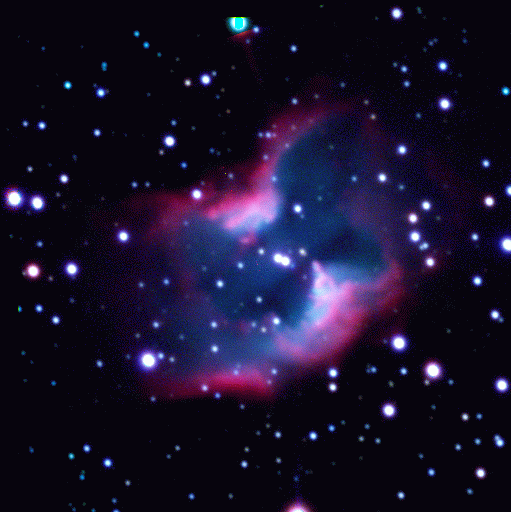
NGC 2899 is a planetary nebula in the southern constellation of Vela. It was discovered by English astronomer John Herschel on February 27, 1835. This nebula can be viewed with a moderate-sized amateur telescope, but requires a larger telescope to resolve details. NGC 2899 is located at a distance of 3,350±670 light-years (1,026±205pc) from the Sun and 25,894±3 light-years (7,939±1pc) from the Galactic Center.
This nebula has an overall kidney shape that is elongated along an axis from WNW to ESE. The overall topology is bipolar with a significant equatorial structure. This shape is believed to result from a binary star system. The mean expansion rate is 43 to 56km/s, with high velocity structures expanding at 110 to 130km/s. The core mass of the central star is estimated as ~1.2M☉.
The nebula lies within a large cavity in the surrounding medium. This opening has quadrupolar shape with a physical dimension of 14pc × 11pc. The elongation lies along a position angle of 37°±5°, which is aligned with the minor axis of the planetary nebula. This opening was most likely crafted by a fast stellar wind coming from the central star during its asymptotic giant branch stage, prior to the formation of a planetary nebula. The shape and filamentary structures suggest the interaction of a binary star system.