Primorial Product of the first "n" prime numbers
In mathematics , and more particularly in number theory , primorial , denoted by "
p
n
#
{\displaystyle p_{n}\#}
function from natural numbers to natural numbers similar to the factorial function, but rather than successively multiplying positive integers, the function only multiplies prime numbers .
The name "primorial", coined by Harvey Dubner , draws an analogy to primes similar to the way the name "factorial" relates to factors .
Definition for prime numbers
p n n The primorial
p
n
#
{\displaystyle p_{n}\#}
n
{\displaystyle n}
p
n
#
=
∏
k
=
1
n
p
k
,
{\displaystyle p_{n}\#=\prod _{k=1}^{n}p_{k},}
where
p
k
{\displaystyle p_{k}}
k
{\displaystyle k}
p
5
#
{\displaystyle p_{5}\#}
p
5
#
=
2
×
3
×
5
×
7
×
11
=
2310.
{\displaystyle p_{5}\#=2\times 3\times 5\times 7\times 11=2310.}
The first few primorials
p
n
#
{\displaystyle p_{n}\#}
1 , 2 , 6 , 30 , 210 , 2310 , 30030, 510510, 9699690... (sequence A002110 in the OEIS ) .Asymptotically, primorials grow according to
p
n
#
=
e
(
1
+
o
(
1
)
)
n
log
n
.
{\displaystyle p_{n}\#=e^{(1+o(1))n\log n}.}
Definition for natural numbers
n
!
{\displaystyle n!}
n
{\displaystyle n}
n
#
{\displaystyle n\#}
In general, for a positive integer
n
{\displaystyle n}
n
#
{\displaystyle n\#}
n
{\displaystyle n}
n
#
=
∏
p
≤
n
p
prime
p
=
∏
i
=
1
π
(
n
)
p
i
=
p
π
(
n
)
#
,
{\displaystyle n\#=\prod _{p\,\leq \,n \atop p\,{\text{prime}}}p=\prod _{i=1}^{\pi (n)}p_{i}=p_{\pi (n)}\#,}
where
π
(
n
)
{\displaystyle \pi (n)}
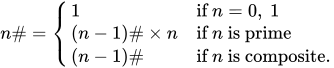
prime-counting function (sequence A000720 in the OEIS ) . This is equivalent to
n
#
=
{
1
if
n
=
0
,
1
(
n
−
1
)
#
×
n
if
n
is prime
(
n
−
1
)
#
if
n
is composite
.
{\displaystyle n\#={\begin{cases}1&{\text{if }}n=0,\ 1\\(n-1)\#\times n&{\text{if }}n{\text{ is prime}}\\(n-1)\#&{\text{if }}n{\text{ is composite}}.\end{cases}}}
For example,
12
#
{\displaystyle 12\#}
12
{\displaystyle 12}
12
#
=
2
×
3
×
5
×
7
×
11
=
2310.
{\displaystyle 12\#=2\times 3\times 5\times 7\times 11=2310.}
Since
π
(
12
)
=
5
{\displaystyle \pi (12)=5}
12
#
=
p
π
(
12
)
#
=
p
5
#
=
2310.
{\displaystyle 12\#=p_{\pi (12)}\#=p_{5}\#=2310.}
Consider the first 12 values of the sequence
n
#
{\displaystyle n\#}
1
,
2
,
6
,
6
,
30
,
30
,
210
,
210
,
210
,
210
,
2310
,
2310.
{\displaystyle 1,2,6,6,30,30,210,210,210,210,2310,2310.}
We see that for composite
n
{\displaystyle n}
n
#
{\displaystyle n\#}
(
n
−
1
)
#
{\displaystyle (n-1)\#}
12
#
=
p
5
#
=
11
#
{\displaystyle 12\#=p_{5}\#=11\#}
12
{\displaystyle 12}
Primorials are related to the first Chebyshev function
ϑ
(
n
)
{\displaystyle \vartheta (n)}
ln
(
n
#
)
=
ϑ
(
n
)
.
{\displaystyle \ln(n\#)=\vartheta (n).}
Since
ϑ
(
n
)
{\displaystyle \vartheta (n)}
n
{\displaystyle n}
n
{\displaystyle n}
n
#
=
e
(
1
+
o
(
1
)
)
n
.
{\displaystyle n\#=e^{(1+o(1))n}.}
Properties
For any
n
,
p
∈
N
{\displaystyle n,p\in \mathbb {N} }
n
#
=
p
#
{\displaystyle n\#=p\#}
iff
p
{\displaystyle p}
p
≤
n
{\displaystyle p\leq n}
Let
p
k
{\displaystyle p_{k}}
k
{\displaystyle k}
p
k
#
{\displaystyle p_{k}\#}
2
k
{\displaystyle 2^{k}}
The sum of the reciprocal values of the primorial converges towards a constant
∑
p
prime
1
p
#
=
1
2
+
1
6
+
1
30
+
…
=
0
.
7052301717918
…
{\displaystyle \sum _{p\,{\text{prime}}}{1 \over p\#}={1 \over 2}+{1 \over 6}+{1 \over 30}+\ldots =0{.}7052301717918\ldots }
(sequence A064648 in the OEIS ) The Engel expansion of this number results in the sequence of the prime numbers. Griffiths (2015) proved that it is irrational. Euclid's proof of his theorem on the infinitude of primes can be paraphrased by saying that, for any prime
p
{\displaystyle p}
p
#
+
1
{\displaystyle p\#+1}
p
{\displaystyle p}
lim
n
→
∞
n
#
n
=
e
{\displaystyle \lim _{n\to \infty }{\sqrt[{n}]{n\#}}=e}
n
<
10
11
{\displaystyle n<10^{11}}
e
{\displaystyle e}
n
{\displaystyle n}
e
{\displaystyle e}
e
{\displaystyle e}
Since the binomial coefficient
(
2
n
n
)
{\displaystyle {\tbinom {2n}{n}}}
n
+
1
{\displaystyle n+1}
2
n
{\displaystyle 2n}
(
2
n
n
)
≤
4
n
{\displaystyle {\tbinom {2n}{n}}\leq 4^{n}}
n
#
≤
4
n
{\displaystyle n\#\leq 4^{n}}
Using elementary methods, Denis Hanson showed that
n
#
≤
3
n
{\displaystyle n\#\leq 3^{n}}
Using more advanced methods, Rosser and Schoenfeld showed that
n
#
≤
(
2.763
)
n
{\displaystyle n\#\leq (2.763)^{n}}
n
≥
563
{\displaystyle n\geq 563}
n
#
≥
(
2.22
)
n
{\displaystyle n\#\geq (2.22)^{n}}
Applications
Primorials play a role in the search for prime numbers in additive arithmetic progressions . For instance,
2236133941
+
23
#
{\displaystyle 2236133941+23\#}
23
#
{\displaystyle 23\#}
5136341251
{\displaystyle 5136341251}
23
#
{\displaystyle 23\#}
Every highly composite number is a product of primorials.
Primorials are all square-free integers , and each one has more distinct prime factors than any number smaller than it. For each primorial
n
{\displaystyle n}
φ
(
n
)
/
n
{\displaystyle \varphi (n)/n}
n
{\displaystyle n}
φ
{\displaystyle \varphi }
Euler totient function .
Any completely multiplicative function is defined by its values at primorials, since it is defined by its values at primes, which can be recovered by division of adjacent values.
Base systems corresponding to primorials (such as base 30, not to be confused with the primorial number system ) have a lower proportion of repeating fractions than any smaller base.
Every primorial is a sparsely totient number .
Compositorial
The
n
{\displaystyle n}
composite number
n
{\displaystyle n}
n
{\displaystyle n}
n
{\displaystyle n}
n
{\displaystyle n}
factorial divided by the primorial
n
#
{\displaystyle n\#}
1 , 4 , 24 , 192 , 1728 , 280 360 903 040 545 600 729 600 Riemann zeta function
The Riemann zeta function at positive integers greater than one can be expressed by using the primorial function and Jordan's totient function
J
k
{\displaystyle J_{k}}
ζ
(
k
)
=
2
k
2
k
−
1
+
∑
r
=
2
∞
(
p
r
−
1
#
)
k
J
k
(
p
r
#
)
,
k
∈
Z
>
1
{\displaystyle \zeta (k)={\frac {2^{k}}{2^{k}-1}}+\sum _{r=2}^{\infty }{\frac {(p_{r-1}\#)^{k}}{J_{k}(p_{r}\#)}},\quad k\in \mathbb {Z} _{>1}}
Table of primorials
n n #p n p n Primorial prime ?
p n p n
0
1
— N/a 1 Yes
No
1
1
2
2
Yes
No
2
2
3
6
Yes
Yes
3
6
5
30
Yes
Yes
4
6
7
210
Yes
No
5
30
11
310 Yes
Yes
6
30
13
030 No
Yes
7
210
17
510 No
No
8
210
19
699 690 No
No
9
210
23
092 870 No
No
10
210
29
469 693 230 No
No
11
310 31
560 490 130 Yes
No
12
310 37
420 738 134 810 No
No
13
030 41
250 263 527 210 No
Yes
14
030 43
082 761 331 670 030 No
No
15
030 47
889 782 588 491 410 No
No
16
030 53
589 158 477 190 044 730 No
No
17
510 59
922 760 350 154 212 639 070 No
No
18
510 61
288 381 359 406 970 983 270 No
No
19
699 690 67
858 321 551 080 267 055 879 090 No
No
20
699 690 71
940 830 126 698 960 967 415 390 No
No
21
699 690 73
729 680 599 249 024 150 621 323 470 No
No
22
699 690 79
217 644 767 340 672 907 899 084 554 130 No
No
23
092 870 83
064 515 689 275 851 355 624 017 992 790 No
No
24
092 870 89
768 741 896 345 550 770 650 537 601 358 310 No
Yes
25
092 870 97
305 567 963 945 518 424 753 102 147 331 756 070 No
No
26
092 870 101
862 364 358 497 360 900 063 316 880 507 363 070 No
No
27
092 870 103
984 823 528 925 228 172 706 521 638 692 258 396 210 No
No
28
092 870 107
566 376 117 594 999 414 479 597 815 340 071 648 394 470 No
No
29
469 693 230 109
734 996 817 854 936 178 276 161 872 067 809 674 997 230 No
No
30
469 693 230 113
610 054 640 417 607 788 145 206 291 543 662 493 274 686 990 No
No
31
560 490 130 127
014 476 939 333 036 189 094 441 199 026 045 136 645 885 247 730 No
No
32
560 490 130 131
896 479 052 627 740 771 371 797 072 411 912 900 610 967 452 630 No
No
33
560 490 130 137
047 817 630 210 000 485 677 936 198 920 432 067 383 702 541 010 310 No
No
34
560 490 130 139
014 646 650 599 190 067 509 233 131 649 940 057 366 334 653 200 433 090 No
No
35
560 490 130 149
492 182 350 939 279 320 058 875 736 615 841 068 547 583 863 326 864 530 410 No
No
36
560 490 130 151
319 534 991 831 177 328 890 236 228 992 001 350 685 163 362 356 544 091 910 No
No
37
420 738 134 810 157
375 166 993 717 494 840 635 767 087 951 744 212 057 570 647 889 977 422 429 870 No
No
38
420 738 134 810 163
766 152 219 975 951 659 023 630 035 336 134 306 565 384 015 606 066 319 856 068 810 No
No
39
420 738 134 810 167
947 420 735 983 927 056 946 215 901 134 429 196 419 130 606 213 075 415 963 491 270 No
No
40
420 738 134 810 173
589 903 787 325 219 380 851 695 350 896 256 250 980 509 594 874 862 046 961 683 989 710 No
No
Notes
1 2 Weisstein, Eric W. "Primorial" . MathWorld 1 2 (sequence A002110 in the OEIS ) ↑ (sequence A034386 in the OEIS ) ↑ Weisstein, Eric W. "Chebyshev Functions" . MathWorld ↑ Griffiths, Martin (November 2015). "99.29 On the sum of the reciprocals of the primorials". The Mathematical Gazette . 99 (546): 522– 523. doi :10.1017/mag.2015.91 . ↑ L. Schoenfeld: Sharper bounds for the Chebyshev functions
θ
(
x
)
{\displaystyle \theta (x)}
ψ
(
x
)
{\displaystyle \psi (x)}
. II. Math. Comp. Vol. 34, No. 134 (1976) 337–360; p. 359.Estimation de la fonction de Tchebychef
θ
{\displaystyle \theta }
k -ieme nombre premier et grandes valeurs de la fonction
ω
(
n
)
{\displaystyle \omega (n)}
n . Acta Arithm. XLII (1983) 367–389 (PDF 731KB ); p. 371 ↑ G. H. Hardy , E. M. Wright : An Introduction to the Theory of Numbers ISBN 0-19-853310-1 341↑ Hanson, Denis (March 1972). "On the Product of the Primes" . Canadian Mathematical Bulletin 15 (1): 33– 37. doi :10.4153/cmb-1972-007-7 ISSN 0008-4395 . 1 2 Rosser, J. Barkley; Schoenfeld, Lowell (1962-03-01). "Approximate formulas for some functions of prime numbers" . Illinois Journal of Mathematics . 6 (1). doi :10.1215/ijm/1255631807 ISSN 0019-2082 . ↑ Sloane, N. J. A. (ed.). "Sequence A002182 (Highly composite numbers)" . The On-Line Encyclopedia of Integer Sequences . OEIS Foundation.↑ Masser, D.W. ; Shiu, P. (1986). "On sparsely totient numbers" . Pacific Journal of Mathematics . 121 (2): 407– 426. doi :10.2140/pjm.1986.121.407 ISSN 0030-8730 . MR 0819198 . Zbl 0538.10006 .↑ Wells, David (2011). Prime Numbers: The Most Mysterious Figures in Math 29. ISBN 9781118045718 . Retrieved 16 March 2016 .↑ Sloane, N. J. A. (ed.). "Sequence A036691 (Compositorial numbers: product of first n composite numbers.)" . The On-Line Encyclopedia of Integer Sequences . OEIS Foundation.↑
Mező, István (2013). "The Primorial and the Riemann zeta function". The American Mathematical Monthly . 120 (4): 321. ↑ Sloane, N. J. A. (ed.). "Sequence A014545 (Primorial plus 1 prime indices)" . The On-Line Encyclopedia of Integer Sequences . OEIS Foundation.↑ Sloane, N. J. A. (ed.). "Sequence A057704 (Primorial - 1 prime indices)" . The On-Line Encyclopedia of Integer Sequences . OEIS Foundation.References
Dubner, Harvey (1987). "Factorial and primorial primes". J. Recr. Math. 19 : 197– 203. Spencer, Adam "Top 100" Number 59 part 4.
Possessing a specific set of other numbers
Expressible via specific sums
Core Combinatorics basics Identities, numbers, sequences Multinomial generalizations Distributions Special functions (connections) Factorials & approximations Structures & arrays Operators & calculus links Theorems & results Methods & integrals